Next: Test Review Sheets
Up: COURSE SYLLABUS Philosophy 302:
Previous: Course Description
Contents
Index
Subsections
Course Requirements
Evaluation
Judgment about the progress of your work is based on the quality and depth of critical and constructive thinking exhibited on three take-home tests. Your course grade is determined by averaging the points you achieve from the following scores:
- Test 1
- The Problems of Ethics (33%)
- Test 2
- Varieties of Determinism; Religious and Duty Ethics 335%)
- Test 3
- The Ethics of Self Interest and Societal Ethics (33%)
Your final course grade is assigned according to your final average.
Tests
Tests are usually a combination of objective, short answer and essay-problems. The subject-matter is primarily based on the reading, lecture notes, and homework assignments. In general, if you understand how to do the homework problems, you will do well on tests.
Even though tests are based on questions from the homework and reading assignments, the tests are neither based exclusively on memorized facts nor based exclusively on objective information derived from memorized arguments. Instead, the emphasis given in tests is on the operation and active transformation or manipulation of the concepts learned. Occasionally, some particularly difficult optional questions are included for extra credit.
On essay-type questions, be sure to answer with complete sentences; answers provided as lists of phrases or the names of concepts, alone, do not reflect an understanding of the subject and usually will be given little, if any, credit. Example tests, quizzes, and lecture notes, are online at
http://philosophy.lander.edu/ethics/
Your final course grade is assigned according to your final average as described above in the subsection ``Evaluation.'' If you study only for tests, your doing well in the course is doubtful.
- A
- (90 points or above) reflects a great deal of time, thought, and effort; and mastery of the subject.
- B
- (80 or above but below 90 points) reflects approximately above average time, thought and effort; and superior achievement.
- C
- (70 or above but below 80 points) reflects average time, thought, and effort; and average achievement.
- D
- (60 or above but below 70 points) reflects cramming for examinations; minimum time, thought, and effort; below college level work; a less than adequate grasp of the course content; and less than satisfactory achievement.
- F
- (below 60 points) reflects little or no understanding of course content and unsatisfactory achievement.
- INC
- can only be given in cases of sudden illness or emergency beyond the student's control.
You may access your grades online at any time on the philosophy server (not Lander WebCT or Bearcat) with a username and password from this course (not your WebCT username and password).
Username: Your username for the course on the philosophy server is the first letter of your first name followed by your complete last name in lowercase letters without spaces. For example ``Lauren Bouchett Satterfield'' would have the login username of ``lsatterfield'' with no limitation of number of letters (as with some email programs or your WebCT username).
Password: Your password is your Lander L-number (without hypen). Type a capital L followed by your eight digits.
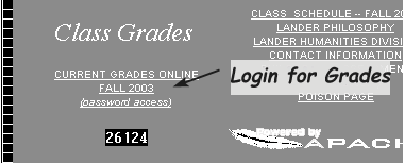
Where to Log In: From the Philosophy Homepage, under the gray heading entitled ``Class Grades,'' click on the link ``Current Grades Online'' as shown in Figure 9. When the Grades Login page loads do the following:
Figure 1:
Where to Find Grades Online
|
|
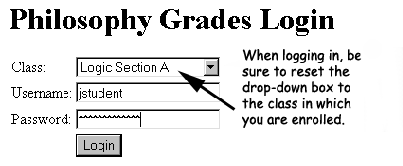
- Choose the class ``Ethics'' from the drop-down box. Note: If you log in incorrectly, be sure to re-select your class from the drop-down box because an incorrect login will re-set the class to a default philosophy course. See Figure 10.
Figure 2:
How to Log in for Grades
|
|
- Enter your username for grades exactly as described above..
- The login process is case-sensitive--be sure to match the case of the letters--capital or lower case. If you obtain the result of ``bad login,'' check to see if the Caps Lock key is on, or you have confused the letter ``l'' with the number ``1'' or with the capital letter ``I.'' Occasionally, the number ``0'' can be confused with the capital letter ``O.''
Your Job
Our course is not difficult if you keep up with the assigned work. At the very beginning of the course, you need to ask yourself if you can spend a minimum of three hours a week studying just for Ethics. If work or family responsibilities interfer with this minimum number of study hours, you should not attempt this course.
In this regard, a good place to see how to study in our course is the ``Notes on How to Study'' on the Web at http://philosophy.lander.edu/study.html. In past semesters, many students have found these study tips helpful.
- Take notes on the important points of the assigned reading.
- Do all homework problems. If you cannot find time for doing homework, you cannot benefit from this course of study.
- Make extensive use of the available online lectures, sample problems, quizzes, and tests.
We will find that ethics is quite essential in most fields of endeavor.
- I will attempt to create the conditions under which you can exercise your native curiosity.
- I will show practical applications for all the methods employed.
- I will provide handouts and Web-based instructions for additional problem-solving support.
If I do my job correctly, our ethics course will be one of the most valuable in your university career.
The following policies are explicitly stated here because these policies help protect fairness for the administration of the course for the class as a whole. Some of these policies are generally assumed in most classes at Lander University.
- Plagiarism:
- Students are expected to do their own work in this course. To use another writer's or speaker's ideas without giving credit by means of standard documentation is plagiarism. All cases of academic dishonesty on tests or written work are handled in accordance with the Academic Honor Code as presented in the Lander University Student Handbook. Normally the grade of ``0'' is assigned for academically dishonest papers. If you plagiarize from any work, your will recieve a ``0' on the test. Almost every semester since this course has been taught, some students do not pass because they copy work from the Web without proper citation. Computer logs clealy show dates documents are processed, saved, and emailed. Any such academic dishonest results in a ``0'' assigned to the work.
- Learning Disabilities:
- If you have a physical or learning disability and you require special accommodations, be sure to contact Mr. Lafayette Harrison (Learning Center 345, telephone (864) 388-8814) and provide him with appropriate documentation. When Mr. Harrison is made aware of your disability, he will inform your instructors every semester unless you ask him in writing not to do so. For additional information, see the ``Disabled Student Information'' on the Lander University Website at
http://www.lander.edu/instructional_services/disabled.htm.
- Closing of the University:
- If hazardous weather conditions or any other state of emergency necessitate University closing, the information will be available from the Lander automated information system (telephone (864) 388 8400) or most major radio and television stations in this area. Usually, however, the Internet and Lander's Web Server are available during inclement weather or other emergency. If Lander's Web service is down, the philosophy server will probably also be down. If access to the Lander domain is not possible immediately proior to a due date for a test or a post, additional time will be allowed for the completion of the assignment.
Next: Test Review Sheets
Up: COURSE SYLLABUS Philosophy 302:
Previous: Course Description
Contents
Index
Lee Archie
2006-08-18