
Introduction to Philosophy
Philosophy of Religion
April 18 2024 22:09 EDT
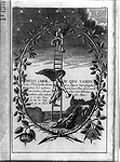
Jacob's Ladder, Biblioteca Chemica Curiosa, 1702, Library of Congress
SITE SEARCH ENGINE
since 01.01.06
Thomas Aquinas, "The Argument from Gradation"
Abstract: Thomas' Argument from Gradation for the existence of God is outlined and briefly clarified. Some standard objections to that argument are listed.
- Thomas' Argument from Gradation begins with the empirical observation of
different degrees of goodness in different kinds of things in the world.
Hence, this argument is actually an à posteriori argument, and
the conclusion is not claimed to follow with absolute certainty.
- Summary of the Argument from Gradation:
- There are different degrees of goodness in different things.
- There are different degrees of being in different things—the more being, the more goodness. (The notion of the Great Chain of Being is being presupposed.)
- For there to be degrees of being at all, there must be something which has being in the highest degree.
- Therefore, a Being in the Highest Degree or Perfect Being exists.
- Some of the difficulties in understanding the Argument from Gradation
are based on the following suppositions briefly described here with
examples.
- Degrees of Being. In Plato's and Plotinus' philosophy, the universe is conceived as an ascent from less real to more real. The highest Form is the Form of the Good, the ens perfectissimum. In the Republic, Plato explains four levels of existence: (1) shadows, reflections, dreams, (2) perceptions, sensations, images, (3) lower forms of science, and (4) higher forms of mathematics and the intelligible form of the good. Levels (1) and (2) are the changing, impermanent, visible realm, and Levels (3) and (4) are the real, permanent, intelligible realm. Similarly, Plato's metaphor of the sun explains the Form of the Good (representing God or ultimate reality) as illuminating the perceptual world of becoming and passing away. In Aristotle's scala naturae or ladder of nature, objects in the world range from inanimate matter to plants, invertebrates, and finally human beings according to their formal factor.
- Goodness is a quality of objects. Thomas' presupposition makes goodness a natural property like pleasure or evolutionary fitness. Instead, good seems to be an intentional or purposive property of human beings. On a planet, without human habitation, the values "good" and "bad" would have no meaning.
- The Great Chain of Being. From the notion of
Jacob's Ladder,
where the rungs go from the materialistic world (rung by rung, through
prayer) to union with God as well as the notion of Homer's
"golden chain"
linking the earth and the heavens, The Great Chain of Being is a
common theme in Western Philosophy. Even John Locke, for example, in his
Essay
speaks of the links in nature which "ascend upward from us toward infinite
perfection,as we see they gradually descend from us downwards." As
Pope
writes …
“Vast chain of being, which from God began,
Natures æthereal, human angel, man,
Beast, bird, fish, insect! what no eye can see,
No glass can reach! from Infinite to thee,
From thee to Nothing!…”
The Great Chain of Being extends from unformed inorganic matter to man to God. For example, a rabbit is higher than a snake and an angel is higher than a person—there is a movement to more form and complexity as one ascends up the chain. A natural rand of graduated essences and purposes result in a unified moral continuum[1].
- Summary of the Argument from Gradation:
- Summary list of common objections to Thomas' Argument from Gradation:
- Goodness is a moral quality—it's a function of human purpose and
intention, not a "kind" of being. As
Spinoza argues in his Ethics…
As for the terms good and bad, they indicate no positive quality in things regarded in themselves, but are merely modes of thinking, or notions which we form from the comparison of thing one with another. Thus one and the same thing can be at the same time good, bad, and indifferent. For instance, music is good for him that is melancholy, bad for him that mourns; for him this is deaf, it is neither good nor bad.For example, in biological taxonomy the hierarchial system of classification does not represent a "chain of goodness," but a kind of niche based success or fitness.
- Difficulties in measuring goodness. How do we measure the goodness
of different things? What could be the standard of comparison of two different
kinds of things? Aren't some things better and are less complex that other
things? Which is better a rose or a crocus? Are the levels of being
and goodness a difference of degree or a difference of kind?
- Voltaire notes that the distance between God and the next good being would be an infinite distance.
- Similarly, Samuel Johnson points out the incommunensurability between the infinite and the highest finite begin. He points as well to the paradox resulting from the apparent infinite divisibility between two order of existence giving rise to other orders of existence.
- Finally, comparisons can be made among things without presupposing maximum values to those things. There seems to be no good reason to assume with Thomas that "…the maximum in any genus is the cause of all in that genus,…" Simply because things exist in degrees, it does not follow that something exists in the maximum or minimum of degree. (For example, there is no greatest integer.) Being is not a genus; consequently, to say that being in the highest degree must follow is to be subject to Russell's Paradox: the problem of the set of sets which are not members of themselves.
- There would be many different things (gods) who are the maximum of the various genera. As Thomas writes, "… there is something which is truest, something best, something noblest…" The various genera would have to be somehow combined rather than have the maximum of the true, the maximum of the best, and the maximum of the noblest—three different maximums or perfections.
- The Problem of Evil How can we account for a Perfect God creating a world in which innocent children suffer? How do we account for the non-moral evil in the world such as flood, hurricane, and earthquake? (Aquinas replies, "This is part of the infinite goodness of God, that He should allow evil to exist, and out of it produce good.")
- Even if Thomas' concepts of being and goodness were intelligible, there could be equally plausible candidates for being in the highest degree: nature, matter, existence, or even limited deities.
- Argument from Polar Concepts. If Thomas can argue that "for there
to be degrees of goodness at all, there must be something which has goodness in
the highest degree," it would also seem to follow that analogously there
would be degrees of badness or evil. For there to be degrees of evil at all,
it would seem to follow that there must be something which has evil to the highest
degree. Can we know what absolute good is without supposing that there is an absolute
bad? Can we conceive of one without the other?
- Couldn't the same argument be used to conclude that an all-powerful evil being exists?
- Augustine would conclude by analogy that God illumes existence. Just as shadow is the absence of sunlight, evil is the absence of goodness. Hence, evil is nothing positive in itself, it is merely the absence of goodness. Thus, absolute evil is nonexistence.
- Even if the Argument from Gradation were correct, Thomas would have to solve the problem that with these five ways he is proving five gods with five different properties. At a minimum, it would be necessary to prove that all five beings are actually the same being.
- Goodness is a moral quality—it's a function of human purpose and
intention, not a "kind" of being. As
Spinoza argues in his Ethics…
- “Chain
of Being” The idea of the Chain of Being or scala
naturae and objections are traced in some detail through the
history of philosophy from Plato's use of Forms, Christian theology,
and the natural sciences by Lia Formigari in the Dictionary
of the History of Ideas maintained by the Electronic Text
Center at the University of Virginia Library.
- “Hierarchy and Order” The notion levels or degrees of existence as an ubiquitous idea in the history of Western philosophy, religion, literature, and science is examined by C. A. Patrides in this article from the Dictionary of the History of Ideas maintained by the Electronic Text Center at the University of Virginia Library.
- 1. From antiquity to the late Middle Ages, Christianity based on the Gospels and Paul increasingly urged equality of all individuals, their souls having the same moral status. And so the graduated continuum of the Great Chain of Being began to lose its sway. See Larry Sideentop, Inventing the Individual (London: Allen Lane, 2014). ↩


“The chain of being assembles all beings in a comprehensive association which specifies every particular being with the attribution of a relative, at once and indifferently ethical and ontological, position with respect to other beings. This assembly is a scale bounded by its extremities, the topmost of which is endowed with absolute value and the lowest of which is somewhat like the obverse the first and its mirror image. The topmost point of the scale, which is occupied by God, is the one in possession of normative positivity in its absolute fullness, positively as ethical norm and as ontological value. All that is not God is regarded according to the neo-Platonic scheme of things: as degrees of privation. Full existence, absolute goodness and eternity (as distinct from sempiternity), are attributable solely to God; apart from Him, existence and value are relative matters. This is the meaning of the saying which Abū Hayyān al-Tawḥīdī (d. after 400/1009) attributes to Abū Sulaimām al-Sijistānī (d. after 391/1001), that ‘evil is nothingness … while good is being,’ a saying that seems to duplicate many others of the same import.” Aziz Al-Azmeth et al. Arabic Thought and Islamic Societies (London: Routledge, 1986), 2.
Relay corrections, suggestions or questions to
larchie at lander.edu
Please see the
disclaimer
concerning this page.
This page last updated 01/27/24
© 2006 Licensed under the GFDL
