Philosophy
103: Introduction to Logic
Syllogistic Fallacies: Exclusive Premisses
Abstract: The Fallacy of Two
Negative Premisses or Exclusive Premisses is illustrated and explained
with examples.
I. We continue our study of fallacies with a fifth fallacy. Consider the following argument.
"No
internal combustion engines are nonpolluting power plants, and no nonpolluting power
plants are safe devices. Therefore, no internal combustion engines are safe devices."
A. First, let's
put the argument in standard form:
M
P
No
[nonpolluting power plants] are [safe devices].
S
M
No [internal
combustion engines] are [nonpolluting power plants].
S
P
No [internal
combustion engines] are [safe devices].
1. The Venn diagram
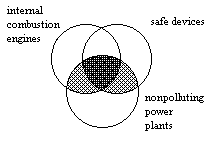
shows this argument to be invalid because the top part of the area
of the diagram where “internal combustion engines” and
“safe devices” overlap is empty of markings. This indicates
no information is available about the relation of those two classes.
2. Note also that both
premisses are negative. As most people are intuitively aware, knowledge
about what a thing is not, does not carry much information
about what that thing is. For example, if I say I am thinking
of something that is not a tree, you would not know very much about what
I am thinking.[1]
3. By referring to the
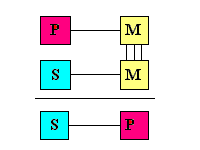
mnemonic of the mechanism of the syllogism sketched here, we can surmise that
the basis of the syllogism is captured by noting that two things relatable to
the same thing should be somehow relatable (positively or negatively) to each
other, if at least one of them is.
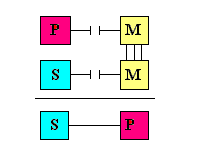
4. However, when both
premisses are negative, our mnemonic shows the classes are not related
in some way to each other, and this information is of no use to see how
the terms in the conclusion are related. This state of affairs can be
illustrated in the diagram on the right.
B. Our Rule of Quality states
that no standard form syllogism with two negative premisses is valid.
1. The fallacy
is called either the Fallacy of Exclusive Premisses or the Fallacy of Two
Negative Premisses.
2. Reason: When a
syllogism has exclusive premisses, all that is being asserted is that S
is wholly or partially excluded from part or all of the M class, likewise
for the P class; the premisses entail no specific relationship
exists between the S and the P class.
3. Note that you can
detect the fallacy of Exclusive Premisses merely by inspecting the first
two statement-names of the mood of the syllogism.
Test yourself
on the following examples by noticing E or I premises in the
initial two letters of the following mood and figure syllogisms:
EOI-2
AAA-2
OOI-3
OEO-1
IEO2
EEE-2
Notes
1. Each premiss gives negative information
about the relation between the middle term and the major and minor
terms.↩
The “Copyleft” copyright assures the user the freedom
to use, copy, redistribute, make modifications with the same terms.
Works for sale must link to a free copy.
The “Creative Commons” copyright assures the user the freedom
to copy, distribute, display, and modify on the same terms. Works for sale
must link to a free copy.