

 |

Philosophy Homepage » Logic Homepage » Informal Fallacies » Ignoratio Elenchi


| Quizzes |
| Tests |
| FAQ |
| Links |
| Search |
| Readings |
| Syllabus |

Ignoratio Elenchi (Irrelevant Conclusion);
Straw Man; Red Herring; Non Sequitur
Abstract: Ignoratio elenchi, or
“ignorance of the refutation,” is broadly defined as any incorrect
argument which reaches an evidentially irrelevant conclusion. Historically,
the fallacy is also more narrowly defined as a counterargument to an argument
or thesis which does not attempt to prove the contradictory of what was intended
to be proved.
In practice today, ignoratio elenchi often functions as a
“catch-all” category of any fallacy of relevance not
specified as one of the specific traditional fallacies of relevance. These
interpretations are discussed here with a variety of specific examples and
are compared to several similar overlapping fallacies, including the fallacies
of non sequitur, red herring, and straw man.
- The Aristotelian Dialogical and the General Traditional Ignoratio Elenchi Fallacies Explained
- Ignoratio Elenchi: Outline of Main Historical Phases
- Criterion of Relevance
- Non Sequitur
- Red Herring
- Straw Man
- Ignoratio Elenchi as a “Catch-All” Fallacy and Some Common Types
- How to Identify and Analyze Ignoratio Elenchi
- Effectiveness of, and How to Respond to, an Ignoratio Elenchi
- Link to Ignoratio Elenchi and Related Fallacies Quiz with Answers
- Notes
- Readings
- The fallacy of ignoratio elenchi
is defined in three principal ways:
The Traditional Form of Ignoratio Elenchi (fallacy of irrelevancy): the fallacy which occurs whenever the conclusion of an argument is irrelevant to its premises. (The fallacy of non sequitur is often identified with this version.)
The Aristotelian Dialogical Form of Ignoratio Elenchi (mistaking the issue): a fallacy usually occurring in a dialogue or a disagreement when arguing to a conclusion not evidentially pertinent and quite different from that which was intended or required and thus misses the point at issue. (The straw man fallacy is one type of this version, and the red herring fallacy is a limiting type of this version.)
The Practical Application of Ignoratio Elenchi (“limited fallacy” of irrelevancy): any fallacy of relevance which cannot be named as one of the traditional “ad …” fallacies. Ignoratio elenchi is of use as a “catch-all” category of unspecified fallacies of relevance.
- The Traditional Form of Ignoratio Elenchi as
irrelevant conclusion is, in effect, any argument whose premises are
irrelevant to its conclusion. This argument is described in detail below
with examples in VIII. Ignoratio
Elenchi as a “Catch-All” Fallacy and Some Common Types.
A typical example of this fallacy form is:
People unacquainted with logic often reason well.
This form of the fallacy is coextensive with that of non sequitur. The connotation of Ignoratio elenchi is that the premises are irrelevant to the conclusion which is claimed to follow, and the connotation of non sequitur is that the conclusion is irrelevant to the premises.
∴ The study of logic is not of much use.
-
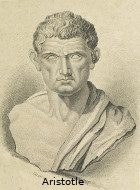 The (Aristotelian) narrow form of Ignoratio Elenchi
is the fallacy committed when an argument proves or attempts to prove a
different conclusion from what was supposed to be the point of the proof either
through intentional or inadvertent irrelevancy. Specifically, it is proving a
statement which is not the contradictory of the conclusion of the argument one
is attempting to refute.[1]
The (Aristotelian) narrow form of Ignoratio Elenchi
is the fallacy committed when an argument proves or attempts to prove a
different conclusion from what was supposed to be the point of the proof either
through intentional or inadvertent irrelevancy. Specifically, it is proving a
statement which is not the contradictory of the conclusion of the argument one
is attempting to refute.[1]
- It's important to realize that the argument proving a different
conclusion may well be formally valid and consequently would not commit a
formal fallacy.[2] Instead,
the argument is said to be materially fallacious since it only, at best,
proves the wrong conclusion.
Alfred Milnes characterizes this aspect of the validity of some ignoratio elenchi arguments as follows:“We must, therefore, be careful not to say that the reasoning is bad because it ends in what is false; for the reasoning may be quite good, and the mistake may be that we started wrongly. The journey has been safely performed, only we have got into the wrong train.”[3]
In the Aristotelian dialectical sense of the term, the fallacy occurs when what is intended to be proved is not the contradictory of an opponent's assertion; instead, a conclusion other than the contradictory is reached. The fallacy occurs when, e.g., your argument “answers” the wrong point, so the error in reasoning is “ignorance of the fact that your conclusion, even if established, would not contradict his conclusion.”[4]
- In the traditional monotonic
sense of the term, the fallacy occurs whenever a conclusion which is not the point at issue is proved, but which sufficiently resembles the point at issue as to be mistaken for it. The fallacy is due to the difference between the conclusion proved and the conclusion which ought to have been proved.close ×
Monotonic Logic
Monotonic logic is composed of arguments whose conclusions are self-standing: the truth of their conclusions is not affected by additional statements.
- The employment of ignoratio elenchi is most
persuasive in extended argumentation when the train of reasoning used
in evading the question makes it difficult to follow and maintain
attention. Richard Whately pointed out two centuries ago, “[A]
Fallacy which when stated barely, in a few sentences, would not deceive
a child, may deceive half the world if diluted in a quarto
volume.”[5]
- So, there are two related contexts of the narrow Aristotelian version of
this fallacy in logic and argumentation:
(Dialectical arguments are critical discussions between two or more persons whereas monotonic arguments are self-standing arguments in that, once stated, if valid, cannot be proved invalid.)(1) The traditional (dialectical argument) view: A disputant in a disagreement neglects a proper refutation which should have proved the contradictory of an opponent's thesis and instead endeavors to establish a different and unrelated point.[6]
(2) The monotonic (an individual argument) view: A self-standing argument concluding something different from what was claimed to be demonstrated in an argument being under examination.[7]
- For example, consider how the following general objective is
sidetracked by ignoratio elenchi arguments in a
dialectical disagreement and in an individual persuasive presentation:
“[I]f I am endeavouring to convince a person that some particular measure is for his personal interest, and I adduce arguments to prove that it contributes to the general utility … I am guilty of an ignoratio elenchi.[8]
(a) Debate or dialectical exchange:During the covid-19 epidemic, a Proponent states it is not in his personal interest to wear a mask because it's difficult to breathe through a mask, and besides masks don't protect that well since it's been shown that virons are so small much of any viral load is inhaled through masks anyway.
The Opponent responds that wearing a mask is in the Proponent's personal interest because when exhaling much of the viral load is filtered which reduces the chances of spreading infection to others.
(b) Monotonic argument or individual presentation:A Proponent argues that the wearing of a mask in a covid-19 epidemic is not in one's self-interest because all that a mask does to filter out some virons if one already has the virus. Reducing the transmission doesn't, the Proponent argues, help himself at all.
Many current logic textbooks which do not cover the ignoratio elenchi fallacy, offer examples similar to this 5(b) monotonic argument as straw man arguments.
- It's important to realize that the argument proving a different
conclusion may well be formally valid and consequently would not commit a
formal fallacy.[2] Instead,
the argument is said to be materially fallacious since it only, at best,
proves the wrong conclusion.
- It's important to emphasize that in dialogical argumentation an
ignoratio elenchi fallacy can occur even if the
counter-argument is sound. In such a case, the counter-argument is
termed “fallacious” not because it is formally
monotonically fallacious (because it might not be), but because the
argument is evidentially irrelevant to the refutation of the initial
thesis of the dispute.[9]
F.C.S. Schiller notes with respect to dialogical ignoratio elenchi;“To detect it, therefore, demands knowledge of the actual context and use, and psychological knowledge, to boot, of the point aimed at in the actual discussion. … For the difference between what are relevant and irrelevant considerations under any circumstances is never formally obvious. [emphasis original]”[10]
Relevance in ignoratio elenchi is shown by intent, interest, and purpose, and is discussed below.
- Many logicians consider ignoratio elenchi
fallacious on the basis of a historically standard view of
fallacy; viz., such arguments involve deceptive language.[11] However, since
many fallacies are not at all deceptive, this a definition
is too narrow.
- Richard Whately describes an example of dialogical
ignoratio elenchi in the story of two coats which
occurred when King Cyrus was a child. Again, note how the fallacy
in reasoning results from mistaking the question at issue:
“One of his schoolfellows, who was tall and stout, had a coat that was too small for him; and proposed to a smaller boy, whose coat was much too big for him, to make an exchange. But the other refused; whereupon the bigger boy took away the coat by force, and left his own in exchange; and Cyrus, on being appealed to, decided in favor of the exchange. He had judged rightly which coat best fitted each boy; but this was not the real question; which was, whether it was right to take away another's property without his consent.”[12]
A sound argument can be set up to demonstrate that the exchange of coats was proper because each boy maximizes utility by owning a fitting coat. However, this outcome is beside the essential point at issue: viz., whether it's just to take another person's property without consent.
- Many logicians consider ignoratio elenchi
fallacious on the basis of a historically standard view of
fallacy; viz., such arguments involve deceptive language.[11] However, since
many fallacies are not at all deceptive, this a definition
is too narrow.
- In general, then, an ignoratio elenchi occurs
when an argument purporting to establish a specific conclusion is
directed, instead, to proving a different conclusion. The responding
argument is considered fallacious because it missed, i.e. did
not prove, the point at issue. For example a typical derailment of a
dialogical argument can be described as follows:
“To argue that a particular branch of study — [the study of mathematics] — should not be included in the curriculum of our schools, on the plea that it will never earn ‘bread and butter’ for nine-tenths of those who study it, would be a typical instance of the fallacy.”[13]
Even when mathematics is not used in future employment, the study not only develops analytical skills but also probably helps improve mental focus required for other aspects of everyday life.
- The Traditional Form of Ignoratio Elenchi as
irrelevant conclusion is, in effect, any argument whose premises are
irrelevant to its conclusion. This argument is described in detail below
with examples in VIII. Ignoratio
Elenchi as a “Catch-All” Fallacy and Some Common Types.
A typical example of this fallacy form is:
- Ignoratio Elenchi: Outline of
Main Historical Phases:
- The first of Aristotle's two characterizations of the ignoratio
elenchi fallacy in the Sophistical Refutations (Soph.
El.) is narrower than the usual contemporary usage of the term.
- For Aristotle, an elenchus is a syllogistic
refutation of an adversary's position which establishes the contradictory of a thesis (hence, this kind of argumentation is termed a “negative dialectic”). So, literally, an ignoratio elenchi is an argument exhibiting an “ignorance of the proof of the contradictory or ignorance of the contradictory conclusion, itself. [Arist. Soph. El. v.167a22-37].close ×
Syllogism
A two premise argument having three terms, each of which is used twice in the argument. The classic example: “ All men are mortal, Socrates is a man; therefore, Socrates is mortal.”
- Ignoratio elenchi not only is one of Aristotle's
thirteen sources of erroneous reasoning [Soph.
El. v.167a22-28] but also is a name for all of
the types of fallacies of relevance [Soph.
El. vi.169a18-21].
This use of Aristotle's second characterization is modified by some contemporary
logic textbooks which call for ignoratio elenchi to denote any
fallacy of relevance not classifiable as one of the classical fallacies
of relevance[14] and by most
textbooks which discuss the term as any fallacy where the conclusion is irrelevant
to the premises.
(Logic textbooks which do not cover the fallacy of ignoratio elenchi, as noted above, often discuss the fallacy of non sequitur as any fallacy whose conclusion is irrelevant to its premises.)
- For Aristotle, an elenchus is a syllogistic
- The dual-view of ignoratio elenchi continued with the medieval
author Peter of Spain, who first named the fallacy in Summae Logicales
as ignoratio elenchi, and defined it as follows:
”‘[I]gnorance of the refutation’[:] a two part distinction is usually made about ignorance of elenchus — regarding its being one specific fallacy from among thirteen, and regarding its being the generic fallacy to which all thirteen are reduced.’” [Peter of Spain, LS 7][15]
— the thirteen being the fallacies Aristotle enumerated in Sophistical Refutations.
- Thomas Wilson, the author of the first English logic textbook (1551), and the
English theologian Henry Aldrich, author of the influential logic text Artis
Logicæ Compendium[16]
(1691) largely based their opaque description of the fallacy on Peter of Spain's
medieval logic text “Quomondo Omnes Fallaciæ Ad Ignorantia
Elenchi Reducuntur,” in Summulæ
Logicales, and their summary definitions are largely consistent with
Aristotle's definition.[17]
- Antoine Arnauld and Pierre Nicole in their Port-Royal
Logic (1662) extended Aristotle's and Peter of Spain's view of
this fallacy with this definition:
The Port-Royal Logic, one of the two most influential classical logic books since Aristotle, was written in support of Rene Descartes' philosophy.(1) “proving something other than than which is in dispute,”
(2) having “ignorance of that which ought to be proved,“ and
(3) attributing “to our adversary that which is vary far from his meaning, in order to carry on the contest with greater advantage;
(4) ”or to impute to him consequences which we imagine may be derived from his doctrine, although he disavows and denies them.”[18]
- Isaac Watts' Logic (1724), used in major universities for almost
two centuries, describes ignoratio elenchi as follows:
Note that Watts describes the fallacy with the phrase “Images of Straw” forecasting what will in the next century be labeled as setting up a “straw man.”“Ignoratio Elenchi, or a Mistake of the Question, that is, when something else is prov’d which has neither any necessary Connection or Inconsistency with the Thing enquired, and consequently gives no determination to the Enquiry, tho’ it may seem at first Sight to determine the Question …
Disputers when they grow warm are ready to run into this Fallacy: They dress up the Opinion of their Adversary as they please, and ascribe Sentiments to him which he doth not acknowledge; and when they have with a great deal of Pomp attack’d and confounded these Images of Straw of their own making, they triumph over their Adversary as tho’ they had utterly confuted his Opinion.”[19]
In his adjunctive The Improvement of the Mind (1741), Watts also relates “laws” of scholastic disputation, one of which prohibits ignoratio elenchi with this obligation:“That he must directly contradict the proposition of the respondent, and not merely attack any of the arguments whereby the respondent has supported that proposition … he must contradict or oppose the very sense and attention of the proposition as the respondent has stated to, and not merely oppose the words of the thesis in any other sense; for this would … attack a proposition different from what the respondent has espoused, which is called ignoratio elenchi.”[20]
Watt's disputation rule predates one of George Smith's “Rules of Judgment” in his 1902 textbook Logic and also anticipates the more generally expressed Rule 3: of “Rules for Critical Discussion” from the contemporary pragma-dialectical theory of the Dutch School:“A party's attack on a standpoint must relate to the standpoint that has indeed been advanced by the other party.”[21]
George Smith argued that ignoratio elenchi results from a violation of his rule of judgment that premises must correspond with the thesis or issue in critical discussions, and this rule is deducible from the law of contradiction and the law of the excluded middle.
- Richard Whately, who led a revival of interest in classical logic with his
influential 19th-century logic textbook, questioned the usefulness of the
of ignoratio elenchi as denoting mistaking the thesis at
issue:
“[F]ew would be inclined to apply to the Fallacy
Whately's work extended the application of the fallacy to a wider sense of “irrelevant conclusion” anticipating present-day usage which more or less began with Thomas Fowler in the mid-1800s: in question the accusation of being … illogical reasoning.… It might be desirable therefore to lay aside the name of
‘ignoratio elenchi,’ but that it
is so generally adopted as absolutely to require some mention
be made of it.”[22]
in question the accusation of being … illogical reasoning.… It might be desirable therefore to lay aside the name of
‘ignoratio elenchi,’ but that it
is so generally adopted as absolutely to require some mention
be made of it.”[22]
“Whenever an argument is irrelevant to the object which a speaker or writer professes to have in view, it is called an ignoratio elenchi[23]
Whereas non sequitur is characterized as an argument with an irrelevant conclusion, ignoratio elenchi is characterized as an irrelevant argument to a point at issue. However, this difference is often taken as a difference of viewpoint rather than a difference of kind.
- Contemporary description of the fallacy, has extended the use of
ignoratio elenchi to include being a “catch-all”
or “rag-tag” category for any fallacy of relevance which cannot
be categorized under some other heading as described by luminaries I.M.
Copi, Charles Hamlin, and Douglas Walton. However, Hamlin concludes that
this interpretation has “no modern justification”[24] and restricts
ignoratio elenchi to its traditional use of refuting the
wrong point at issue spuriously taken from an opponent's argument.
- The first of Aristotle's two characterizations of the ignoratio
elenchi fallacy in the Sophistical Refutations (Soph.
El.) is narrower than the usual contemporary usage of the term.
- Criterion of Relevance: Any evidentially relevant argument must either uphold or contravene supporting statements for the thesis at issue.
The fact that no theoretical definition or sufficient condition of relevance (or “logical relatedness”) is established for informal fallacies is a central difficulty for identifying instances of this fallacy. Arguments and statements can be related in many different ways — not just in terms their topical subject matter.
- As a matter of definition, a formal analysis of relevance is
not possible.
- Note that in formal logic, valid arguments are a property of
the formal structures of statements (e.g., the syntax, form,
or structure), rather than the material content or subject matter
(e.g. the meaning) of those statements.
- If an argument is formally valid, it is so even if what is
said is not understandable. For example, a formally valid argument
structure can be fallacious in content or application.[25]
- A formally valid argument can turn out to be an informal fallacy
whenever the argument is irrelevant to the thesis to be proved (as
in ignoratio elenchi, straw man, or red herring) or
whenever the premises are probatively irrelevant to the conclusion
or the conclusion is topically irrelevant to the premises.
- Note that in formal logic, valid arguments are a property of
the formal structures of statements (e.g., the syntax, form,
or structure), rather than the material content or subject matter
(e.g. the meaning) of those statements.
- One important caution in the identification of fallacies of relevance
in general as well as ignoratio elenchi and its subtypes
in particular, is to be aware of the both the global and local context of
the argument under consideration.
In other words, the subject of discourse or the viewpoint of the argumentative position of the particular argument is what determines global relevance of the argument, and the purpose or interest of the argument itself is what determines the probative or local relevance.[26]
- What first appears to be a fallacy of relevance from a local context
(i.e. internal to the particular characteristics of the argument
itself) might turn out to be globally relevant (i.e. an over-arching
argument external to the particular characteristic issue detailed in the
argument but exhibiting a logical relation to overriding issues which take
precedence).
- For example, consider the following argument from Ramos
v. Louisiana.
The U.S. Supreme Court overturns the 1972 precedent divided-court
decision in ruling that the Constitution requires that jurors in
criminal cases reach unanimous verdicts:
“Six justices agreed on the result, but that took four opinions outlining different rationales … that ranged from the most conservative … to the most liberal. … A similarly unexpected coalition of three justices … dissented, not necessarily because they thought the Constitution permits non-unanimous juries but because they thought the 1972 case should not be so lightly overruled.”[27]
The reasons for the dissent are not relevant to the issues of the case but have to do with the legal principle of stare decisis: the court is obligated to follow previous cases when making a ruling on the same issues as in a previous case before the courts. So the doctrine of stare decisis is essentially relevant to the question of the inviolability of a legal precedent which overrides the particular question at issue, namely, the requirement for a jury's unanimous verdict in criminal cases.
- What first appears to be a fallacy of relevance from a local context
(i.e. internal to the particular characteristics of the argument
itself) might turn out to be globally relevant (i.e. an over-arching
argument external to the particular characteristic issue detailed in the
argument but exhibiting a logical relation to overriding issues which take
precedence).
- Note that when ignoratio elenchi occurs in dialectical
exchange, the argument used to refute the opponent's thesis is said to be
fallacious if it does not prove that thesis false. But that does not mean
that argument, considered by itself, is invalid — it only shows the
wrong thesis was proved.
Moreover the demonstration that a statement has not been proved does not thereby prove that the statement is false. (Q.v, the ad ignorantiam fallacy.)[28]
- The current usage of ignoratio elenchi is wider than the
traditional refutative or dialogical usage. In the more general contemporary
use (as a fallacy of any kind of irrelevance), the question of relevance is
determined ad hoc by the material evidential support of a conclusion.
So a minimal criterion of relevance is necessary by which to test for
the presence of an ignoratio elenchi and related
fallacies of relevance.
close ×
Fallacies of Relevance
Fallacies such as argumenta ad misericordiam, ad populum, ad baculum and ad hominem
- For this test, we will use an criterion of evidential relevance: the
requirement that any evidentially relevant argument must either uphold or
contravene supporting statements for the thesis at issue. In other words,
the crucial question is whether the premises provide evidential support
for or against the conclusion of the argument.
- Consequently, if a premise of an argument provides evidential support
of either a proper denial or affirmation of a thesis in dispute, then the
premise is thereby relevant, and the argument cannot be classified as an
ignoratio elenchi.[29]
Instead, historically, if the premises are relevant and support the conclusion, the argument is called an argumentum ad rem: “the direct or ostensive proof [or disproof] of the thesis or main point in question.”[30]
- For this test, we will use an criterion of evidential relevance: the
requirement that any evidentially relevant argument must either uphold or
contravene supporting statements for the thesis at issue. In other words,
the crucial question is whether the premises provide evidential support
for or against the conclusion of the argument.
- Non Sequitur, Red Herring, and Straw Man Fallacies
are often regarded as subtypes of ignoratio Elenchi:
Ignoratio elenchi is often considered broader in focus than
the non sequitur, red herring, or the straw man fallacies
if we include the later added “catch-all” category as
part of its definition. Unfortunately these these terms have been defined
in various ways with some of fallacies used interchangeably.)[31] What follows is an attempt
to clarify some of the traditional interpretations of these fallacies.
- As a matter of definition, a formal analysis of relevance is
not possible.
- A non sequitur fallacy occurs whenever a conclusion does not logically follow from its premises. Even if both premises and conclusion are true in a non sequitur, the fallacy occurs because the premises do not logically support the conclusion. Generally speaking, the non sequitur fallacy is said to occur in fallacies of relevance so confused they are impossible to classify.
Until the early 20th century, the non sequitur was defined as a fallacy occurring whenever new material appears in the conclusion of the argument which did not appear in the premises, Under this definition, any argument whose conclusion does not follow from its premises is a non sequitur fallacy, and non sequitur then would generically become equivalent to “fallacy”[32]
- Since non sequitur is inconsistently defined in informal
logic textbooks, it is perhaps best to identify the fallacy in its lexical
sense as an argument whose conclusion does not logically follow from its
premises.
- This traditional definition is described by William Stanley Jevons as
“little more than the assertion of a conclusion which has no connection
with the premises.”[33]
And, generally speaking, non sequitur fallacies are assumed to
have true or generally granted premises.[34] The fallacy of the undistributed middle term constitutes
a typical example:
Obviously, there are nonvirtuous people who are happy as well.Everyone wants to be happy.
Virtuous people are happy.
∴ Everyone wants to be virtuous.
- Even though the premises in non sequitur arguments do not
have probative relevance with the conclusion, they can have a topical relevance
as in the following enthymene:
“We are apt to forget the extent of our debt to antiguity and the all-pervading influence of our great heritage. … [M]uch of the symbolism that we still associate with New Year's Day is a relic of the magical influence with which that day was supposed to exert on the Nile and the welfare and prosperity of the whole community. These ideas persist although the time of New Year's Day has been changed from July to … [January]. If on January the first we form good resolutions and express the wish for good fortune, it is because sixty centuries ago the goddess Hathor … was believed to bring prosperity on New Year's Day by causing inundation, which assured the year's supply of food. She is also reputed to have effected this purpose … by brewing vast quantities of beer, with which she herself became intoxicated and lachrymose.”[35]
 The practice of making resolutions and good wishes on New Year's day are not
related in a substantive way to a promise of prosperity by a drunken goddess
dating from ancient Egypt. There may well be a historical connection of some
sort between the events cited, but the example used to demonstrate the connection
lacks reason in support of the conclusion that events from the history of the
world affect our present outlook.
The practice of making resolutions and good wishes on New Year's day are not
related in a substantive way to a promise of prosperity by a drunken goddess
dating from ancient Egypt. There may well be a historical connection of some
sort between the events cited, but the example used to demonstrate the connection
lacks reason in support of the conclusion that events from the history of the
world affect our present outlook.
- Some logicians have characterized non sequitur as derived
from, or the same as, Aristotle's fallacy of the consequent (fallacies of
affirming the consequent or denying the antecedent), but this characterization
is not generally accepted today.[36]
- This traditional definition is described by William Stanley Jevons as
“little more than the assertion of a conclusion which has no connection
with the premises.”[33]
And, generally speaking, non sequitur fallacies are assumed to
have true or generally granted premises.[34] The fallacy of the undistributed middle term constitutes
a typical example:
- Ordinary language arguments are commonly stated with a missing premise
when the premise is assumed to be obvious. Such arguments are often mistakenly
taken for a non sequitur. Consider the following argument
from a critical reasoning textbook:
The author explains that since the premise is an irrelevant reason for the conclusion, it is an instance of the non sequitur:“It is important that we provide our students with a quality education.”
∴ “We should require every student to study a foreign language.”[37]
“There were no reasons given as to why studying a foreign language should be a required part of a quality education. The conclusion did not follow from the reason that was given.[38]
Following Paul Grice's discussion of conversational implicature, if we have no reason to suppose a speaker is uncooperative, the speaker expects that it is within the competence of the listener to understand what was said. Since the listener has no reason to suppose the speaker violates the maxim to be relevant, the listener looks for ways the speaker's comments are relevant.[39]
- The implicit premise for the argument at issue which impartially
suggests itself is the plausible assumption that foreign language
study is a necessary component of a quality education. So, the argument
can be translated as follows:
Translating in this manner is a normal application of the principle of charity.Subjects necessary for a quality education should be required.
[Foreign language study is a subject necessary for a quality education.]
∴ Foreign language study should be required.
- Both premises can be questioned , so the argument might not be
considered sound, but on this analysis, the argument is not a fallacy
of irrelevant reason or non sequitur.[40]
- The implicit premise for the argument at issue which impartially
suggests itself is the plausible assumption that foreign language
study is a necessary component of a quality education. So, the argument
can be translated as follows:
- Currently the narrow interpretation of the term ignoratio
elenchi as wrong refutation describes a putative refutation which
proves or attempts to prove a statement or a thesis different from that
which it claims to disprove, and, for that reason, this definition of
ignoratio elenchi has a different scope of application
from that of the non sequitur, which describes any conclusion
of an argument not logically following from its premises.
Ignoratio elenchi, in the broad sense of the term, as referring to any fallacy of relevance, and non sequitur are both often characterized as “irrelevant conclusion.”
- A difference between the narrow version of ignoratio
elenchi when it is a valid argument but a wrong refutation and the
non sequitur is that the non sequitur
is always invalid. The irrelevance of a non sequitur stems
from the relation of premises to conclusion, whereas the irrelevance in
ignoratio elenchi lies in the mistaken conclusion established
which is irrelevant to that which was supposed to be established.
- Alfred Sidgwick states, “[S]o long ago as Aristotle's time it has
been pointed out that every case of Non sequitur may in one
sense be viewed as Ignoratio elenchi.” [41].
This course, however, follows the traditional view that non sequitur is one type of the general Aristotelian definition of ignoratio elenchi
- A difference between the narrow version of ignoratio
elenchi when it is a valid argument but a wrong refutation and the
non sequitur is that the non sequitur
is always invalid. The irrelevance of a non sequitur stems
from the relation of premises to conclusion, whereas the irrelevance in
ignoratio elenchi lies in the mistaken conclusion established
which is irrelevant to that which was supposed to be established.
- Since non sequitur is inconsistently defined in informal
logic textbooks, it is perhaps best to identify the fallacy in its lexical
sense as an argument whose conclusion does not logically follow from its
premises.
- A red herring fallacy occurs when attention is diverted, intentionally or unintentionally from the real question at issue by introducing an argument on a different subject leading to a topically irrelevant conclusion or irrelevant subject. [42]
- In disputations, the use of a red herring fallacy is an attempt to redirect
attention away from an adversary's argument by proving an unrelated often
stimulating conclusion or moving on to a different subject.
- The red herring fallacy developed outside of the logic tradition in the
early 1800's and only appeared in logic textbooks fifty years ago with the
development of the informal logic movement.[43] It is essentially a
dialectical fallacy which is subsumable within the Aristotelian
ignoratio elenchi ignorance of the refutation.
- The red herring fallacy differs from the straw man fallacy in that the
opponent's argument or position is not misrepresented — the opponent's
argument is simply abandoned.
For example, the eminent historian Albert Hart was assigned to evaluate an article assessing the blame for World War I by Harry Barnes which conflicted with his own view of the origins. What follows is his red herring:”“[T]he eminent historian who, on being confronted with various documentary facts tending to throw much doubt on his preconceived opinion as to responsibility for World War I, made this startling admission: ‘The subject is too involved, the underlying race and language antipathies are too strong, the confusion of relations in Eastern Europe too complex to make any review of printed testimony a safe basis for changing an opinion which was forged by the fires of war.’” [italics deleted].[44]
Rather than provide reasons for or against the different view provided by the incisive writer Barnes, he throws up his hands. abandons arguments for any position on the issue, and diverts attention to the complexity of the problem.
- The red herring is distracts attention from the argument under
consideration by segueing to a different issue, often emotive, as a digression
which misdirects the argument. For example:
“Texting on a cellphone while driving is not a good idea, so the mayor wants City Council to adopt an ordinance … that would ban the practice in city limits. … Texting is a distraction, but so is ejecting a CD and searching for a new one to play. So is eating while driving. Shaving. Applying makeup. Talking. Reading the plethora of flashing and stationary signs that bombard us as we drive. … [W]e're not 100 percent sold on the idea this ordinance will have the net effect desired.…[45]
The paper's editorial argues that since texting is only one of many kinds of distractions, a law forbidding texting while driving is unnecessary. The fact that texting on cellphones is a major cause of traffic accidents is ignored.
- Both the red herring and straw man fallacies occur commonly in the context
of dialogue, discussion, and debate.
- The red herring fallacy developed outside of the logic tradition in the
early 1800's and only appeared in logic textbooks fifty years ago with the
development of the informal logic movement.[43] It is essentially a
dialectical fallacy which is subsumable within the Aristotelian
ignoratio elenchi ignorance of the refutation.
- If the “red herring” presents no argument, but confines itself
as a diversion to a different topic, (as in the Clinton example above), then it
should be considered a rhetorical distraction rather than a fallacy, if fallacy is to be considered as an
incorrect argument or a logical rule violation.[46]
- In disputations, the use of a red herring fallacy is an attempt to redirect
attention away from an adversary's argument by proving an unrelated often
stimulating conclusion or moving on to a different subject.
- A straw man fallacy occurs when a locutor's argument or position is intentionally or unintentionally misrepresented[47] and then rejected as if it were the original argument at issue. So the result is that a different position from the one initially advanced is more easily assailed or refuted.
- The straw man argument begins with an argument to be refuted. Just as a
constructed figure of straw is easily knocked down, so likewise an argument to be
refuted is readily knocked down when misrepresented.[48] Historically, straw-man type
arguments were traditionally subsumed under ignoratio elenchi as
evidenced by examples provided in logic textbooks in the 18th and 19th centuries.
- As Marcin Lewiński and Steve Oswald write, “[T]he more
the straw man’s content can plausibly be taken for what we believe its
victim had previously uttered (and thus endorsed), the more it will be
effective.”[49] The
more closely the straw man's content is to the original argument, the more
topically relevant it is to the original argument. If the interpretation is
less charitable, the original argument is usually weaker in both topical
and probative relevance since it may neglect qualifications in the original
argument.[50]
- The fallacy of straw man often distorts the argument being attacked
by reformulating the argument using another informal fallacy. Some authors
wish to distinguish ways in which the argument at issue is reformulated in
terms of weaker, stronger, more charitable, or different claims based on a
pragmatic redefinition of a fallacy in terms of altering the course of a
dialogue rather than as we use the term here as a inferential
rule-violation.[51]
- The fallacy of straw man is often effected by misquotation of reasons
or of conclusion since these points represent the essential parts of the
argument under examination. Douglas Walton and Fabrizio Macagno point out
“manipulation of quotation … can be carried out quite
deceptively in ways that are hard for … an opponent to deal with
effectively.”[52]
- Statements and phrases can be extracted from extended arguments and
rearranged such that what is said is minimized, exaggerated, or altogether
changed.
- Often a good indicator to a straw man argument is a beginning phrase
similar to “They have given the argument …” or
“Our opponent would have you believe …” and the like.
- Any thorough analysis of straw man argumentation needs to be from
a dialogical rather than a monotonic perspective since the structure
of the fallacy involves two opposing viewpoints.[53]
- Statements and phrases can be extracted from extended arguments and
rearranged such that what is said is minimized, exaggerated, or altogether
changed.
- As Marcin Lewiński and Steve Oswald write, “[T]he more
the straw man’s content can plausibly be taken for what we believe its
victim had previously uttered (and thus endorsed), the more it will be
effective.”[49] The
more closely the straw man's content is to the original argument, the more
topically relevant it is to the original argument. If the interpretation is
less charitable, the original argument is usually weaker in both topical
and probative relevance since it may neglect qualifications in the original
argument.[50]
- Although the straw man argument is inherently dialogical, a monotonic version
of the argument is often given in political speeches. It's termed here a
“rhetorical straw man” argument since it begins with a locutor's
disagreement with a misleading, attention-getting point of view, a disagreement
also likely to be shared by others.
Rhetorical Straw Man Argument
Many (or some) people claim misconstrued standpoint x is the case.
(Misconstrued standpoint x is unqualified, extreme, partial, or dubious.)
∴ Standpoint x is mistaken.
This argumentative structure is a favorite of politicians, but it occurs in other forms of rhetoric and rhetorical writing as well.
- Consider the following two examples. The first is from a book of speeches
on education by a former bishop of London:
“There are some people who say that education is the dullest of all subjects, and that everything has been said about it that can be said. I do not think it is at all a dull subject except, perhaps, to those who are the objects of it. I believe that they at the beginning almost universally vote it to be dull.”[54]
This particular argument is a common type of straw man argument; several logicians have suggested that this variety is a subclass of a secundum quid fallacy.[55]
- The second example from a speech, by the founder of modern conservatism,
Edmund Burke is similar in structure:
“Some people say, you ought to hate the crime and love the criminal. No, that is the language of false morality; you ought to hate the crime and the criminal, if the crime is of magnitude. If the crime is a small one, then you ought to be angry with the crime and reluctant to punish the criminal; but when there are great crimes, then you may hate them together. What! am I to love Nero? to fall in love with Heliogabalus?”[56]
The problem of determining the exact thesis when the position is not explicitly stated, of course, arises in debate and dialogue as well. Many times, the best that can be done to object to, and resolve, an imprecise rhetorical straw man argument is to explicate a careful interpretation of the standpoint.
- Consider the following two examples. The first is from a book of speeches
on education by a former bishop of London:
- Misquotation as part of straw man argumentation is often used and is
occasionally pragmatically effective in debate and other forms of argumentation
because this stratagem shifts the burden of proof to the opposing party such
that the point of the original overall argument is sidetracked.
- In trial closing arguments (summations), debate, and rhetoric, this
maneuver should be avoided since as soon as the opposition corrects a
misquotation, the bearer of the straw-man position appears as dishonest
or careless to the jury, judge or audience.
- Preempting a straw man response: In fact, when presenting
an argument in debate or elsewhere, it is judicious to safeguard an
argument from anticipated misrepresentation by means of qualifications.
Caroll Pollock Lahman provides this example of a qualification in a debate
where the presenter is arguing that the use of a judge rather than that
of a jury can ease the problem of judicial backlogs:
“We do not claim that paneling a jury normally take days, but we do say that frequently there is needless expenditure of time and money.”[57]
Not only does this practice help avoid misconstrual but also it helps present the argument with apparent impartiality.
- In trial closing arguments (summations), debate, and rhetoric, this
maneuver should be avoided since as soon as the opposition corrects a
misquotation, the bearer of the straw-man position appears as dishonest
or careless to the jury, judge or audience.
- In contrast to an ignoratio elenchi, where the
conclusion of an argument is intentionally misrepresented thereby
enabling a straightforward refutation, a straw man argument intentionally (or
even unintentionally) misrepresents the argument in order to insure artless
refutation. It is this intentional difference which is sometimes used to
distinguish these fallacies.
- The ignoratio elenchi answers to the wrong point in a
refutation; the straw man reconstructs a wrong argument in its rebuttal.
Often in practice the distinction between ignoratio elenchi
and straw man is dispensable.[58]
In any case, whenever either fallacy is intentionally committed, the
principle of charity is
violated.
- However, Douglas Walton points out in reference to straw man (and, as
well, ignoratio elenchi) any interpretation of the premises
or conclusion of the initial misrepresented argument should be by the principle
of empathy rather than the principle of charity:
“[T]he critic needs to take into account … his or her empathic reconstruction of the proponent's position, as far as the particulars of that position can be inferred, or reasonably presumed, in the context of the dialogue.”[59]
Nonetheless, it's difficult to see how an empathic reconstruction of the proponent's argument can accurately capture the intentions behind its parts without distortion of the original presentation. It's best to stick with what is said rather than interpret what one feels should have been said. Pragmatic analysis of what is said includes context of presentation, relevance, and proponent's intention but need not include empathy for understanding what is said.[60]
- The ignoratio elenchi answers to the wrong point in a
refutation; the straw man reconstructs a wrong argument in its rebuttal.
Often in practice the distinction between ignoratio elenchi
and straw man is dispensable.[58]
In any case, whenever either fallacy is intentionally committed, the
principle of charity is
violated.
- The straw man argument begins with an argument to be refuted. Just as a
constructed figure of straw is easily knocked down, so likewise an argument to be
refuted is readily knocked down when misrepresented.[48] Historically, straw-man type
arguments were traditionally subsumed under ignoratio elenchi as
evidenced by examples provided in logic textbooks in the 18th and 19th centuries.
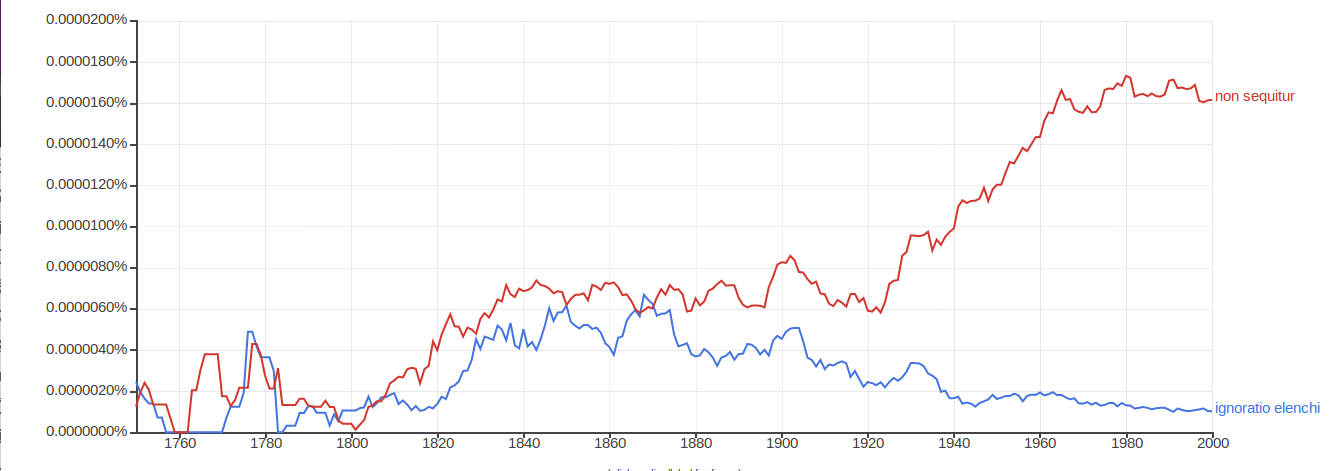
FIG. 1. Historical Frequency of Use of “ignoratio elenchi” and “non sequitur” in Google Books 1740-2000.
- Ignoratio elenchi is used as a “catch-all” classification for fallacies of irrelevance not properly classified under more specific fallacies of relevance.[61]
Identifying fallacies of relevance such as ad hominem, ad populum, and so forth as ignoratio elenchi, although historically justifiable, is no longer done in contemporary textbooks.
Many of these textbooks expand the traditional definition of ignoratio elenchi as arising from a misunderstanding of the proper way to refute the argument being contested.
- The ignoratio elenchi is often persuasive in oral
political argumentation. Often listeners in such a venue are easily distracted
by the confidence and resolve of a speaker. The fallacy is especially effective
as a persuasive technique when coupled with the ad populum
fallacy. The emotional situation in a crowd can often be distracting and can
result in overlooking the logical import of what is said.
- Some Common Examples of Ignoratio Elenchi: There
are many ways to evade a question. Some of the fallacious techniques to change
or shift the focus of an argument are listed below together with a perfunctory
example.
It is essential to point out that these examples apply to short “one-off” arguments and do not necessarily apply to parts of overarching argumentation in support a thesis such as those found in essays, books, debates, trials, disputations, and the like.[62] A major disadvantage of the examples given in textbooks (and within these notes) is that these sources do not analyze ignoratio elenchi occurrences as extended arguments. Extended fallacy examples are much less identifiable than the brief examples typically used in textbooks and tutorials.
Few logic texts point out that many instances of a purported ignoratio elenchi, when considered in the wider context of an extended argument not only can be relevant but also can effectively add inductive evidence to the elenchus or counter-thesis.[63]
- Sometimes a purported argument attempts to prove a wholly different
statement than that related to the question at issue.
The essential terms of the claim are changed (i.e., an elenchi mutatio, “changing the question” occurs). Here are two summary examples:(1) “Is the soul immortal? It is proved, or attempted to be proved, that the soul has not always been, and therefore, it is not eternal.” [italics deleted][64]
That is, the original claim is not that the eternal soul is “infinite in past and future duration,” but that it is “infinite in future duration”[65] This is the second example:
(2) “Those who deny the immortality of the soul on the grounds that ‘No dead man ever came back.’”[66]
Changing this issue in this manner is more specifically an example of straw man.
- The responding argument does not affirm or deny the question at
issue.
The following example describes an attempt to disprove that the soul is immortal by irrelevant facts:“Thus, if a person should undertake to prove the existence of ghosts, and should only prove some unusual noises and appearances during the night, he would exemplify this kind of fallacy.[67]
Rather than prove the existence of ghosts, mysterious occurrences are shown. Since these occurrences are not in question, the issue has been changed in accordance with the red herring fallacy.
- A given argument rhetorically provides emotional or a sentimental
statements than a genuine reasons.
Examples:(1) “Is the person at the bar guilty or not? … A counsel might prove the heinousness of the crime charged, the dreadful aggravations in this case, the need for making public example of such a wretch …”[italics deleted][68]
These outcries miss the point of proving the accused's guilt. Also, humor can be used as a distraction:(2)“If a sophist has to defend one who has been guilty of some serious offence, which he wishes to extenuate, though he is unable distinctly to prove that it is not such, yet if he can succeed in making the audience laugh at some causal matter, he has gained practically the same point.”[69]
In this case, the “fallacy” consists in “artful diversion” (or red herring) resulting in no conclusion of any kind.[70]
- The original argument is misrepresented by refuting only part of the
topic: i.e., the refuting conclusion drawn is only part of what
is required.
A minor point is sometimes addressed, and the fallacious reasoner concludes the original view is completely overcome. Thomas Reid provides this example from John Locke's criticism of Nicholas Malebranche's metaphysical distinction between idea and sensation:“… Locke [neglects] the Cartesian opposition of Idea and Sensation altogether, been guilty of an egregious mutatio elenchi in his strictures of the Cartesian doctrine of Extension, as the essential attribute of body.”[71]
Thomas Reid argues here that John Locke criticizes Malebranche by imputing to him a Cartesian doctrine Malebranche did not hold.
- The original argument is misrepresented by attempting to prove
something more general than that which is required
The deceptive argument proposed in reply is only vaguely applicable in resolution of the controversy:”[E]ighty-seven Port Royal nuns refused to denounce [Jansenism] in spite of its condemnation by two papal bulls. … When Archbishop Pérefixe demanded that the nuns sign the formula … the nuns [stated] such matters were “above their profession and their sex.’ … [The nuns signed] the formula with this heading[:] they ‘espouse absolutely and without reserve the faith of the Catholic Church’[72]
In effect, the nun's overarching statement implied to the Archbishop they were religious, not Jansenist, since the Archbishop viewed these beliefs incompatible. Yet, the nuns remained Jansenists since they viewed the beliefs compatible. The ignoratio elenchi here is accomplished by an equivocation between the nuns' and the Archbishop's definitions of the faith of the Church.[72]
Here's a brief second example. In a determinism–indeterminism debate, if a determinist were to attack the thesis …“Not all events are wholly determined by antecedent causes”
… by refuting the straw-man position of …“No events are wholly determined by antecedent events,”
… this procedure would commit the fallacy of ignoratio elenchi.
- The issue under discussion from an argument is sidestepped by
irrelevant weighing of alternatives.
E.g., a critic misrepresents the arguments of a locutor by raising a litany of collective objections or criticisms and concludes that the alternative issues are too complex for solution. Objections to almost any argument can be raised, but the crux is whether or not the objections are telling and are not simply rhetorical or whether or not other arguments outweigh those objections. The truth of a conclusion is not determined by the number of answerable objections that can be raised.[74] An example:”Ilhan Omar is one of the four Democratic congresswomen of color who Mr. Trump told to ‘go back’ to their original countries. … [When] asked how he would feel if someone told the first lady, who is from Slovenia, to go back to her country [the president said] ‘Well if you go back into the four congresswomen, the things they've said about our country are terrible, what they've said about Israel are just terrible. … I don't know I can't say for sure but certainly a lot of people say they hate our country and I think it's a disgrace what they've said. … And then you have these people I think Omar I find it hard to believe but I hear Omar today put in or yesterday put in a sanctions bill against Israel and other things beyond sanctions. So when I hear that, you just can't talk about our country that way. And when people are angry at them I fully understand it.”[75]
President Trump's ignoratio elenchi is bundled with an implicit ad populum, an ad hominem, and hearsay. Simply to point out the existence of objections is not a fallacy per se, but simply pointing out objections in the absence of counter objections to reach a default conclusion is fallacious. In public discussions or debates, raising objections can overwhelm an opponent since only a limited number of objections can be effectively answered within the time constraints.
- The contradictory is erroneously thought to be proved from the falsity
of the contrary of the point at issue.
(Contrary statements can both be false but cannot both be true; contradictories have opposite truth-values).
A fallacy occurs if it is thought that the failure of establishing a specific conclusion is proof of the opposite conclusion.“Maybe the two most famous opposing views on this debate [about the nature of human beings] are those of Thomas Hobbes and Jean-Jacques Rousseau. Hobbes describes humans as ‘nasty’ and ‘brutish’, needing society and rules to reign in their instincts in order to thrive; later Rousseau openly criticised him, arguing instead that man would be gentle and pure without the corruption of greed and inequality caused by the class system imposed by our society.”[76]
An ignoratio elenchi would occur if from the falsity of Hobbes' belief, Rousseau concludes that people are essentially good. Both views could be false; that is, people neither innately are born good or bad.
- An argument shifts the grounds of the argument being examined and to
some other more familiar subject.
“When an opinion is propounded, we find people attacking it on the ground of its traditional character, its being nothing new, or its bearing, real or supposed, upon existing interests and institutions”[77]
To say that an argument is not new, or is antiquated, is not to say that the argument is mistaken.
This type of ignoratio elenchi can often be more narrowly defined as a red herring fallacy.
Or, to take another example, many international and national leaders lament by means of example, the increase of ill-mannered speech among U.S. politicians. Such an argument is thought discounted by the contention that this contention is nothing new: foreigners have always referred to U.S. citizens of being discourteous and inconsiderate “ugly Americans.”
- The argument, in effect, disproves a statement which is not
at issue:
Thus, when in a discussion one party vindicates, on the ground of general expediency, a particular instance of resistance to Government in a case of intolerable oppression, the opponent may gravely maintain that ‘we ought not to do evil that good may come:’ a proposition which of course had never been denied, the point in dispute being ‘whether resistance in this particular case were doing evil or not.’”[78]
Many people assume the truth of an aphorism in oral discourse since the evaluation of its appropriateness to the argument at hand would cause momentary inattention to the continuing discourse.
- The fallacy can occur when the thesis to be opposed is taken
in narrow sense of the point at issue.
Consider this example of misconstruing the theory of general utility in utilitarianism:“The theory … as expressed by Bentham, ‘the greatest good of the greatest number is the foundation of morals and legislation’ … is converted into the execrable maxim that the good of the majority is alone to be consulted,”[79]
The good of the majority and the good of the greatest number persons are not equivalent concepts.
- The fallacy can occur when a few objections are made to parts of
the argument under examination, and this is claimed to show that the whole
argument is mistaken:
Example:“Mr. William Jennings Bryan, for example, proved to thousands of persons that some of the alleged causes of evolution are not valid, but what he asserted he was proving (but failed to prove) was the falsity of the hypothesis of evolution. He inadvertently set up a straw man —he called it “Darwinism”—and demolished it completely.”[80]
To defeat some sub-arguments locally does not refute the overarching argument globally. The success of such an argument depends on onlookers losing track of the stronger arguments in the opponent's position. This type of ignoratio elenchi is described as the “selection form” of a straw man argument by Robert Talisse and Scott F. Aiken.[81]
- The fallacy can occur when an opponent raises doubts about the
argument:
E.g., Considerations such as (1) pointing out other factors which might be important, (2) stating nothing can be proved beyond a shadow of doubt, (3) raising the question, “Who can really say? The question must be left open.” The effect of inducing doubts is as Francis Bacon states: “Not to resolve, is to resolve, [an action].”[82] The import of the objection is that the question must be left open. As Richard Whately elaborates:“[W]ithout considering whether more and weightier objections may not lie against their own schemes … their opponents have this decided advantage over them, that they can urge with great plausibility, ‘we do not call upon you to reject at once whatever is objected to, but merely to suspend your judgment and not come to a decision as long as there are reasons on both sides:’ now since there always will be reasons on both sides, this non-decision is practically the very same thing as a decision in favour of the existing state of things; the delay of trial becomes the equivalent to an acquittal.” [italics original] [83]
In this case, leaving open the question by raising doubts and questions shifts back the burden of proof to the objector. For example:Are these considerations really warranted? The objections are too many to enumerate here as they are many and weighty. Can such an argument be worthy of serious consideration? …
And so forth.
- With respect to general positions of a doctrine, political
position, ideology, or school of thought, particular conflicting less
important tenets can be specially selected in order to to conclude that
the general position is flawed.
Augustus De Morgan points out this tactic in his discussion of fallacies:“Nothing is more common that to represent sects and individuals as avowing all that is esteemed by those who make the representation to be what, upon their premises, they ought to avow. … [I]t is not very uncommon to take one premise from some individuals … another from others, and to fix the logical conclusion of the two upon the whole party.”[84]
Douglas Walton points out that “This is a subtle form of straw man fallacy that involves the notion of a subposition within a broader, or more inclusive position on an issue.”[85]
- Sometimes a purported argument attempts to prove a wholly different
statement than that related to the question at issue.
- In a legal context, ignoratio elenchi arguments in
witness testimony in response to cross examination are considered
“nonresponsive.” [86]
- In law and as well as argumentative discourse, unresponsive testimony
hinders the opposing party from an orderly presentation its case. In
United States v. Schneiderman the court explained:
“[T]o deny the questioning attorney the privilege of having non-responsive answer stricken [from the record] would make the course of direct examination infinitely more difficult and render cross examination virtually useless.[87]
Of course, if facts are suppressed in the irrelevant response to questioning, opposing counsel can elicit the testimony in later examination.
- Also, to allow unsolicited testimony to stand is to increase the
likelihood that a chronically nonresponsive witness will eventually
say something prejudicial.[88]
So likewise in dialectical argumentation or debate in the presence of
an audience, irrelevant arguments can unfairly sway prejudicial opinion.
- The Argument From Consequences: the fallacy of rejecting an
scientific argument or a conclusion because the argument or
statement may lead to unfavorable or disadvantaged circumstances.
The difficulty with this fallacy is that it implies that any argument or conclusion of an argument which results unfavorable or disadvantaged circumstances is, for that very reason, incorrect or false. Consider the common 19th century religious argument against evolution based on consequences:“The idea is ‘Creation’ is the exact contradition (not of nature, but)of “Evolution.” … [T]herefore,the Bible and Science are, in regard to Evolution, in exact contradiction: therefore since the ‘Bible” is true ‘Evolution’ must be false[89]
The findings of scientific research are fallible but are based on reasoning and empirical evidence — they can be cogently rejected by additional empirical findings but are not undermined by religious beliefs.
- In law and as well as argumentative discourse, unresponsive testimony
hinders the opposing party from an orderly presentation its case. In
United States v. Schneiderman the court explained:
- The ignoratio elenchi is often persuasive in oral
political argumentation. Often listeners in such a venue are easily distracted
by the confidence and resolve of a speaker. The fallacy is especially effective
as a persuasive technique when coupled with the ad populum
fallacy. The emotional situation in a crowd can often be distracting and can
result in overlooking the logical import of what is said.
- How to Identify and Analyze for Ignoratio
Elenchi: Examples of Ignoratio elenchi in Personal
Disagreements:
- As outlined above, the key for argument evaluation of ignoratio
elenchi fallacies is the determination as to whether or not evidence or
reasons used in the premises are relevant to the conclusion. Relevance
in arguments is established by material evidential connections of the premises
with the conclusion.
So, one statement is irrelevant to another statement if and only if the first statement does not does provide evidence for or against the second statement.
- Consider how to assess relevancy in the following example based on the
final release of the last hostage U.S. embassy diplomats and citizens
imprisoned for over 14 months in Iran in 1981:
“The 52 former hostages are seen as national heroes. I consider them survivors. A hero is one who is admired for his achievements and qualities. Therefore, the true heroes are those servicemen who volunteered for the failed rescue mission.”[90]
Ms. Coyne's conclusion indicates that the 52 released U.S. hostages are not true heroes, but the servicemen who failed the rescue attempt are the true heroes. The “achievements and qualities” of the servicemen are due to their courage, nobility of purpose, and risk of life — not due to the outcome of the attempt. Similar qualities are attributed to the survivors who endured harsh conditions during imprisonment by the Iranians for over 14 months.
- Rather than directly proving that the 52 former hostages are not heroes,
by means of misdirection, Ms. Coyne conceals the dubious assumption that the
withheld hostages cannot be admired for their achievements and qualities since
they are (just) survivors.
The statement that the soldiers are heroes implies nothing whatsoever as to the “achievements and qualities,” i.e., the heroism of the survivor hostages and thus is evidentially irrelevant.
- Consider how to assess relevancy in the following example based on the
final release of the last hostage U.S. embassy diplomats and citizens
imprisoned for over 14 months in Iran in 1981:
- In order to address and demonstrate the nature of the fallacy, the question
at issue stated in argument form is compared side-by-side with the
elenchus, or supposed refutation:
“Refutations … must … be met by examining the conclusion in light of its contradictory and seeing how the same term shall be resent in the same respect and in the same relation, manner and time.” [Arist. Soph. El., xxvi.181a1-5 (trans. Forster)]
For example, consider the following summary of a disagreement:[Medic]: “The man is unfit to travel, because he has a life-threatening fever.”
Comparison: “Being unfit to travel” is not necessarily connected with being a soldier but is necessarily connected with serious illness. So the statement that a man is a soldier does not obviate the statement that when seriously ill he is fit to travel.
[Captain:] ”The man is fit to travel, because he is a soldier.”[91]
- On occasion, the lack of a clear and distinct response to an argument
can lead to a charge of ignoratio elenchi. What follows
is an example where a less than straight-forward apology became an incipient
event in one thread of a complex conflict in the storied Kingsley-Newman
controversy:
Mr. Kingsley states in an article in a Macmillan's Magazine:“Truth, for its own sake, had never been a virtue with the Roman clergy. Father Newman informs us that it need not, and on the whole ought not be …“[92]
Dr. Kingsley responds in a letter to the magazine:”There is no reference … to any words of mine … in justification of this statement. … I do wish to draw the attention … to a grave and gratuitous slander …
To which Mr. Kingsley replies in a letter to Macmillan's:“Dr. Newman has by letter expresst, in the strongest terms, his denial of the meaning which I have put upon his words. It only remains, therefore, for me to express my hearty regret at having so seriously mistaken him.”[93]
This should have been the end to the matter, but Dr. Newman expected the “slanderous” statement to be withdrawn. Instead, Mr. Kingsley's subtle response was seen as an ignoratio elenchi: namely the regret that Dr. Newman had misunderstood the statement — not the regret that Dr. Newman had never made such a statement.
From this point on, the disagreement only intensified as one of the greatest “ungentlemenly” controversies of the nineteenth century.
- Another example of the attempted use of an ignoratio
elenchi to escape from being forced to accept either of the horns
of a dilemma is that of the Burr-Hamilton duel which occurred in early U.S.
history.
Alexander Hamilton's use of ignoratio elenchi in his reply to a personal demand by Aaron Burr resulted, after a series of letters, in their fateful, tragic duel. Hamilton was charged to either acknowledge or deny Burr's evidence, based on a physician's letter, that Hamilton had voiced publicly a even more “despicable opinion” of Burr than that of being a ”a dangerous man” and a man ”not to be trusted with the reins of government.”[94]
Hamilton's responding letter to Burr was noncommittal and evasive. Hamilton first summarizes the physician's letter and then attempts to deflect its import:
Hamilton's evasive argument does not dispute Burr's conclusion; his ignoratio elenchi was an attempt to avoid both supplying a truthful response inevitably resulting in a duel and crafting a deceitful response wholly uncharacteristic of a gentleman. Unfortunately, the stratagem was unsuccessful.“The language of Doctor Cooper plainly implies that he considered this opinion of you [i.e. you (Burr) being a “dangerous man”], which he attributes to me, as a despicable one, but he affirms that I have expressed some other [view] still more despicable [than that], without however mentioning to whom, when or where. ’Tis evident that the phrase ‘still more despicable” admits of infinite shades from very light to very dark. How am I to judge of the degree intended or how shall I annex any precise idea to language so indefinite? …
[I]t cannot be reasonably expected that I shall enter into an explanation upon a basis so vague as that which you have adopted. I trust on more reflection you will see the matter in the same light with me. If not, I can only regret the circumstance and must abide the consequences.”[95]
- As outlined above, the key for argument evaluation of ignoratio
elenchi fallacies is the determination as to whether or not evidence or
reasons used in the premises are relevant to the conclusion. Relevance
in arguments is established by material evidential connections of the premises
with the conclusion.
- Effectiveness of and How to Respond to an
Ignoratio Elenchi Fallacy
In rhetoric, a straw man argument is usually not very effective, but on those occasions when the argument is presented to non-partisans indifferent to the issues under discussion, the argument can be somewhat influential.
If an opponent is charged with committing an ignoratio elenchi of any sort, the opponent should restate precisely the standpoint of the original issue and then precisely state the conclusion of the original argumentation. Finally the opponent should explain how the conclusion of the respondent's argument (i.e., the elenchus, or contradictory of the opponent's argument) does not refute the original argument.
- George Y. Bizer et. al. studied whether college students are influenced the
straw man fallacy, independently of whether the students were able to identify
the fallacy.
They found that some college students were not influenced by straw man arguments, but those students with less interest in the arguments (and had attitudes less affected by the argument's quality) were more likely to be influenced by it.
- Their research suggested that the straw man technique is not as
effective for students for whom the arguments had high personal relevance.
The authors conclude:
“In the current research, people who were motivated to process a message — due to disposition or situation — were not persuaded by the technique. … Although the straw man may be effective in some cases, it may actually backfire in others. Understanding the motivation of one's audience to carefully process the message, it seems, is of critical importance.[96]
Hence, as a technique of persuasion, the use of the rhetorical ignoratio elenchi is to be particularly avoided in debate and dialogue whenever an audience has an especial interest in the topic.
- Thomas Vernon and Lowell Nissen write, “ If you base your opinion
of an opposing ideology on an oversimplified and distorted version of that
ideology which can easily be made to look ridiculous, then you are making
the serious mistake of underestimating your opponent.”[97]
- Their research suggested that the straw man technique is not as
effective for students for whom the arguments had high personal relevance.
The authors conclude:
- As a pedagogical example of how to respond to an ignoratio
elenchi, suppose after showing some pictures of swans and explaining that
dominant white feathers help camouflage in snow and dominant black feathers
help camouflage in open water, a naturalist concludes that this is one reason
mature swan feathers around the world are predominately black or white in color.
- A respondent states this argument is an ignoratio
elenchi since the conclusion does not universally follow. Not all
swans are either black or white. The South American cygnus
melancoryphus or black-necked swan has a white body with a black
head. So it's neither all-black nor all-white.
- The locutor points out reasons were given for the conclusion that
feathers are predominately black or white, not for the conclusion that
the entire plumage is black or white but not both. The locutor then might
go on to clarify that in point of fact, all mature swans are mostly black
or white or both black and white. No swan is entirely one color, and this
actually enhances the camouflage. Even black swans have white flight colors,
and white (mute) swans have a black feathers bordering its eyes and beak.
- This short example illustrates that in public discourse and debate, it
is especially important to state clearly the point at issue, and
the speaker should clarify in advance the limitations of the claim in
anticipation of typical objections.
- A respondent states this argument is an ignoratio
elenchi since the conclusion does not universally follow. Not all
swans are either black or white. The South American cygnus
melancoryphus or black-necked swan has a white body with a black
head. So it's neither all-black nor all-white.
- Finally it should be noted that one reason for identifying an apparent fallacy as
a ignoratio elenchi, rather than of identifying it as a specific
informal fallacy, is that the reasoning provided is unclear, given the context of the
argument.
For example, the following passage can be plausibly analyzed in different ways depending upon how missing premises are supplied:“One after another of our leaders and heroes managed to shame himself in the past couple of decades. Americans have always been a little skeptical of politicians, but Bill Clinton (and too many others of both parties to name in recent years) invited outright contempt and disgust. Baseball players and world champion bikers admit to doping after vigorous and protracted denials. Best-selling historians and journalists are caught plagiarizing. Teachers are having sex with their underage students. Doctors are caught taking lewd photographs of their patients. The Secret Service uses prostitutes. The most decorated and esteemed military officer of our time is forced to resign as CIA director after a sex scandal. One of the most admired college football coaches in the nation is found to have kept silent about child abuse. The Catholic Church as been profoundly tarnished for failing to protect children from pedophile priests. So, for all of us, even the non-Catholics, it will be a tonic, and possibly even a little inspiring, if Pope Francis turns out to be just what he seems “a truly Godly man who lives out his faith.’” [108]
From her list of contemporary leaders and heroes who have flawed character or behavior, the author suggests that it will be somewhat surprising to learn that the character of the newly selected pope will be different from the character of the other evidenced examples.
- One interpretation of the argument might be just to notice the biased selection
of flawed leaders and flawed heroes (without consideration of honest and ethical
leaders and heroes) and conclude the argument commits a fallacy of cherry picking
or biased selection.
- The author might be presupposing that all of these examples point implicitly to
the generalization as a subconclusion that most leaders and heroes are flawed. And
then the author might be concluding from this that if the pope turns out to be an
exception to that generalization, it will be unexpected. The fallacies of converse
accident and accident might be plausibly argued.
- But since there is no clear connection or relevance of the kinds of leaders
or heroes mentioned in the premises with respect to the leader of the Catholic
Church, assuming the passage is argumentative, identification of the fallacy of
ignoratio elenchi seems appropriate.
- However, in the end, simply accepting what is said as the author's opinion and
not the author's attempt to convince others of that opinion is perhaps the safest
course. In which case, the “so” in the last sentence is not a conclusion
indicator and the author did not intend the passage to be argumentative.
- One interpretation of the argument might be just to notice the biased selection
of flawed leaders and flawed heroes (without consideration of honest and ethical
leaders and heroes) and conclude the argument commits a fallacy of cherry picking
or biased selection.
- George Y. Bizer et. al. studied whether college students are influenced the
straw man fallacy, independently of whether the students were able to identify
the fallacy.
- Test your understanding of ignoratio elenchi and
related fallacies with this quiz with provided answers:
Ignoratio Elenchi, Straw Man, Red Herring, and Non Sequitur Fallacy Exercise
- [M]ildly denying that a certain thing is absolutely
all-important.
- [B]oldly point out that something else is altogether valueless,
we are met by the answer that we ‘can't expect perfection.’
- [A]sserting that some doctrine lacks argument to prove its
truth, we are referred to excellent reasons for believing in its utility.
- [E]ndeavouring to trace the manner in which some highly
developed growth (e.g. conscience) originated, we are supposed to be refuted
by a mere description of its present nature.
- [D]isputing an argument, or an instance, we are
supposed flatly to deny the theory in support of which there were brought
forward.
- [M]aking some merely tentative suggestion we are
asked for definite proof.
Alfred Sidgwick, Fallacies: A View of Logic from the Practical Side (New York: D. Appleton, 1884), 188.
Notes: Ignoratio Elenchi
1. The elenchus, historically, either is the contradictory of the assertion of an opponent or is the argument intended to prove the contradictory of an opponent's thesis thereby showing the thesis false.
The Ignoratio elenchi, then, describes an irrelevant argument which does not prove the contradictory of the conclusion of an opponent's argument. This “ignorance of the proper refutation“ is not necessarily a logically invalid argument — it simply does not prove the conclusion required. So the fallacy is not necessarily a logical or formal one; it is a material fallacy whose error is said to lie in the deception of “missing the point.”
A distinction is sometimes made between ignoratio elenchi and mutatio elenchi:
If the fallacy is committed unknowingly, it is an ignoratio elenchi.
If the fallacy is committed on purpose, the fallacy is a “mutatio elenchi.
See, for example, Wilhelm Traugott Krug, System der theoretischen Philosophie: Logik oder Denklehre (Königsberg: August Wilhelm Unzer, 1833), 507 and Lawrence Johnstone, A Short Introduction to the Study of Logic (London: Longmans, Green, 1887, 101.) ↩
2. Thomas Fowler, The Elements of Deductive Logic (Oxford: Clarendon Press, 1867), 138.↩
3. Alfred Milnes, Elementary Notions of Logic (London: W. Swan Sonnenschein & Allen, 1880), 4.↩
4. Francis Bowen, A Treatise on Logic or the Laws of Pure Thought (Cambridge, MA: Sever and Francis, 1865), 298-299. Aristotle says:
“A refutation is a contradiction of one and the same predicate, not of a name but of a thing, and not of a synonymous name but of an identical name, based on the given premisses and following necessarily from them (the original point at issue not being included) in the same respect, relation, manner and time. [Soph. El. v.167a23-28 (trans. Forster).↩
And from this, suggests that ignoratio elenchi might be seen as a material fallacy. [Soph. El. v.167a35-36.] ↩
5. Richard Whately, Elements of Logic (London: J. Mawman, 1826), 151.↩
6. Ignoratio elenchi is not only one of Aristotle's thirteen sources of erroneous reasoning [Soph. El. v.167a22-28] but also is a name for all the types of relevance fallacies [Soph. El. vi.169a18-21] — so modern usage corresponds somewhat with the Aristotelian origin, even though Aristotle described the fallacy as used in disputation or dialogical argumentation (as described in the text above as view (1) where two or more disputants interact).
The Port-Royal Logic defined ignoratio elenchi as
(1) “proving something other than than which is in dispute,”
(2) “the ignorance of that which ought to be proved,” and
(3) “to attribute to our adversary that which is vary far from his meaning, in order to carry on the contest with greater advantage;
or to impute to him consequences which we imagine may be derived from his doctrine, although he disavows and denies them.”
[Antoine Arnauld and Pierre Nicole, 5th ed. The Port-Royal Logic, trans. Thomas Spencer Baynes (Edinburgh: James Gordon, 1861), 247.] Note that the third sense includes a description of the straw man fallacy which had been named and used since the early 17th century. C.f. footnote 48 below.↩
7. Many modern non-pragma-dialectical logic texts discuss ignoratio elenchi in the context of monotonic argumentation where the structure of arguments are evaluated individually and apart from a dialogical context.
Many sub-types of the monotonic version of ignoratio elenchi are listed with short examples in the anonymous treatise An Elementary Treatise on Logic (London: J. Chapman, 1852), 67.↩
8. Thomas Fowler, Logic: Deductive and Inductive, 149.↩
9. Some logicians prefer to use the term “fallacy” in the formal sense only and maintain that the ignoratio elenchi is not a fallacy per se. E.g. W.D. Wilson advises:
”The words Ignoratio Elenchi mean ‘Ignorance of the Proof’ which ought to be given, and are applied equally to cases in which one is really and innocently ignorant [i.e., what is called elsewhere mutatio elenchi, and to those in which one chooses to ignore the real issue to be met and the Proof necessary to meet it. In this view of it, therefore, it is not a Fallacy in Logic at all, but simple a fault in sagacity or honesty, or both. It is not fault in Form nor a fallacy in the use of Forms [i.e. a formal fallacy].”
[William Dexter Wilson, Logic, Theoretical and Practical (New York: D. Appleton, 1856), 185.]
And in diatonic logic, Douglas Walton advises before citing the fallacy of ignoratio elenchi one must make sure that the opponent has completed his argument: “The question of how final the criticism of irrelevance should be taken to be, therefore, depends on whether the dialogue can be continued.” [Douglas N. Walton, Informal Logic: A Pragmatic Approach 2nd. ed. (1989 Cambridge: Cambridge University Press, 2008), 80.]↩
10. F.C.S. Schiller, Formal Logic: A Scientific and Social Problem (London: Macmillan, 1912), 358-359.↩
11. Consider Richard Whately's influential description of “fallacy”:
By a ‘Fallacy’ is meant ‘any deceptive argument or apparent-argument, whereby a man is himself convinced, — or endeavors to convince others — of something which is not really proved.’” [emphasis original]
[Richard Whately, Easy Lessons on Reasoning 2nd. ed. (Boston: James Monroe, 1845), 133.]
And C.L. Hamlin points out in his important work on fallacies:
“A fallacious argument, as almost every account from Aristotle onwards tells you, is one that seems to be valid but is not so.” [emphasis original]
[C.L. Hamlin, Fallacies (London: Methuen, 1970), 12.]↩
12. Richard Whately, Introductory Lessons on Morals, and Christian Evidences (Cambridge: John Bartlett, 1860), 144-145.↩
13. Adapted from Peter Coffey, The Science of Logic (London: Longmans, Green, 1912), II:315.↩
14. Aristotle concludes that ignoratio elenchi in its general sense is coextensive with any kind of fallacy of relevance. Soph. El. viii.170a9-11 (trans. Forster):
“Thus we should know the various conditions under which false proofs occur, for there are no further conditions under which they could occur, but they will always result from the above causes [i.e., reasons].”
As least this is what Erik Krabbe concludes with this (uncredited) translation of that passage:
“Thus we may know in how many ways fallacies come about. For there can be no more ways; they all will come about in the ways mentioned.
“Fallacies” here are defined as mistaken sophistical refutations (dialectical fallacies), by which Krabbe concludes Aristotle reduces “all fallacies to ignoratio elenchi.” [Erik C.W. Krabbe, “Aristotle's Sophistical Refutations,” Topoi 31 no. 2 (April, 2012), 245. doi: 10.1007/s11245-012-9124-0↩
15. Brian P. Copenhaver with Calvin Normore and Terence Parsons, Peter of Spain: Summaries of Logic, Text, Translation, Introduction, Notes (Oxford: Oxford University Press), 61. doi: 10.1093/actrade/9780199669585.book.1↩
16. Henry Aldrich, A Compendium of Logic 2nd ed. (London, 1756), 31. Aldrich states:
“The Fallacy Ignorationis Elenchi. An Elenchus is, A Syllogism that confutes the Opponent. Therefore he falls into this Fallacy, who thinks he confutes his Opponent, without observing the Rules of Contradiction.”
It's important to see that a claimed valid refutation which concludes with a contrary would be an ignoratio elenchi since it is not a contradictory. (Contraries cannot both be true but can both be false.)↩
17. Thomas Wilson (Thomas Vuilson), The Rule of Reason, Conteinyng the Arte of Logique Set Forth in Englishe (London: Richard Grafton, printer to the Kynges Maiestie), n.p. Henry Aldrich, A Compendium of Logic, 31.↩
18. Antoine Arnauld and Pierre Nicole, The Port-Royal Logic trans. Thomas Spencer Baynes, 5th ed. (Edinburgh: James Gordon, 1861), 247. Note that the third sense includes a description of the straw man fallacy had been named and used since the early 17th century.↩
19. Isaac Watts, Logick; or, the Right Use of Reason in the Enquiry after Truth 3rd. corrected ed. (London: Printed for John Clark et al., 1729), 314-315.↩
20. Isaac Watts, The Improvement of the Mind;, or A Supplement to the Art of Logic (London: J. Abraham, 1801), 99-100.↩
21. George H. Smith, Logic or the Analytic of Explicit Reasoning (New York: G.P. Putnam's Sons, 1901), 143-144.
Frans H. van Eemeren, Rob Grootendorst, Ralph H. Johnson, Christian Plantin, Charles A. Willard, Fundamentals of Argumentation Theory: A Handbook of Historical Backgrounds and Contemporary Developments (Routledge, 2013), 284.↩
22. Richard Whately, Elements of Logic (London: J. Mawman, 1826), 141-142.↩
23. Thomas Fowler, The Elements of Deductive Logic (Oxford: Clarendon Press, 1867), 138.↩
24. Hamlin, Fallacies, 31.↩
25. E.g., In symbolic logic the formal argument:
p
∴ p ∨ q
is a valid argument form. So, therefore, an argument such as:
The cat is on the mat.
∴ The cat is on the mat or the earth is flat.
is valid formally in that if the premise is true, the conclusion is necessarily true as well.
“The earth is flat” is part of the conclusion, but statement is irrelevant to the statement “The cat is on the mat.” And although “The cat is on the mat” entails that “The cat is on the mat,” to argue this is would be petitio principii (the fallacy of circular argument). Formal logic provides no basis for topical relevance among statements.
Relevance logics have been developed with a view to avoid these failures of relevance. See, for example, Edwin Mares, “Relevance Logic,”, The Stanford Encyclopedia of Philosophy ed. Edward N. Zalta (Spring 2014 Edition). Also, see John Woods, Andrew Irvine, and Douglas Walton, “Non-Classical Propositional Logics,” Argument: Critical Thinking, Logic and the Fallacies 2nd. ed. (Toronto: Pearson Prentice Hall, 2004), 148-175.↩
26. Douglas Walton defines “probative relevance” as a statement playing some part in proving or disproving another statement. [Douglas Walton, Informal Logic: A Pragmatic Approach 2nd. ed. (Cambridge: Cambridge University Press, 1989), 203.] Trudy Govier defines positive and negative relevance as if and only if the truth of one statement counts in favor of, or against, another statement. [Trudy Govier, A Practical Study of Argument 7th ed. (Belmont, CA: Wadsworth Cengage Learning, 2010), 149.] Material evidential relevance, probative relevance, and positive and negative relevance are similar concepts with some differences in applications.
W.R. Boyce Gibson, following an insight articulated by G.F. Stout, describes argumentative relevance in this manner:
“[The natural framework of] a logical whole, the object that can satisfy a given logical interest … is defined by the limitations of the interest [and purpose]. What in respect of that interest is extra-marginal is logically irrelevant …
…
[W]hether that [reference to] context be formal or real, is always conceived as limited by an involved reference to purpose or interest …
[W.R. Boyce Gibson with the cooperation of Augusta Klein, The Problem of Logic (London: A. and C. Black, 1914), 118,120.]↩
27. Ruth Marcus, “An Ominous Sign for Roe vs. Wade,” Index-Journal 95 no. 345 (April 28, 2020), 8A. ↩
28. G.K. Chesterton's analogy illustrates the point that an unproved statement is not necessarily a false statement:
“A false ghost disproves the reality of ghosts exactly as much as a forged banknote disproves the existence of the Bank of England …”
[Gilbert K. Chesterton, Orthodoxy (London: John Lane, 1909), 281-282.]↩
29. Douglas N. Walton, Topical Relevance in Argumentation, 48. Also, adapting Douglas N. Walton and Fabrizio Macagno, “Profiles for Dialogue for Relevance,” Informal Logic (2016), 527. doi: 0.22329/il.v36i4↩
30. 11. Noah K. Davis, The Theory of Thought: A Treatise on Deductive Logic (New York: Harper & Brothers, 1894), 139.↩
31. Many current logic textbooks show no consistent use of these terms. Many of their traditional uses have merged.
Douglas N. Walton, for example, uses ignoratio elenchi and red herring interchangeably in an early paper “Ignoratio Elenchi: The Red Herring Fallacy,” Informal Logic 2 no. 3 (January, 1979), 3-7. doi: 10.22329/il.v2i3.2823
Diane Halpern uses irrelevant reasons and non sequitur interchangeably. Diane F. Halpern, Thought and Knowledge: An Introduction to Critical Reasoning 5th ed. (New York: Psychology Press, 2014), 274. doi: 10.4324/9781315885278
I.M. Copi et al. states ignoratio elenchi and non sequitur “similar breadth and flexibility.” [Irving M. Copi and Carl Cohen, Introduction to Logic 13 ed. (Upper Saddle River, NJ: Pearson, 2009), 134]. but this text stipulates a more restricted use of ignoratio elenchi.↩
32. Originally with Aristotle, non sequitur was identified with the “fallacy of the consequent” (or sometimes termed the “fallacy of the false consequent”) which Aristotle narrowly defined as fallacies related to the hypothetical syllogism (i.e., fallacies such as invalid conversion of a universal affirmative proposition or conversion of a hypothetical statement as related to the fallacy of affirming the consequent or the fallacy of denying the antecedent). [Vide Arist. Soph. El. v.167b1-5 (trans. Forster)].
In the 18th century logicians employed the definition of the fallacy to syllogistic reasoning whenever the conclusion did not logically follow from the premises. [Adam L. Jones, Logic, Inductive and Deductive: An Introduction to Scientific Method (New York: Henry Holt, 1909), 174.] Today, non sequitur is used to describe any invalid argument whose conclusion is irrelevant to its premises as in this characterization by Roy Wood Sellars: a non sequitur is defined as “a conclusion which does not follow the premises.” [Roy Wood Sellars, The Essentials of Logic (Boston: Houghton Mifflin, 1917), 157.]
On this definition of non sequitur, Arthur Ernest Davies points out:
Whenever, for any reason, a conclusion does not follow from the assigned premises, we have, in the literal sense of the term, a Non Sequitur. When used in this sense to include all the errors in reasoning which lead to erroneous conclusions, the term is generic, and must be understood as synonymous with ‘fallacy.’”
[Arthur Ernest Davies, A Text-Book of Logic (Columbus, OH: R.B. Adams, 1915), 576, 578.]
Historically, non sequitur has been defined in a baffling assortment of definitions:
(1) Some logicians have viewed the narrow form of the Aristotelian ignoratio elenchi (i.e. ignoring of the real point to be proved) as a subfallacy of non sequitur. [Vide, Henry B. Smith, How the Mind Falls into Error: A Brief Treatment of Fallacies (New York: Harper & Brothers, 1923), 47.]
However, including ignoratio elenchi as one type of non sequitur, mistakenly ignores the fact that some ignoratio elenchi arguments are designated fallacious because they do not prove the conclusion intended, even though they do validly prove the wrong conclusion. In this sense, the “fallaciousness” of this type of ignoratio elenchi resides in its deceptiveness rather than in the fact of the conclusion not following from its premises.
(2) More often the opposite relation of the two fallacies is held: the non sequitur, is usually classified as one kind of ignoratio elenchi. Alfred Sidgwick states:
“[S]o long ago as Aristotle's time it has been pointed out that every case of Non sequitur may in one sense be viewed as Ignoratio elenchi; while it is quite clear that the first and second of the above heads are, strictly speaking, cases of ‘Untruth implied.””
[Alfred Sidgwick, A View of Logic from the Practical Side (New York: De. Appleton, 1884), 178-179.] Douglas Walton at one time also held this view as well. [Douglas N. Walton, “Which of the Fallacies are Fallacies of Relevance?” Argumentation (1992), 237-250. doi: 10.1007/BF00154328] In addition, C.L. Hamlin states with respect to ignoratio elenchi, “[A]lmost any fallacy at all might be put under this heading.” [Fallacies, 41.]
Steven Barbone, in effect, continues this view as described here:
“[I]gnoratio elenchi (“ ignorance of the proof”) fallacy, is, in effect, the parent of all other fallacies since every fallacy yields a conclusion that even it be true is not related — that is, is irrelevant — to the premises of the argument…”
[Steven Barbone, “Irrelevant Conclusion,” in Bad Arguments, (Hoboken, NJ: Wiley Blackwell, 2019), 172.] doi: 10.1002/9781119165811.ch33]
(3) I.M. Copi's initial textbook of logic, together with successive editions with co-authors takes a unique view of ignoratio elenchi:
“We reserve this name for those fallacies of irrelevance that do not fit into other categories.”
These editions equate the extension of the term ignoratio elenchi with that of non sequitur. [E.g., Irving M. Copi and Carl Cohen, Introduction to Logic 13 ed. (Upper Saddle River, NJ: Pearson, 2009), 134.] But the implication of this equivalence seems to be that ignoratio elenchi is taken in the equivocal sense of any fallacy of relevance as well as a “catch-all” category of all fallacies of relevance not more specifically named, such as the fallacies tradtionally labelled “ad …”
(4) As late as the early 20th century, the non sequitur was more narrowly identified with Aristotle's fallacy of the consequent, i.e. for any fallacy involving a hypothetical syllogism including the fallacy of affirming the consequent or the fallacy of denying the antecedent). [A.E. Davies, A Text-Book of Logic (Columbus, OH: R.G. Adams, 1915), 578.]
(5) Some logicians describe non sequitur as a “fallacy of the consequent” meaning in this case the conclusion includes irrelevant information not present in the premises, whereas ignoratio elenchi, as irrelevant conclusion, includes irrelevant material in the premise which proves the wrong conclusion. [Sam Blows, Cusack's Principles of Logic (London: City of London, 1899), 163, 166; and William J. Taylor, Elementary Logic (New York: Charles Scribner's Sons, 186; among others.] However, this description rests on a misinterpretation of Aristotle's fallacy of the consequent. Vide Arist. Soph. El. v.167b1-5 (trans. Forster).
(6) Other logicians see version (5) as two aspects of the same fallacy: the first from the origin of the fallacy of getting the wrong issue in the premises (ignoratio elenchi in the narrow sense of mistaking the issue) and the second from the outcome of the fallacy (non sequitur or irrelevant conclusion). For example, George Smith, seemingly taking an early pragma-dialectical approach, concludes from the rule that premises must correspond to the thesis at issue, that …
“The fallacy resulting from a violation of this rule … will necessarily involve a departure from the thesis at issue, both in the premises and in the conclusion. With regard to the premises, it is called the fallacy of Mistaking the Issue; with regard to the conclusion, that of Irrelevant Conclusion; and in either case, Ignoratio Elenchi”
[George H. Smith, Logic or the Analytic of Explicit Reasoning (New York: G.P. Putnam's Sons, 1901), 143-144.] This point of view is retained in Alburey Castell's very popular logic textbook in the mid-20th century where he suggests, “They are in a sense convex and concave of the same situation.” [A College Logic (New York: Macmillan, 1935), 22.]↩
33. William Stanley Jevons, Elementary Lessons in Logic (London: Macmillan, 1879), 181. ↩
34. James H. Hyslop, The Elements of Logic: Theoretical and Practical (New York: Charles Scribner's Sons, 1892), 253.↩
35. G. Elliot Smith, In the Beginning; The Origin of Civilization (London: G. Howe, 1928), 12.↩
36. My guess is that the confusion arises since both fallacies have been defined as occurring whenever a reason is used, when it is not a reason or when the conclusion does not follow from the premises. [Arist. Soph. El. vi.168b23-30]. A good example of a fallacy of the consequent is as follows:
“If the farmers will Organize, they have a good Chance of keeping the price supports. But (~O) whoever heard of farmers really getting together on anything?”
Adapted from W. Ward Fearnside and William B. Holther, Fallacy:
The Counterfeit Argument (Englewood Cliffs, NJ: Prentice-Hall, 1959), 156.]
So the implicit conclusion is “Farmers don't have a good chance of keeping price
supports” but it doesn't logically follow since the government might have its
own reasons to continue the supports whether or not the farmer's organize. Note that the
structure of the argument is the fallacy of denying the antecedent:
If O then C
~O
∴ ~C
Many logicians since the beginning of the 19th century equate the fallacy of the consequent with any argument whose conclusion does not logically follow from its premises. However, this interpretation would also omit those cases of ignoratio elenchi which are valid but prove a different conclusion from that required as a refutation.↩
37. Diane F. Halpern, Thought and Knowledge: Introduction to Critical Thinking 5th ed. (New York: Psychology Press, 2014), 274. doi:10.4324/9781315885278 ↩
38. Halpern, Thought and Knowledge, 274. In her defense, it is possible that she acknowledges foreign language study (or better, modern language study) is a subject important for a quality education, but not all subjects important for a quality education can be required because of, e.g.. undergraduate time constraints, etc.
Also, it should be noted in passages like this one, it is important not to commit the straw man fallacy when supplying missing premises for an opponent in critical discussions. Douglas Watson explains why in this short passage:
“When attributing enthymemes, especially to an opponent, it can be very tempting to exaggerate the opponent's position by filling in a missing premise of the form ‘Generally things that have property F also have property G, subject to exceptions’ with an absolute, or strict generalization, of the form ‘All things that have property F also have property G, without exception.’ This kind of move is a form of the secundum quid fallacy,meaning that qualifications have been ignored. But the same move may also be a case of the straw man fallacy …”
Douglas Walton, “The Straw Man Fallacy,” in Logic and Argumentation ed. Johan van Bentham, Frans H. van Eemeren, Rob Grootendorst and Frank Veltman (Amsterdam: North-Holland, 1996), 122.↩
39. Paul Grice, Studies in the Way of Words (Cambridge MA: Harvard University Press, 1989), 30-31. Deirdre Wilson's and Dan Sperber's development of Grice's Communicative Principle of Relevance is applicable to argumentation as well: “Every utterance conveys a presumption of its own optimal relevance.” Meaning and Relevance (Cambridge: Cambridge University Press, 2012), 282.
The point of view taken in these notes follows Alfred Sidgwick: “[T]he asserter is, in every case, the arbiter of what he means to say.” [The Practical Side of Logic, (London: Kegan Paul, Trench, 1883), 193.]
F.C.S. Schiller cautions, with respect to apparent non sequitur:
“[It really is not safe to infer that the logical thread of connexion has been severed because you cannot trace any verbal identity between the terms in the conclusion and in the premises. The apparent non sequitur may be merely due to an elliptical statement on the part of the reasoner, or even to a use of language you do not understand; actual inquiry may show that there is a good connexion lurking in his mind, though it does not appear on the face of his argument.” (London: Macmillan, 1912), 361-362.
[F.C.S. Schiller, Formal Logic, 361.]↩
40. What the author might be arguing is the implicit (minor) premise is the real question at issue; therefore, the enthymeme would be a petitio principii. A similar objection regarding enthymemes of this type is made by various authors including James H. Hyslop, [The Elements of Logic: Theoretical and Practical (C. Scribner's Sons, 1892), 254-255] and David Hitchcock, “Enthymematic Arguments,” Informal Logic 7 no. 2 & 3 (Spring & Fall, 1985), 87.]
However, this tactic is to ignore Grice's principle of communication as well as to ignore that the objector has the burden of proof to show the enthymeme invalid: i.e. to disprove the implicit premise.
There are many other different reasons logicians have given for making regarded implicit assumptions explicit even though the principle of charity is not useful for many enthymemes derived from probabilities and signs [c.f. Arist. Rh. I.2.1357a14-18].
Ignoratio elenchi can occur when the principle of charity is disregarded. For example, Viśwanátha states that when the belief of an individual who asserts “I am eternal” is taken literally so that the objection, “How canst thou be eternal that was born of so and so?[emphasis original]” The objector well knows the individual is speaking of an internal spirit within him, and not his body, ”the temporary-prison house of his soul.” The ignoratio elenchi occurs since the question “does not assail that which the speaker meant to say. [Viśwanátha, The Aphorisms of the Nyáya Philosophy by Gautama, trans. J. R. Ballantyne, Sanskrit and English (Allahabad: Presbyterian Mission Press, 1854), IV: 45-46.]
For a useful outline of many approaches for analysis of enthymematic arguments see David Hitchcock, “Does the Traditional Treatment of Enthymemes Rest on a Mistake?,” Informal Logic 12 Argumentation (1998), 15-37.↩
41. Alfred Sidgwick, Fallacies: A View of Logic from the Practical Side (New York: D. Appleton, 1884), 179. Sidgwick has in mind Arist. Soph. El. VI. But Sidgwick's judgment is based on the claim in where Aristotle states “Thus we should know the various conditions under which false proofs occur, for there are no further conditions under which they could occur, but they will always result from the above causes [reasons].” Soph. El. VIII 170a9-11 (trans. Forster). Q.v, footnote 14 for Erik Krabbe's translation of this passage.↩
42. The red herring fallacy seems to have originated from Nicholas Cox's description of training hunting dogs to follow a scent of a red herring [Nicholas Cox, The Gentleman's Recreation: Or, a Treatise Giving the Best Directions for Hunting … (London: J.C. and F.C., 65.] and was metaphorically adapted as a fallacy by William Cobbett in his political pamphlets in the early 19th century. See for example William Cobbett, “Continental War,” Cobbett's Weekly Political Register XI no. 7 (February 14, 1807), (London: Cox and Baylis), 233.↩
43. Ralph H. Johnson, Manifest Rationality: A Pragmatic Theory of Argument (Mahwah, NJ: Lawrence Erlbaum, 2000), 115. doi: 10.4324/9781410606174
Non sequitur is often identified with “irrelevant conclusion” which, in turn is often identified with ignoratio elenchi. S. Morris Engel equates red herring with “ignoring the issues“ or “irrelevant conclusion.” [S. Morris Engel, Fallacies and Pitfalls of Language: The Language Trap corrected (1984 New York: Dover, 1994), 119. (Orig. published as The Language Trap by Prentice-Hall.)] In our course, examples of these fallacies sometimes overlap but the fallacies are not equivalent.↩
44. George A. Lundberg, Social Research: A Study in Methods of Gathering Data (New York: Longmans, Green, 1942), 47.↩
45. Editor, “ Education, Responsibility More Beneficial than Law,” Index-Journal 94 no. 132 (September 9, 2012), 8A.↩
46. Textbooks differ on this point. E.g., in Douglas Walton's 2004
classification system, a red herring fallacy has no conclusion, but he
terms it as a fallacy either of “diversionary irrelevance” or
“petifogging irrelevance” [Classification
of Fallacies of Relevance,” Informal Logic 24
no. 1 (January 2004)77. doi: 10.22329/il.v24i1.2133]
See also Douglas N. Walton, Relevance in Argumentation
(Mahwah, NJ: Lawrence Erlbaum, 2004), 243. doi: 10.4324/9781410609441
The “fallacy” involved is the deception “to cover up for
his failure to move his argument along a line that would make it probatively
useful with respect to the goal of a dialogue.” [Relevance
in Argumentation, 244].
So this is a fallacy in the sense of a violation of a rule for critical
discussion. Basing the classification of logical fallacies on a discrimination
of attributed intentional aims of the disputants seems intractably subjective.
It's difficult to see how Walton's explication of red herring is compatible
with his equivalence of “fallacy” and “incorrect
argument” [“Classification,” 101]. Certainly, some instances
of introducing a wholly different perspective, providing an extended
instructive example, constructing a colorful analogy, providing a bit of
humor, evoking an electrifying image, provision of a welcome interlude, and
even excessive analysis or “logic chopping” all can raise debatable
questions of relevance and values of probative weight by disputants without
fallacy commission. But also, on the other hand, Tracy Bowell and Gary Kemp
describe a “smokescreen tactic” without a conclusion as a
“rhetorical ploy,” not a fallacy [Critical Thinking
(London: Routledge Taylor and Francis, 2009), 49-50.] doi: 10.4324/9780203874134↩
47. Christopher W. Tindale, Fallacies and Argument Appraisal (Cambridge: Cambridge University Press, 2007), 22. doi: 10.1017/cbo9780511806544↩
48. Douglas N. Walton, “The Straw Man Fallacy,” in Logic and Argumentation ed. Johan van Bentham, Frans H. van Eemeren, Rob Grootendorst and Frank Veltman (Amsterdam: North-Holland, 1996), 116.
Two points should be mentioned concerning this paper.
(1) Douglas Walton's pragmatic theory of fallacy distinguishes straw man
from ignoratio elenchi in this manner:
“[The straw man fallacy] is different from ignoratio elenchi because in this fallacy, it is specifically the thesis of the other (and not her whole position, or set of commitments as a whole) that is misrepresented or gotten wrong.” [Walton, “The Straw Man Fallacy,“ 115.]
Walton points out that this distinction cannot be made in the monotonic logic of current textbooks [Douglas Walton, Relevance in Argumentation (New York: Routledge, 2003), 24-25]. His distinction is consistent with the characterization of straw man/person by Ralph H. Johnson and J.Anthony Blair in Logical Self-Defense U.S. Edition (New York: McGraw-Hill, 1994), 93-94. Nevertheless, Johnson and Blair also characterize mistaking a specific claim in an opponent's standpoint as the fallacy of straw person (i.e., straw man). And Walton (with Fabrizio Macagno) does not seem to continue the distinction later [in Fabrizio Macagno and Douglas Walton, Interpreting Straw Man Argumentation (Cham, CH: Springer International, 2017), xiii, 111, 139] where a “rebuttal” straw man distorts a claim or the argument.
We also do not follow the distinction between a position, a view, a thesis, and so forth as distinguishing between ignoratio elenchi and straw person since the historical literature and much of the contemporary literature does not do so.
For example, Antone Arnauld in his Logic; or, The Art of Thinking, The Port-Royal Logic, 1685) describes ignoratio elenchi is terms of what Walton, Johnson, Blair, and others characterize as straw man:
“To prove another thing than that which is in question.
This Sophism is call'd by Aristotle. Ignoratio Elenchi: The ignorance of that which is to be prov'd against the Opponent. For in dispute we grow Hot, when many times we do not understand one another. This is a common vice in the disputes among men. Through passion, or falshood [sic] we attribute that to the Opponent, which is remote from his thoughts, to combat him with more advantage: or we tax him with consequences which we think we can draw from his Doctrine, which he disavows and denies.” Antoine Arnauld with Pierre Nicole, Logic; or, The Art of Thinking trans. by several hands (London: T.B. for H. Sawbridge, 1685), Pt. III: 90-91.
Defining a straw man argument as one type of ignoratio elenchi appears a prudent solution to these confusions of definitions. Indeed, Walton, when discussing Stuart Chase's and Augustus De Morgan's view of straw man, admits the misrepresentation of “subpositions” as examples of this fallacy:
“The straw man tactic is essentially to take some small part of an arguer's position, and then treat it as if that represented his larger position.” [“The Straw Man,” 118-119.]
Walton is well aware that recent logicians use the straw man fallacy in the sense of ignoratio elenchi. [E.g., Walton, Relevance in Argumentation 23, 51, 84], and more recently he and Fabrizio Macagno point to the characterization of straw man fallacy in a later revision of the definition of ignoration elenchi quoted above from the Port-Royal Logic with apparent approval [Interpreting Straw Man Argumentation: The Pragmatics of Quotation and Reporting Series: Perspectives in Pragmatics, Philosophy & Psychology (Cham, Switzerland: Springer Nature, 2017), xiii. The authors allow for the straw man argument in computer modelling to cover both arguments that attack a position as well as a conclusion in that position (p. 174).
(2) And Walton suggests that the straw man argument was first included in a logic textbook with Stuart Chase's 1956 Guides to Straight Thinking [(also locatable here: Internet Archive with free registration)(New York: Harper, 1956), 40-41.]. [Walton, “The Straw Man Fallacy,“ 123.]
Neither of the claims is historically accurate. From the 16th century on, the phrase “man of straw” described a misrepresented opponent's argument setup for refutation. Awareness of this mode of argumentation dates from Aristotle's discussions of types of objections in argumentation [Rh. II.25.3.1402b 6; Soph. El. xiv.174b 21-23; Top. I.xiv.105b 6-7; Top. VIII.ix.159b 30-40]. The early use of the phrase “man of straw” described easily refuted put-up arguments from the early 17th century on; here are several examples:
(1) “In the fourth argument … whiles hee fighteth with an idle fancie, which like a man of staw hee hath set up against himselfe, hee yeeldeth …to the truth.” [George Dovvname [Downame], “A Treatise of Ivstification [Justification],” (London, F. Kyngston, 1633), 305. (A text written before the introduction of standardized English spelling).]
(2) “Disputers … dress up the opinion of their adversary …[with] images of straw.” [Isaac Watts, Logick; or, The Right Use of Reason new ed.(London: C. Whittingham, 1801), 284.]
(3) “Your adversary … dressed up his own man of straw … which he calls yours, cudgeled in effigy.” [S.E. Parker, Logic or the Art of Reasoning Simplified (Philadelphia: Robert Davis, 1837), 286.]
(4) “Sometimes an argument is stated incorrectly
… which is popularly called — setting up a man of straw,
and then knocking him down.” (emphasis mine). [John Daniel Morell, Handbook
of Logic: Adapted Especially for the Use of Schools (London: Robert
Theobald, 1855), 60-61.]
Cf., also additional historical examples of the use and definitions of
straw man from traditional logic textbooks cited in footnote 58 below.↩
49. Marcin Lewinski and Steve Oswald, “When and How Do We Deal with Straw Men? A Normative and Cognitive Pragmatic Account,” Journal of Pragmatics 58 Part B (December 2013), 167.↩
50. E.g., Scott Aikin and John Casey, “Don't Feed the Trolls: Straw Men and Iron Men,” in Virtues of Argumentation: Proceedings of the 10th International Conference of the Ontario Society for the Study of Argumentation (OSSA) (May, 2013), 1-10. (In this paper, the “arguments” are mostly more-or-less disagreements rather than arguments (i.e., a group of propositions of which one is claimed to follow logically from the others).↩
51. For instance, Fabrizio Macagno and Douglas Walton, list types of straw men in terms of ambiguity, misquotation, rhetorical, distortion, and so forth. Interpreting Straw Man Argumentation: The Pragmatics of Quotation and Reporting Perspectives in Pragmatics, Philosophy & Psychology, Vol. 14 (Cham, Switzerland: Springer, 2018), 147. doi: 10.1007/978-3-319-62545-4
Robert Talisse and Scott F. Aiken want to distinguish a respondent's misrepresentation version of a whole position from a misrepresentation by a selection of weaker claims [“Two Forms of the Straw Man,” Argumentation 20 no. 3(November, 2006), 345-352. doi: 10.1007/s10503-006-9017-8], but historically both “versions” have been included in the definition of the fallacy. [Vide, Alex C. michalos, Improving Your Reasoning (Englewood Cliffs, NJ, Prentice-Hall, 1970), 63.] In other papers they have distinguished straw men, weak men, hollow men, iron men, and so forth. Such a proliferation of fallacies seems unnecessary given the traditional treatment of ignoration elenchi in the 19th century which included the notion of straw man argumentation..↩
52. Douglas Walton and Fabrizio Macagno, “Quotations and Presumptions: Dialogical Effects of Misquotations,” Informal Logic 31 no. 1 (March, 2011), 27-28. doi: 10.22329/il.v31i1.657↩
53. Douglas Walton, ”The Straw Man Fallacy“ in Methods of Argumentation (Cambridge: Cambridge Univ. Press, 2013), 250. Ralph H. Johnson and J. Anthony Blair emphasize that the scheme of the straw-man fallacy is often in an adversarial context. [Ralph H. Johnson and J. Anthony Blair, Logical Self-Defense U.S. Edition (New York: McGraw-Hill, 1994), 93-94.]↩
54. Mandell Creighton, Thoughts on Education ed. Louise Creighton (London: Longmans, Green, 1902), 69.↩
55. E.g.Thomas S. Vernon and Lowell A. Nissen's
limpid text Reflective Thinking: Fundamentals of Logic (Belmont,
CA: Wadsworth, 1968), 160; and Douglas N. Walton, Plausible Argument
in Everyday Conversation (Albany NY: State University of New York, 1992),
75-80.
Secundum quid occurs when there is a confusion between using a
word or phrase in a relative, limited, or qualified sense and using it in an
absolute, unlimited, and an unqualified sense. In the pragma-dialectical theory,
secundum quid is one way to violate the standpoint rule:
“A party's attack on a standpoint must relate to the standpoint that has indeed been advanced by the other party. [capital letters omitted]”
The misrepresentation occurs by oversimplifying or exaggerating the point at issue. [Frans H. van Eemeren, Rob Grootendorst, and A. Francisca Snoeck Henkemans, Argumentation: Analysis, Evaluation, Presentation (London: Lawrence Erlbaum, 2002), 118.↩
56. Edmund Burke, “Speeches in the Impeachment of Warren Hastings,” in The Writings & Speeches of Edmund Burke vol. XII (New York: J.F. Taylor, 1901), 277.↩
57. Carroll Pollock Lahman, Debate Coaching (New York: H.W. Wilson, 1930), 126.↩
58. Often, in the history of logic the terms “straw man,” “man of straw,”, or ”images of straw” are used to explain the fallacy of ignoratio elenchi. C.f., the following examples:
Isaac Watts, Logick or The Right Use of Reason (London: Emanuel Matthews, 1733), 314.
S.E. Parker, Logic or the Art of Reasoning Simplified (Philadelphia: Robert Davis, 1837), 285-286.
John Daniel Morell, Handbook of Logic: Adapted Especially for the Use of Schools (London: Robert Theobald, 1855), 60-61.
James R. Boyd, Elements of Logic: On the Basis of Lectures by William Barron (New York: A.S. Barnes, 1856), 149-150.
James Welton, Groundwork of Logic (London: W.B. Clive, 1917), 109-110.↩
59. Walton, Plausible Argument in Everyday Conversation, 170. Walton speaks of the “right of empathic conjecture” of what a position is taken to be.↩
60. The word “empathy” was coined from the Germanhttps://hdl.handle.net/2027/coo1.ark:/13960/t8bg37h2n?urlappend=%3Bseq=37 word “Einfühlung” by Edward N. Titchener in Lectures on the Experimental Psychology of the Thought-Processes (New York: Macmillan, 1909), 21. He used to term to call attention to the fact that visual images have a kind of kinaesthetic accompaniment when thought independently experience. In the context of Walton's use of the principle of empathy, it is what Arnold Goldberg called a “second-person perspective”:
“ … the experience that you are having as graspable by another by way of an inner comparison or vicarious introspection. … essentially derived from the eye of the empathizer It is a judgment.”
[Arnold Goldberg, “Between Empathy and Judgment,” Being of Two Minds: The Vertical Split in Psychoanalysis and Psychotherapy (London: Analytic Press, 1999), 158.]
Lou Agosta writes in a thorough explication of the use of the term “empathy” that the relevant meaning of “Einfühlung” is “feeling one's way into.” [Lou Agosta, “Empathy and Sympathy in Ethics,” Internet Encyclopedia of Philosophy (accessed 07.04.2020).]↩
61. For this reason, few examples of ignoratio elenchi are provided in the exercises, quizzes, and tests on this website. ignoratio elenchi should be cited only if the fallacy in question is not properly classifiable as one of the more specific fallacies of relevance. ↩
62. W. Stanley Jevons is one of the few logicians who point this out; he writes:
“[I]t would be difficult to adduce concise examples, because the fallacy usually occurs in the course of long harangues, where the multitude of words and figures leaves room for confusion of thought and forgetfulness.“
[W. Stanley Jevons, The Elements of Logic ed. David J. Hill (New York: Sheldon, 1883), 172.]↩
63. Douglas Walton's Relevance in Argumentation (Mahwah, New Jersey: Lawrence Erlbaum, 2004) is a notable exception to this generalization. Q.v.; esp. q.v. his Chapter 3: “Textbook Treatments of Irrelevance.”↩
64. John Veitch, Institutes of Logic (Edinburgh: W. Blackwood and Sons, 1885), 542.↩
65. “Eternal, n.1, 3a,” Oxford English Dictionary 2nd. ed on CD-ROM, v. 4.0 (Oxford: Oxford University Press), 2009.↩
66. Celestine N. Bittle, The Science of Correct Thinking (New York: Bruce, 1934), 330.↩
67. Henry N. Day, Elements of Logic (New York: C. Scribner, 1867), 194. (From Krug, Logik, 507.)↩
68. Veitch, Institutes, 542.↩
69. Horne Tooke quoted in George Bentham, Outline of a New System of Logic (Hunt and Clarke, 1827), 279.↩
70. George Bentham, Outline of a New System, 280.↩
71. Thomas Reid, The Works of Thomas Reid 7th ed. (Edinburgh: Maclachlan and Stewart, 1872), II: 835.↩
72. Daniella Kostroun, “A Formula for Disobedience: Jansenism, Gender, and the Feminist Paradox,” 75 no. 3 (September 2003), passim 487-491. doi: 10.1086/380236↩
73. The Port Royal nun example is suggested in Lawrence Johnstone, A Short Introduction to the Study of Logic (London: Longmans, Green, 1887), 102.↩
74. With regard to practical reasoning, even the weighted listing of pros and cons in decision-making has its limitations. See, for example, the evaluation of Benjamin Franklin's method by David Hitchcock, On Reasoning and Argument (Cham, Switzerland: Springer, 2017), 280-283. doi: 10.1007/978-3-319-53562-3↩
75. Weijia Jiang, “Trump Took Heat from Melania and Ivanka Over Racist Chants at Rally,” CBS Evening News (July 19, 2019) CBS Interactive Inc.↩
76. Tom Aglietti, “Are We Born Good or Evil? (Haughty or Nice),” BBC Earth n.d. Hobbes' view is somewhat misrepresented here — the quoted description ‘nasty’ and ‘brutish’ in this passage describes that of “human life” without law, not human nature. [Thomas Hobbes, Levithan Or, The Matter, Forme, & Power of a Common-wealth Ecclesiasticall and Civill (London: Andrew Crooke, 1651), 62.↩
77. Veitch, Institutes, 544.↩
78. Richard Whately, Elements of Logic (London: J. Mawman, 1826), 190.↩
79. George H. Smith, Logic (New York: Putnam, 1901), 195.↩
80. Chilton Rowlette Bush, Editorial Thinking and Writing: A Textbook with Exercises (New York: D. Appleton, 1932), 183.↩
81. Robert Talisse and Scott F. Aikin, “Two Forms of the Straw Man,” Argumentation 20 no. 3 (November, 2006), 345-352. doi: 10.1007/s10503-006-9017-8↩
82. Francis Bacon, A Fragment of the Colours of Good and Evil in The Works of Francis Bacon (London: A. Millar, 1765), I:438.↩
83. Whately, Logic, 198-199.↩
84. Augustus De Morgan, Formal Logic: or, the Calculus of Inference (Taylor and Walton, 1847), 281.↩
85. Walton, “Straw Man Fallacy,” Logic and Argumentation, 119.↩
86. “A nonresponsive answer is an answer given by a witness upon examination in a trial or in the taking of a deposition which evades or does not relate to the question posed.” [Anon., “Nonresponsive Answer and Legal Definition,” US Legal, (September 12, 2019.]↩
87. United States v. Schneiderman 106 F. Supp. 892 – 905 Dist. Court, S.D. California, 1952).↩
88. Steven C. Day, “Getting More Than You Asked For: The Nonresponsive Answer,” Litigation 14 no. 1 (Fall, 1987), 19.↩
89. 4. Argument attributed to John L. Girardeau in Jas. L. Martin,“Anti-Evolution: Girardeau versus Woodrow,” A New Theory of the Origin of Species I: 74.↩
90. Irene Coyne, “Letters” Time 117 no. 7 (February 16, 1981), 4. The argument that Ms. Coyne probably had in mind is reflected in the following valid argument:
All persons admired for their achievements and qualities are heroes.
All failed servicemen-rescuers are persons admired for their achievements and qualities.
All failed servicemen-rescuers are heroes.
All persons admired for their achievements and qualities are heroes
No survivors are persons admired for their achievements and qualities.
No survivors are heroes.
No survivors are heroes.
All former hostages are survivors.
No former hostages are heroes.
For the argument to be sound, the burden of proof in on Ms. Coyne to show that the premise “No survivors are persons admired for their achievements and qualities” is true. Since she did not do this, her argument is deceptive.↩
90. Adapted from Gautama, The Aphorisms of the Nyáya Philosophy, trans. J. R. Ballantyne, Sanskrit and English (Allahabad: Presbyterian Mission Press, 1854), IV: 49. Soldiers might be required to travel, fit or not, but it's not the case that a soldier qua soldier is always fit to travel.↩
92. Charles Kingsley,“Froude's History of England, Vols. VII & VIII,” in Macmillan's Magazine 9 (January, 1864), 217. This example was suggested in John J. Toohey's An Elementary Handbook of Logic (New York: Schwartz, Kirwin & Fauss, 1918), 183.↩
93. Charles Kingsley, “To the Editor of Macmillan's Magazine,” Macmillan's (February, 1864), 368.↩
94. Aaron Burr, “Letter No. 1, ” in The Burr-Hamilton Duel with Correspondence Preceding Same, ed. Irving C. Gaylord (New York: Hamilton Bank, 1889), 5.↩
95. Alexander Hamilton, “Letter No. 2,” in The Burr-Hamilton Duel, 6-9.↩
96.George Y. Bizer, Shirel M. Kozak, and Leigh Ann Holterman, “The Persuasiveness of the Straw Man Rhetorical Technique,” Social Influence 4 no. 3 (July, 2009), 227-228. doi: 10.1080/15534510802598152↩
97. Thomas Vernon and Lowell L. Nissen, Reflective Thinking, 160.↩
98. Hillary Rodham Clinton, What Happened (New York: Simon & Schuster, 2017), viii.↩
99. C. Everett Koop, “The Importance of Drinking Plenty of Water for Enhancing Weight/Fal Loss,”,” Dedicated Strength: Tag Archives: C. Everett Koop (December 11, 2013)↩
100. Thomas Sowell, “ Random Thought on the Passing Scene,” Index-Journal (March 5, 2015) 97 No. 14, 6A.↩
101. Robert Lowes, “Opioid Makers May Have to Teach Physicians About Yoga,” Medscape News (12 May 2017).↩
102. Mary Ann Crum, “Change Hearts, Not Menus,” Index Journal, 94 No. 54 (June 23, 2012), 7A.↩
103. Daniel White, “Here Are All the Women in Justin Trudeau's New Cabinet” Time World (November 4, 2015).↩
104. Clarence Darrow, The Plea of Clarence Darrow In Defense of Richard Loeb and Nathan Leopold, Jr. on Trial for Murder(Chicago: Ralph Fletcher Seymour, 1924). 14.↩
105. Tricia Ward and Nina Teicholz, “An Interview With The Big Fat Surprise Author Nina Teicholz,” Medscape Multispecialty.↩
106. Marc Thiessen, “There is Nothing Wrong with a Census Question About Citizenship,” 100 no. 16 Index-Journal (April 3, 2018), 8A..↩
107. Abigail Van Buren “Dear Abby,” The Index-Journal (February 2, 1980), 14.↩
108. Mona Charen, “Hoping for the Real Deal in Francis,” Index-Journal 94 no. 322 (March 19, 2013), 6A.↩
Readings: Ignoratio Elenchi
Contributors, “Straw Man,” Wikipedia.
Scott F. Aikin, “Straw Men, Iron Men and Argumentative Virtue,” Topoi: An International Review of Philosophy 35 no. 1 (2016), 431-440. doi: 10.1007/s11245-015-9308-5
Scott Aikin and John Casey, “Don't Feed the Trolls: Straw Men and Iron Men,” in Virtues of Argumentation: Proceedings of the 10th International Conference of the Ontario Society for the Study of Argumentation (OSSA) (May, 2013), 1-10. doi: 10.1007/978-3-319-21103-9_11
Scott F. Aikin and John Casey, “Straw Men, Weak Men, and Hollow Men,” Argumentation 25 (2011), 87-105. doi: 10.1007/s10503-010-9199-y
Anthony Blair, “Premissary Relevance,” Argumentation 6 no. 2 (May, 1992), 203-217. doi: 10.1007/bf00154326
David Hitchcock, “Enthymematic Arguments,” Informal Logic 7 no. 2&3 (1985), 83-97. doi: 10.22329/il.v7i2.2707 [Also here “Chapter 4: Enthymematic Arguments,” in On Reasoning and Argument: Essay in Informal Logic and on Critical Thinking eds. Frans van Eemeren, Rob Grootendorst and Anthony Blair; Argumentation Library vol. 30 (Cham, CH: Springer, 2017), 39-56.] doi: 10.1515/9783110867718.289
David Hitchcock, “Relevance,” Argumentation 6 (1992), 251-270. doi: 10.1007/bf00154329 [Also here “Chapter 4: Enthymematic Arguments,” in On Reasoning and Argument: Essay in Informal Logic and on Critical Thinking Argumentation Library vol. 30 (Cham, CH: Springer, 2017), 349-370 doi: 10.1007/978-3-319-53562-3_22
Erik C.W. Krabbe, “Aristotle's On Sophistical Refutations,” Topoi 31 no. 2 (April, 2012), 243-248. [HTML link] doi: 10.1007/s11245-012-9124-0
Erick C.W. Krabbe and Jan Albet Van Laar, “About Old and New Dialectic: Dialogues, Fallacies, and Strategies,” Informal Logic 27 no. 1 (February 2008), 27-58. doi: 10.22329/il.v27i1.463
Erik C.W. Krabbe, “So What? Profiles for Relevance Criticism,” Argumentation 6 no. 2 (May, 1992), 271-283. doi: 10.1007/BF00154330
Marcin Lewinski, “Towards a Critique-Friendly Approach to the Straw Man Fallacy Evaluation,” Argumentation 25 no. 4 (November, 2011), 469-497. [Academia] doi: 10.1007/s10503-011-9227-6
Marcin Lewinski and Steve Oswald, “When and How Do We Deal with Straw Men? A Normative and Cognitive Pragmatic Account,” Journal of Pragmatics 58 Part B (December 2013), 164-177. doi: 10.1016/j.pragma.2013.05.001
Fabrizio Macagno and Douglas Walton, Interpreting Straw Man Argumentation (Cham, CH: Springer International, 2017). doi: 10.1007/978-3-319-62545-4
Jacques Moeschler, “Pragmatic Connectives, Argumentative Coherence and Relevance,” Argumentation 3 no. 3 (August, 1989), 321-339. doi: 10.1007/BF00128944 Google
W.H.S. Monck, “Petitio Principii and Ignoratio Elenchi,” An Introduction to Logic (Dublin: Hodges, Foster & Figgis, 1880), 83-89.
Steve Oswald and Marcin Lewinski, “Pragmatics, Cognitive Heuristics and the Straw Man Fallacy,” in Rhée et Cognition — Rhetoric and Cognition eds. Thierry Herman and Steve Oswald Sciences pour la Communication vol.112 (New York: Peter Lang, nd). T doi: 10.3726/978-3-0352-0271-7/21 Also here: “Pragmatics, Cognitive Heuristics and the Straw Man Fallacy”
Robert Talisse and Scott Aikin, “Two Forms of Straw Man,” Argumentation 20 no. 3 (September, 2006), 345-352. doi: 10.1007/s10503-006-9017-8 Also here.
Christopher W. Tindale, “Fallacies of Diversion,” in Fallacies and Argument Appraisal (Cambridge: Cambridge University Press, 2007), 19-40. doi: 10.1017/cbo9780511806544.003 Google preview: [“Table of Contents.”]
Frans H. van Eemeren and Rob Grootendorst, “Relevance Reviewed: The Case of Argumentum ad Hominem,” Argumentation 6 no. 2 (May, 1992), 141-159. doi: 10.1007/bf00154322
Douglas N. Walton, “Classification of Fallacies of Relevance,” Informal Logic 24 no. 1 (January 2004), 71-103. doi: 10.22329/il.v24i1.2133 The red herring fallacy is distinguished from ignoratio elenchi
Douglas N. Walton, “Ignoratio Elenchi: The Red Herring Fallacy” Informal Logic 2 no. 3 (1979), 3-7. doi: 10.22329/il.v2i3.2823
Douglas N. Walton, “The Philosophical Basis of Relatedness Logic,” Philosophical Studies 36 no.2 (August, 1979), 115-136. doi: 10.1007/bf00354266
Douglas N. Walton, “The Straw Man Fallacy,” in Logic and Argumentation ed. Johan van Bentham, Frans H. van Eemeren, Rob Grootendorst and Frank Veltman (Amsterdam: North-Holland, 1996), 115-128. doi: 10.1017/cbo9781139600187.009 Also, here: “The Straw Man Fallacy”
Douglas N. Walton, Relevance in Argumentation (New York: Routledge, 2013). doi: 10.4324/9781410609441 [Google Preview: “Ch. 6: Evidence and Methods for Making Relevance Judgments.”]
Douglas N. Walton, Topical Relevance in Argumentation (Amsterdam: John Benjamins, 1982). doi: 10.4324/9781410609441
Douglas N. Walton, “Which of the Fallacies are Fallacies of Relevance?,” Argumentation 6 no. 2 (May, 1992), 237-250. doi: 10.1007/bf00154328
Douglas N. Walton and Fabrizio Macagno, “Quotations and Presumptions: Dialogical Effects of Misquotations,” Informal Logic 31 no. 1 (2011), 27-55. doi: 10.22329/il.v31i1.657
Richard Whately, Elements of Logic (London: J. Mawman, 1826), 187-202.
John Woods, “Apocalyptic Relevance,” Argumentation 6 no. 2 (May, 1992), 189-202. doi: 10.1007/bf00154325




Read the disclaimer concerning this page.
1997-2020 Licensed under GFDL and Creative Commons 3.0


The “Copyleft” copyright assures the user the freedom to
use, copy, redistribute, and make modifications with the same
terms. Works for sale must link to a free copy.
The “Creative Commons” copyright assures the user the
freedom to copy, distribute, display, and modify on the same
terms. Works for sale must link to a free copy.
Arguments | Language | Fallacies | Propositions | Translation | Symbolic

