

 philosophy.lander.edu philosophy.lander.edu
|
 |


| Quizzes |
| Tests |
| FAQ |
| Links |
| Search |
| Readings |
| Syllabus |
Ad Populum: Appeal to Popularity
Abstract: The Argumentum ad Populum is an argument, often emotionally laden, that claims a conclusion is true because most, all, or even an elite group people irrelevantly think, believe, or feel that it is. This argument is characterized here with many examples and shown to be sometimes persuasive but normally fallacious if there is no direct relevant evidence presented for the truth of its conclusion.
- Ad Populum: with Listing of Sub-Types
- “Snob Appeal”
- “Bandwagon”
- Ad Passiones (appeal to the passions)
- Ad Captandum Vulgus (appeal to the crowd)
- Consensus Gentium (universal human agreement)
- The Ad Judicium (universal consent as to the probable nature of things)
- Ad Populum as an Inductive Argument
- Ad Populum Distinguished from Other Informal Fallacies
- Vox Populi, vox Dei: (voice of the people [is] the voice of God) the appeal of ad Populum
- Links to Ad Populum Examples with Solutions
- Notes
- Readings
- Argumentum ad Populum (an appeal to popularity, public opinion or to the majority) is an argument, often emotively laden, for the acceptance of an unproved conclusion by adducing irrelevant evidence based on the feelings, prejudices, or beliefs of a large group of people.
In general, the argument considered as a fallacy occurs due to taking advantage of people's positive or negative emotions in order to divert attention away from logically relevant evidence for the conclusion being advanced. So the appeal is a fallacy of diversion rather than any kind of deductive fallacy. To say that many people believe a statement is not a proof that the statement is true, although in some cases it can provide inductive or empirical evidence for its truth.[1]
- Two main subcategories of ad populum are
“snob appeal” and “appeal to the people” The
fallacy of appealing to the people has several important discussed
varieties:
Identification of these varieties can overlap; discussion and examples are given in order below. (Most current textbooks address only the snob appeal and bandwagon varieties).• bandwagon (an appeal to the majority of persons),
• argumentum ad passiones (an argument appealing to the passions),
• argumentum consensus gentium (an argument based on the general beliefs of mankind), and
• argumentum ad captandum (vulgus) (an improper argument intended to captivate the populace).
- Insight into why a group's belief sometimes does not provide good
evidence for the truth of the belief is reflected in this anecdote about
Einstein retold by Stephen Hawking:
“When a book was published entitled 100 Authors Against Einstein, he [Albert Einstein] retorted, “If I were wrong, then one would have been enough!”[2]
Einstein indicates here that the proper way to show a theory false is to disprove the theory rather recruit the opinions of others.
- Two main subcategories of ad populum are
“snob appeal” and “appeal to the people” The
fallacy of appealing to the people has several important discussed
varieties:
- Snob Appeal: the fallacy of attempting to prove a conclusion by appealing to what the elite, the noteworthy, the wealthy, or celebrities think or feel about a subject which is outside their field of knowledge.
“Snob appeal” is founded in part on the desire to be distinctive, intelligent or respected and/or to have the taste or wealth of a high-status social group.
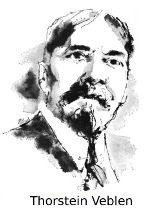 Thorstein Veblen studied the phenomenon of snob appeal when he
introduced the “principle of conspicuous waste” as the
“prescriptive example of the leisure class” to explain the
particular cachet or distinction of this social class.[3]
Thorstein Veblen studied the phenomenon of snob appeal when he
introduced the “principle of conspicuous waste” as the
“prescriptive example of the leisure class” to explain the
particular cachet or distinction of this social class.[3]
E.g., what is expensive is sometimes erroneously identified with what is beautiful:“The marks of expensiveness come to be accepted as beautiful features of the expensive articles. They are pleasing as being marks of honorific costliness …“[4]
Items of what might be not so beautiful items of conspicuous consumption become regarded as beautiful, according to Veblen solely because they are highly regarded by the upper classes.
- The beliefs or the emotions (positive or negative) of an elite
or exclusive group toward a state of affairs can influence what is
thought true. In general, most snob appeal fallacies are founded on
an individual's desire for a higher social status. Most examples have
something like the following structure:
Schema for Snob Appeal:
Elite group G considers statement p true.
or
Elite group G is enthusiastic about p.
[Statement p is irrelevant to group G's expertise.]
Statement p is true.
- Many advertising slogans are tacitly based on this fallacy. Strictly
speaking, one statement considered by itself is not a fallacy because one
statement cannot be an argument. Nevertheless,
the import of advertising “catch-phrases” can be conversationally
implicit arguments in that the slogan can be aptly interpreted from its
context into an implicit argument.[5]
For example, the slogan “Coffee is the Think Drink” was introduced by the International Coffee Association in the 1960s to appeal to teenagers to become a persons of intelligence:“London (AP) The coffee industry says it will try to convince youngsters that coffee is the ‘think drink.’ … ‘We want to capture the youth market.’”[6]
The import of the slogan as a fallacy can be taken as follows:
In the U.S., the FDA required the industry to withdraw the slogan.Smart people and thinkers are coffee drinkers.
[Drinking coffee is not relevant for becoming a smart person.]
Drinking coffee makes you smart.
- In the following example of the fallacy of snob appeal, the opinions of
noteworthy writers and statesmen (and presumably not economists) weigh in on
a tariff issue in the early 1800s:
“Great Britain has been the most prosperous nation in Europe; the Restrictive [Tariff] System, till within a few years has been maintained there, and the people … were told that their prosperity was the consequence of these restrictions; but there has not, for a long period, been a writer of any eminence, nor a statesman whose opinions are worth quoting, who does not consider these restraints upon the occupations of men, as having retarded the advancement of that kingdom in civilization and wealth.”[7]
Although in most circumstances, the notables cited here are correct in their judgment; the judgment is not true on the basis they are notable (unless, of course, their expertise would have been in the field of import-export duties).
- In spite of the irrelevancy of the use of snob appeal in argumentation,
the appeal is used because it can be persuasive in practical decisions.
Consider this argument expressed in the Department of Transportation hearing
on the Federal Aviation Administration approval of the development of the
Concorde, a commercial supersonic aircraft:
“Mr. BROWNE. So if you consider the Concorde as an all first-class airplane, it will not only appeal to the businessman but it will have a distinct snob appeal. Whether we approve of that or not, it is a real economic fact.
Mr. YATES. Do you think the United States ought to spend $4.5 billion to develop snob appeal in an SST?
Mr. BROWNE. Because the ladies' garment trade is largely snob appeal, and you get your money back with a return on investment, and since I believe the $4.5 billion will come home with all sorts of benefits which have been expounded to you many times in the way of return on investment, I say, yes, the same as cosmetics or ladies' garments. … I consider it a sound investment.”[8]
 Five-Star dining on the Concorde included fine wine, caviar, and lobster;
souvenirs included gifted Concorde swag.
Five-Star dining on the Concorde included fine wine, caviar, and lobster;
souvenirs included gifted Concorde swag.
- A word of caution is necessary with respect to the identification
the snob appeal fallacy: When an appeal is made to a knowledgeable
majority of experts in their fields of expertise, for example, style,
fashion, or even politics, the arguments are not considered fallacious
whenever relevant evidence is presented.
- For example, consider the following climate-change argument:
“[It] may take decades for the atmosphere to respond to our actions, most experts agree that decisive action must be taken now. This conclusion is reinforced by the fact that many of the consequences of the atmospheric change may be irreversible and by the recognition that society is often very slow to change.”[9]
Atmospheric experts as a group are relevant sources for arguments about climate change and ozone depletion; so this argument is nonfallacious even though it is based on a consensus of most experts in the field. As this is an inductive argument, the argument is only claimed to be probable, so it would not be considered fallacious even though the conclusion should turn out to be false.
The appeal in this example is not based on snob appeal or bandwagon versions of the ad populum fallacy but is based on expert knowledge. Hence, the climate-change example is not fallacious because the knowledge of experts in the field is relevant to the conclusion reached.
Arguments such as these are described below as a variety of consensus gentiumwhere truth is a result of consensual progress in scientific inquiry via the pragmatic theory of truthclose ×Pragmatic Theory of Truth:
The truth of a statement is determined by its practical consequences.
- In this second example the snob appeal of an in-group of economic
historians is non-fallacious:
[John Dickie] is an industrious outsider wholly reliant on published literature [of] deeply flawed documents … Dickie's contemptuous dismissal of the contention that annexation was economically disastrous for Sicily contradicts the consensus of economic historians who have published on the subject.[10]
The authorities cited as writers who are economic historians of the subject in question are relevant authorities in their field.
- For example, consider the following climate-change argument:
- Bandwagon: the fallacy of attempting to prove a conclusion on the grounds that all, a majority, or many people think, believe, and feel it is true.
- The main issue with the bandwagon fallacy is the mere fact
that many people agree on something often does not imply that what they
agree on is true. That is, the popularity of an idea does not imply its
truth. E.g., This point is often made by noting that the earth
wasn't flat in the the early middle ages because most people thought it
was, but today the earth isn't flat because most people think that it isn't.
The truth or falsity of the earth being a certain shape is not established
by what most people believe.
- Nevertheless, the fact that many people agree, can be relevant
evidence for the truth (or the falsity) of a statement. Whether or not a
fallacy is present is based on the nature of the relevance of the
premises to the conclusion. E.g. consider this example which fits the
schema of an ad populum bandwagon:
”[Edmond] Goblot holds that induction involves determinism, but that the latter cannot be self-evident since many people believe in undetermined free-will.“[11]
This argument is not fallacious since what many people believe is a relevant indication for what is self-evident to them. Additional examples of non-fallacious type ad populum will be discussed below with consensus gentium and ad judicium arguments.
Schema for Bandwagon:
Many or the majority believe statement p is true.
[The truth of statement p is not relevant to what people believe.]
∴ Statement p is true.
In the “negative” variation of this fallacy, what many or most people think is not true, is mistakenly thought to be proof that it is not true.
- Following are some typical examples of the bandwagon
version of the ad populum fallacy. Practice
analyzing these examples in accordance with the schema for the
bandwagon fallacy shown highlighted above.
- “We might perhaps be disposed to assume, on the
ground of theoretical conjecture, that all the animals living
together in the same climate must be affected in the same manner
by the normal variations of its temperature; but such an assumption
would be, as everyone knows, altogether false.”[12]
The fallacy scheme for this example can be translated to be:
(The conclusion is the contradictory of the theoretical conjecture.)Everyone knows not all animals in the same climate are similarly affected by normal temperature variations.
∴ The assumption that some animals in the same climate are not similarly affected by normal temperature variations is true.
- “Everybody thinks everybody else wants to get the better of
them, to take precedence, to impress. There is nothing to do but
quarrel.”[13]
- “I think that the reasonable men of the world have long
since agreed that intemperance is one of the greatest, if not the
very greatest, of all evils among mankind. That is not a matter of
dispute.”[14]
- “Man could alleviate his misery by marriage. This
close companionship enhances the joys of one and mitigated the
sorrow of the other, and anyone knew God always provided for
married people.”[15]
On the one hand, the conclusion in this example is not necessarily true due to the unsoundnessof the argument.close ×Sound Argument:
a valid argument (good structure or form) with all true premises (and so the conclusion is necessarily true also).
The premise that it is generally believed that God always provides for married people is not relevant. (The dubious premise that “God always provides for married people” would be relevant.) On the other hand, the argument could be presented as this non-fallacious inductive argument:
Most persons know marriage alleviates misery.
Close companionship enhances the joys of one and mitigates the sorrows of the other.
∴ Some people can alleviate misery by marriage.
- “Shell [Oil Company] was charged with misleading advertising
in its Platformate advertisements. A Shell spokesman said: “The
same comment could be made about most good advertising of most
products.‘“[16]
“[T]he Federal Trade Commission in the Shell platformate case prohibited the advertisement of platformate because in fact platformate is in all gases [sic: gasolines].”[17]
- Advertising Examples: In context, these Pepsi Cola
slogans through the years functioned as ad populum
appeals to join the crowd.
These catchphrases can function tacitly as enthymematic arguments of popular appeal:“Come Alive, You're in the Pepsi Generation!” (1960's)
“Join the Pepsi People Feelin' Free” (1970s,)
“Join the Pepsi Generation” (1980s)
“Pepsi — The Choice of a New Generation!”(1990s)
“Pepsi. Something for Everyone!“ (2000s)
However, the relevance of the popular appeal of the Pepsi advertisements depend to a large extent on the context of their presentation.All Pepsi drinkers are part of something special.
∴ You are special also by drinking Pepsi.
- The prejudice exhibited by an in-group can function as an
ad populum snob appeal or a bandwagon as in the
following example:
“[A] simple deadlock between National and municipal authorities has been the net result of Japan's protest against the exclusion of her children from the public schools of San Francisco. … Facts, even prejudices at times, must be reckoned with no less than theories, and one truth may as well be understood by our Eastern brethren first as last, namely, that, treaty or no treaty, the American people will never admit to full personal association a race, however worthy, which they regard as inherently so alien that attempt at commingling could only result in disastrous failure, to the infinite disadvantage, not only of those directly concerned, but of all others throughout the world.”[18]
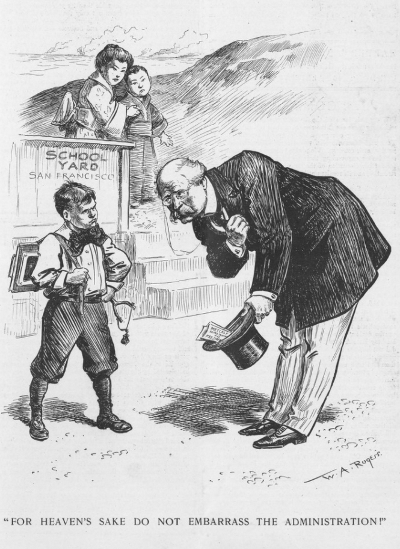
FIG. 1. Cartoon depicts part of Labor Secretary Metcalf's efforts to defuse the 1906 diplomatic crisis caused by the segregation of San Francisco's public schools. Harper's Weekly
The prejudicial beliefs of the local municipal authorities in San Francisco at the time were based on the mistaken notion that individuals in different ethnic and racial divisions ought not to have the same political and social freedom and equality.
- “We might perhaps be disposed to assume, on the
ground of theoretical conjecture, that all the animals living
together in the same climate must be affected in the same manner
by the normal variations of its temperature; but such an assumption
would be, as everyone knows, altogether false.”[12]
- The bandwagon appeal is not fallacious when the premise is relevant
to the conclusion. E.g., this argument was presented in the United States
just before the second World War:
“There is no popular demand for government ownership of the railroads. … We should not have government ownership of the railroads.”[19]
So, the structure of the argument is essentially in accordance with our schema:
Even though the argument accords with the bandwagon schema, it is not fallacious. Since the argument is given in the context of a representative democratic society, what most people think about government ownership is relevant to governmental policies.Most people do not demand government ownership of the railroads.
∴ The government shouldn't own the railroads.
Note also in the example, it is, so to speak, a negative version of the argumentum ad populum in that it is based on what most people do not believe rather than what most people believe.
- The main issue with the bandwagon fallacy is the mere fact
that many people agree on something often does not imply that what they
agree on is true. That is, the popularity of an idea does not imply its
truth. E.g., This point is often made by noting that the earth
wasn't flat in the the early middle ages because most people thought it
was, but today the earth isn't flat because most people think that it isn't.
The truth or falsity of the earth being a certain shape is not established
by what most people believe.
- The Argumentum ad Captandum (Vulgus) (captivation of the masses): an emotive argument devised to appeal to the popular favor of an unthinking crowd, often used in advertising and political speech.
The ad captandum is one kind of improper ad populum. (Usually the final “vulgus is not appended to the phrase, but either way, the phrases are used to denote the same type of fallacy.)
An essential aspect of the ad captandum fallacy is an “appeal to emotion”: the fallacy of using expressive and emotively laden language to arouse emotion in support of a conclusion. The inspiration created by enthusiasm, pride, flattery, amusement, dreams, or even “plain folks” appeal are used as evidence to support a conclusion.
- Sometimes the ad captandum is a deceptive argument devised
to be acceptable to credulous, simple individuals. The superficial argument
captures their fancy and seems to be plain, common sense.
- The emotively significant language used in this fallacy is not dependent
upon its literal meanings or references, but as Charles L. Stevenson remarks,
the emotive terms tend to produce a psychological reaction in addition to
their descriptive meaning.[20]
Their emotional overtones as a favorable or unfavorable subjective view are
not essential to, and tend to be independent of, their denotations.
-
For example, the slanted terms in the following argument about the current
political division in the U.S. are chosen by the author to produce a
psychological response beyond the literal meanings of the terms used:
“The United States is beginning to break apart. Since the [2016 presidential] election, tens of thousands of Americans are talking secession. The number of states where disillusioned and disgusted citizens are signing secession petition is 20 and growing. We are witnessing the start of a multi-dimensional revolt by red and true Americana against the untrue blue. This is a revolt by taxpayers against tax consumers. It is a revolt by God's people against moral degeneracy and cultural filth. It is a revolt by hard work against pilfering laziness and tyrannical envy. … God willing, may that remnant that is real America gain freedom and begin thereby an American renaissance.”[21]
Note the slanting of the following terms: disgusted, true [Americana], untrue [Americana], God's people, degeneracy, filth, pilfering, and tyrannical. The emotive significance of these words is independent of their literal significance. The argument is an ad captandum appeal based on the opinion of “tens of thousands of Americans.”
- The following argument uses emotively significant language differently.
The emotive terms there are dependent on their literal significance —
so the argument is not an ad captandum argument:
“Arthur Lyons gave his book a title that is frighteningly accurate: The Second Coming: Satanism in America. This theme, which intellectuals would have derided a generation ago is now being dealt with seriously … Some polls indicate that 70 percent of Americans believe in a personal devil. Some years ago Walter Cronkite announced a poll over his CBS network news showing that the number of American who believe in a personal devil has increased 12 percent.”[22]
The emotive meanings of the terms “satanism” and “devil” are tied to the literal meanings. Even so, the passage provides evidence for what most people believe as a reason for what must exist. Since the existence of something is not dependent upon what many Americans believe, the bandwagon fallacy occurs.
- The emotively significant language used in this fallacy is not dependent
upon its literal meanings or references, but as Charles L. Stevenson remarks,
the emotive terms tend to produce a psychological reaction in addition to
their descriptive meaning.[20]
Their emotional overtones as a favorable or unfavorable subjective view are
not essential to, and tend to be independent of, their denotations.
- A typical example of ad captandum occurs in an argument,
voiced by a captivating speaker, intended to win the applause of ordinary
people. Consider the following example excerpted from a fictional argument
illustrating one of the first English uses (1762) of the fallacy in a promotion
for an “Elixir of Long Life”:
“Very likely, you may undervalue me and my medicine, because I don't … make you laugh by making wry faces; but I scorn to use these dirty arts for engaging your attention. These paltry tricks, argumentum ad captandum vulgus, can have on effect but on ideots [sic]; and if you are ideots, I don't desire you should be my customers.”[23]
The ad captandum connotes showy claptrap in usage and often consists of a hypocritical appeal to a crowd of simple people. and this dishonesty is in stark contrast to the guileful fallacies present in classical eristicargumentation.close ×Eristic:
The art of controversy, often involving fallacious but persuasive reasoning. [Alexander P.D. Mourelatos, The Cambridge Dictionary of Philosophy ed. Rogert Audi (Cambridge Univ. Press, 1995), 240.]
- However, in most uses in argumentation, the charge of ad
captandum is leveled against an opponent as an accusation of superficial
thinking as in the following attempted defense of the legitimacy of
phrenology:
close ×
Phrenology:
The study of the contour of the human skull claiming to reveal the character and abilities of people.“ [Dr. Thomas Sewell's] first count, in the impeachment of phrenology, is that it is not sustained by the structure and organization of the brain. This allegation must be advanced merely ad captandum, and to influence the general reader and the tyro in physiology. Where, we would ask the lecturer, is our belief of the function of any part of the nervous system, or of any of the external senses sustained or confirmed by structure and organization[?]”[24]
Likewise, the accusation of the ad captandum fallacy is used in this 1832 Antebellum South Carolina pamphlet urging the dissolution of the United States:“In the composition of these pamphlets, talents of the first order are employed. However fallacious, they are to the last degree plausible, and admirably calculated ad captandum.”[25]
In general, the sincere use of a ad captandum argument, or an ad captandum means of persuasion, is naive, seemingly common sensical and designed to incline someone to agree to accept another person's opinion. Charles Dickens uses this sense of ad captandum as part of the following conversation in The Pickwick Papers:
In inducements such as these, the means of persuasion is best not evaluated in terms of informal logic.“‘The fact of the matter is,’ said the benevolent gentleman, ‘that my friend here … will give you half a guinea, if you will answer one or two’ —
“… but you must see the impropriety of your interfering with my conduct in this case, with such an ad captandum argument, as the offer of half a guinea.”
[26]
- Sometimes the ad captandum is a deceptive argument devised
to be acceptable to credulous, simple individuals. The superficial argument
captures their fancy and seems to be plain, common sense.
- Consensus Gentium (the general consent of mankind): “the notion that some things which all men will be found to agree upon as right, real, just, or attractive, and that these things are, therefore, in fact right, real, just or attractive.”[27]
- Some interpretations describe consensus gentium as
cultural universal beliefs resulting from biological, evolutionary, or
anthropological development of human beings. For example, the Stoics thought
of consensus gentium as produced in the minds of human
beings the world over as natural, primary, or intuited concepts which makeup
universal beliefs.
- As a criterion or test of truth the consensus gentium
from the time of Hellenistic and Roman philosophy was considered to be
inferred truths or principles considered common to mankind deriving from
universal beliefs in a moral order. Seneca writes:
And elsewhere Seneca states:““People are wont to concede much to the things which all men take for granted; in our eyes that fact that all men agree upon something is a proof of its truth. For instance, we infer that the gods exist, for this reason among others — that there is implanted in everyone an idea concerning deity …” [Seneca Ep. 17.6 (trans. Penn)]
As well, with many other classical writers, Cicero argued:“The seeds of all ages and sciences are hidden in us from our birth, and that great Workman God produceth out of the hidden all natural instincts.” [Seneca, De Beneficiis IV.6. (trans. Thomas Lodge)]
“[S]ince it is the constant and universal opinion of mankind, independent of education, custom, or law, that there are Gods, it must necessarily follow that his knowledge is implanted in our minds, or, rather, innate in us.” [Cicero, N.D. I: 17 (trans. C.C. Yonge).]
Yet Cicero was well aware of some of the classical objections to this view as he re-iterates the views (probably from the skeptic Carneades, a head of Plato's Academy) in On the Nature of the Gods:
In general, consensus gentium is not based on the ideals of an individual so much as it is based on the ideals of a group — within a society, consensus gentium can function as a means to establish truth pragmatically.(1) the response that “there are many people so savage that they have no thoughts of a Diety [Cicero,N.D. I.23];
(2) “belief of the existence of Gods … [should not] be left to the decisions of fools” (i.e., some persons beliefs are mistaken) [Cicero, N.D. III.4]; and
(3) “the whole subsists by the power of nature, independently of the Gods.” [Cicero, N.D. III.11).]
- Currently, this criterion of truth is often viewed as a cultural
belief of reflective of those ages, even though some form of the
criterion continues to be espoused. In the Gifford Lectures, Bruce A.
Balmain states:
“This message, handed on from antiquity … ‘Believe this and thou shalt live.’ The consensus gentium firmly supports this cardinal article in the religious creed of mankind.”[28]
As a religious creed, however, reference to consensus gentium can be used to impose authoritarian belief.
- An even pyschologist C.G. Jung argues that Anselm's ontological
argument for God's existence “had really nothing to do with
logic” but it “bequeathed … a supplementary
intellectualized or rationalized psychological fact”
of God's existence proved “universally existing” by
consensus gentium [emphasis original]:
”For the real issue [in the proof for God's existence] is a psychological fact whose occurrence and effectiveness are so overwhelmingly clear that no sort of argumentation is needed. The consensus gentium proves that, in the statement ‘God is because he is thought’ … ”[29]
Aldous Huxley reflects a more moderate commonly-held view on consensus gentium:“Nor is the old Stoic appeal to the consensus gentium by any means entirely negligible. That so many philosophers and mystics, belonging to so many different cultures, should have been convinced, by inference or by direct intuition, that the world possesses meaning and value is a fact sufficiently striking to make it worth while at least to investigate the belief in question.[30]
In some of the weaker versions of consensus gentium the notion is understood as a public, philosophical, or scientific consensus. However, the central difficulty with all notions of consensus gentium is the question of what precisely it is that everyone is claimed to agree upon.
- As a criterion or test of truth the consensus gentium
from the time of Hellenistic and Roman philosophy was considered to be
inferred truths or principles considered common to mankind deriving from
universal beliefs in a moral order. Seneca writes:
- So consensus gentium arguments can fall prey to the same
kind of fallacy as other ad populum arguments. Hegel points
out, with regard to the consensus gentium, not only does belief
in God, for example, turn out to be a “perfectly vague idea,” but
also a “proof of this kind does not amount to being an individual inner
conviction.”[31]
- J.S. Mill also explains the inadequacies of universal consent:
“[T]he argument from other people's opinions has little weight. It is but secondhand evidence; and merely admonishes us to look out for and weigh the reason on which this conviction of mankind or of wise men was founded. … [I]t is needless here to dwell upon the difficulty of the hypothesis of a natural belief not common to all human beings, [as] an instinct not universal.[32]
This does not preclude, however, a consensual statement correctly serving as a premise when evidential support is lacking.
- Frederich Nietzsche ironically remarks:
“The consensus gentium and especially hominum can probably amount only to an absurdity. Against it there is no consensus omnium sapientium on any point … the consensus sapientium is to the effect that the consensus gentium amounts to an absurdity.”[33]
In sum, Nietzsche asserts all wise persons disagree over any conclusion claimed true in an absolute sense. And, of course, this fallibilism is an essential part of the contemporary scientific attitude as well.
- Aristotle states the purpose of his Topics is to show how
popular beliefs, although fallible, are probable, and their reliability can
be used as starting points in reasoning:
“The purpose of this treatise is to discover a method by which we shall be able to syllogize about every proposed problem from probabilities … Probabilities … appear to all, or to most men, or to the wise, and to these either to all or to the greater number, or to such as are especially renowned and illustrious.” [Aristotle, Topics I.1.]
So often the starting point in dialectical reasoning can only be common opinion, for, as he states all “mankind have a tolerable natural tendency toward that which is true; and, in general, hit the truth; wherefore an aptness in conjecturing probabilities belongs to him who has a similar aptness in regard to truth.“ [Aristotle, Rh. I.1.11.]
- Nevertheless, Charles Peirce warns against the comfort of the fixation
of popular belief, the so-called “method of tenacity,” which can
shut us off from truth. The incursion of doubt arising the irritation of
disagreement is the moment when this conception of truth begins to lose its
hold, and a different method is sought whereby all persons can reach the
same conclusion independently of their previous opinions.[34]
- J.S. Mill also explains the inadequacies of universal consent:
- Three typical fallacy examples involving consensus gentium
follow.
- The first is T.W. Douban's summary of Cicero's argument for immorality
of the soul:
“[C]onsensus gentium — the universal practice of wailing for the dead serves to shew that the dead are believed to be conscious of their loss.”[35]
The fact that everyone wails for the dead, even if it were true universally, is irrelevant to the conclusion that the dead can be conscious of anything.
- The second example, exhibits the typical invocation of a similar fallacy
at the end of one of the 19th century in the Clifford Lectures:
“This message, handed on from antiquity … ‘Believe this and thou shalt live.’ The consensus gentium firmly supports this cardinal article in the religious creed of mankind.”[36]
Here again, even if everyone were to believe the religious creed, fact does not provide evidence for the creed, itself. The truth of the belief could only be established on other grounds.
- In this last example, the principle of consensus
gentium is put forward without invoking the name of the
criterion:
“So much, Mr. President, by way of general remark. I say fearlessly to this Convention that any effort on the part of this Convention to write an iron law in this Constitution that shall go more than one step, will be the height of folly and infatuation. All that we can do is to come down to principle. That which we rest on solid principle, which the experience of mankind confesses to be principle, we may rely upon. The moment we step beyond that, to expediency, we step in the dark; and what the ruin may be that is to follow that step no human sagacity can predict.”[37]
As Nietzsche pointed out above. universal consent of mankind, in this case for constitutional law, is lacking.
- The first is T.W. Douban's summary of Cicero's argument for immorality
of the soul:
- Some interpretations describe consensus gentium as
cultural universal beliefs resulting from biological, evolutionary, or
anthropological development of human beings. For example, the Stoics thought
of consensus gentium as produced in the minds of human
beings the world over as natural, primary, or intuited concepts which makeup
universal beliefs.
- Argumentum ad Judicium (nonfallacious): Arguments from probability or knowledge — the reasoning is based on the nature of things. [38]
- Isaac Watts defines the argumentum ad
judicium as an “argument taken from the Nature or Existence
of Things, and address'd to the Reason of Mankind.[39]
Richard Whately regards the argument as nonfallacious and distinguishes it from other or the Lockean “ad” arguments (such as ad populum which, he notes, can be used fallaciously in some instances).[40]
- Even when there are no hypothetical facts on which to base an argument,
some appeals to general or universal consent based upon epistemological
judgments are considered non-fallacious argumentum ad judicium.
These arguments are distinguished from ad populum since
the latter arguments are based on the passions, prejudices, or opinions of
the many rather than upon intellectual or unbiased common-sense
judgment.[41]
- Consider the following examples of ad judicium:
- The first is G.E. Moore's proof of the external world:
Moore, then, concludes, without adducing reasons beyond the proof itself, that all persons would take his argument as conclusive.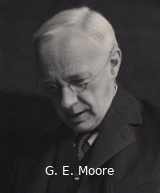 “I can prove now, for instance, that two human hands exist.
How? By holding up my two hands, and saying, as I make a certain
gesture with the right hand, ‘Here is one hand’ and
adding, as I make a certain gesture with the left, ‘ and here
is another’. … I do want to emphasize that, so far as
I can see, we all of us do constantly take proofs of this sort as
absolutely conclusive proofs of certain conclusions — as
finally settling certain questions, as to which we were previously
in doubt.”[42]
“I can prove now, for instance, that two human hands exist.
How? By holding up my two hands, and saying, as I make a certain
gesture with the right hand, ‘Here is one hand’ and
adding, as I make a certain gesture with the left, ‘ and here
is another’. … I do want to emphasize that, so far as
I can see, we all of us do constantly take proofs of this sort as
absolutely conclusive proofs of certain conclusions — as
finally settling certain questions, as to which we were previously
in doubt.”[42]
- The second is an example many current texts might consider fallacious:
“Everybody thinks that the drama should be morally sound — that the prevailing sentiment of every play should be sweet and wholesome and bracing. It is certain that this kind of diversion will continue to be resorted to for a long time to come.”[43]
This example is weakly inductive since the opinions of playgoers have an effect on the types of plays which are successful.
- The first is G.E. Moore's proof of the external world:
- The argumentum ad judicium is discussed here in its
traditional Lockean sense in order to
distinguish it from the argumentum ad populum: the
ad judicium appeals to the reason of persons, whereas
the ad populum appeals to the beliefs of persons.
- Unfortunately on the Web the ad judicium is widely
defined as a fallacy as many sites describe the argument as an “an
appeal to common sense”
- Here's the description from John Locke:
“Argumentum ad Judicium[:] This alone of all the four [sorts of arguments] brings true Instruction with it, and advances us in our way to Knowledge.”[44]
The other “sorts of arguments” to which Locke contrasts the ad judicium are the ad verecundiam (argument from authority), ad ignorantiam (argument from ignorance) and ad hominem (argument against the person).
- Unfortunately on the Web the ad judicium is widely
defined as a fallacy as many sites describe the argument as an “an
appeal to common sense”
- Isaac Watts defines the argumentum ad
judicium as an “argument taken from the Nature or Existence
of Things, and address'd to the Reason of Mankind.[39]
- Argumentum ad Passiones: an appeal to strong feelings, emotions, or enthusiasm rather than judgment in order to establish a conclusion. So instead of providing reasons or evidence for the truth of a conclusion, strong emotion is invoked to impart belief in a conclusion.
- In 1726 Isaac Watts added argumentum ad
passiones[45] to John
Locke's list of informal “ad” fallacies.
- Watts describes the fallacy in dialectical fashion as follows:
“[W]hen an Argument is borrowed from any Topics which are suited to engage the Inclinations and Passions of the Hearer on the Side of the Speaker, rather than to convince the Judgment, this is Argumentum ad Passiones, an Address to the Passions, or if it be made publickly, 'tis called an Appeal to the People.”[46]
The emotively significant language used in this fallacy is not dependent upon its literal meanings or references, but as Charles L. Stevenson remarks, emotive terms tend to produce a psychological reaction in addition to their descriptive meaning.[47] Their emotional overtones as a favorable or unfavorable subjective view are not essential to, and tend to be independent of, their denotations.
- James R. Boyd's definition of the fallacy, over a century later
in 1860, remains a paraphrase of Watt's definition:
“Argumentum ad passiones (an address to the passions), is such an address as at once rouses passions ready to be inflamed, when the speaker chooses this means to gain his end, instead of an appeal to judgment, or the argumentum ad judicium.”[48]
The ad judicium discussed above Locke defines as founded on “knowledge and probability.
- Additionaly, the argumentum ad passiones can be
said to occur as a mode of composition when strongly urging a point of
view by dividing premises into three distinct phrases, each phrase
reinforcing the same idea, and ending with a conclusion. Examples:
“He's a traitor to his country, he is a traitor to the human kind, he is a traitor to heaven, who abused the talents God has given him.”
This mode of composition is especially effective in oral discourse.
“This alliance I would unmercifully reprobate. It unnerves the parties; it debilitates the structure; let them be divorced.“[48a]
- Watts describes the fallacy in dialectical fashion as follows:
- The following illustrative examples give insight into this fallacy:
- John Adamson describes a typical example of the emotive
ad populum, the ad passiones:
“[S]uppose a body of workmen strike for higher wages. Their leaders, instead of setting forth reasons why they should accept or refuse a certain rate of pay, will sometimes confuse the real issue by arousing the passions of their hearers.”[49]
The use of “loaded” language or “slanted” language where the emotive significance is “super-added” to the literal significance is illustrated by Samuel Taylor Coleridge's summary account of patronage of fine arts by older women:
While the literal significance is roughly the same in each description, the emotive significance moves sequentially from positive to negative import.“There are three classes into which all the women past seventy that ever I knew were to be divided: —
1. That dear old soul;
2. That old woman;
3. That old witch.”[50]
- John Adamson describes a typical example of the emotive
ad populum, the ad passiones:
- In our course, the version of the traditional purely emotive
ad passiones (ad populum) is taken to be
a diversion rather than a logical fallacy. Occasionally this
informal fallacy is termed “playing to the gallery.”
Lachlan McClean provides the following example:
“Let us march against Phillip, let us fight for our liberties, let us conquer or die.”[50a]
The three initial phrases with the same words provides graceful expression.
- In the pragma-dialectical theory of argumentation the emotional appeals
of argumenta ad passiones are labeled the “pathetic
fallacy” since they violate a discussion rule of relevance in that
system: The appeal is irrelevant to the topic at issue.[51]
- So this kind of “fallacy” in the pragma-dialectical theory
of Frans H. van Eemeren is non-argumentative:
“All derailments of strategic maneuvering are fallacies in the sense that they violate one or more of the rules for critical discussion and all fallacies can be viewed as derailments of strategic maneuvering.”[52]
The pragma-dialectical approach views the ad passiones version of the ad populum as a violation of a relevance rule and the appeal to popularity as an inappropriate argument scheme: in point of fact, “two different fallacies.”[53]
- In Aristotelian rhetoric the persuasive method of pathos
is said to supplant the method of logos — i.e.,
the appeal to emotion is used instead of proper reasoning. Aristotle writes:
“[There is persuasion] through the hearers when they are led to feel emotion [pathos] by the speech; for we do not give the same judgment when grieved and rejoicing or when being friendly and hostile.… Persuasion occurs through the arguments [logoi] when we show the truth or the apparent truth from whatever is persuasive in each case.[54]
Aristotle proposes rhetoric be defined as an ability to see all means of how to persuade in any subject [Rh. I.2.1 trans. Buckley] and a rhetorician as one who can see in given circumstances all the ways how to persuade [Topics VI.12.149b26 trans. Owen]. Just as a deductive argument can be valid or sophistically apparently valid so likewise so likewise a rhetorical argument can be persuasive or sophistically apparently persuasive.[Rh. I.1.14]
Most logicians regard informal logic separate from the disciplines of formal logic and rhetoric.
-
When taking this position, they are following Richard Whately's
dismissal of the then established emotive version of the ad
populum first and rhetorically characterized in The Port-Royal
Logic (1662).[55]
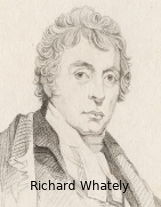 Whately defines the argumentum ad populum “as an
appeal to the prejudices, passions, etc. of the multitude” and
describes this kind of argument as one of “certain kinds of argument
recounted and named by Logical writers, which we should by no means
universally call Fallacies.”
Whately defines the argumentum ad populum “as an
appeal to the prejudices, passions, etc. of the multitude” and
describes this kind of argument as one of “certain kinds of argument
recounted and named by Logical writers, which we should by no means
universally call Fallacies.”
Instead, he sees these types of appeals as a “deceit, or attempt to deceive”, and seems to concede “in so far as they are fallacious”; they are “unfairly used.” [emphasis original][56]
- So this kind of “fallacy” in the pragma-dialectical theory
of Frans H. van Eemeren is non-argumentative:
- The Resolution of Emotional Arguments: Informal logic does not
resolve emotional arguments per se.
- Generally speaking, many logical emotive arguments can be evaluated
after translating to emotively neutral language.
However, Linda Carozza points out:
“While it would be admittedly easier to separate emotion from reasoned arguments, it simply will not work for long-term, sustainable resolutions … in fact, separating emotion from the dialogue may impede agreement on a settlement at all in this context.[57]
Emotional disagreements often stem from different presuppositions of the parties involved — often unknown to each party and stemming from past experiences and resultant unwitting bias.
 For example, in her biography, former First Lady Michelle Obama
characterizes her emotional exchanges with her husband as follows:
For example, in her biography, former First Lady Michelle Obama
characterizes her emotional exchanges with her husband as follows:
“[F]or better or worse, I tend to yell when I'm angry. When something sets me off, the feeling can be intensely physical, a kind of fireball running up my spine and exploding with such force that I sometimes later don't remember what I said in the moment. Barack, meanwhile, tends to remain cool and rational, his words coming in an eloquent (and therefore irritating) cascade.” [emphasis added][58]
Rationality in disagreements is sometimes successful in revealing those hidden presuppositions; nevertheless, the resolution of emotional disagreements involves techniques of persuasion, rhetoric, empathy, and psychological insight not possible through the discipline of logical alone.
- Generally speaking, many logical emotive arguments can be evaluated
after translating to emotively neutral language.
However, Linda Carozza points out:
- In 1726 Isaac Watts added argumentum ad
passiones[45] to John
Locke's list of informal “ad” fallacies.
- The Ad Populum as an Inductive
Argument: As we have seen, not all argumentum ad populum
arguments are fallacious arguments. The ad populum appeal can
be a correct inductive argument when what
most persons or an exclusive group or persons believe is relevant and provides
acceptable evidence for what is true.
- For example, conventional truths such as the proper definition of words
or the standard use of symbols are functionally established through the
majority as, are other typical examples such as clothing styles, jury verdicts,
Hollywood Oscars, public opinions, or political elections. Also, of course,
appeals to experts or qualified authorities in their fields of expertise are
relevant appeals and so are not necessarily fallacious appeals.
- For germane arguments to be effective in dialectical disputes, agreement
on premises is essential. Sometimes this agreement can be reached via
consensus gentiam, ad judicium, or by
consensus of the disputants prior to the dispute or the debate.
- Some logic textbooks define the ad populum fallacy as any
argumentative emotional appeal purporting to establish a conclusion. However,
the presence of emotion alone in expressions rhetorical passages, patriotic
speeches, diatribes, or even cheerful accolades do not, in themselves.
constitute a fallacy as defined in this course.
- For germane arguments to be effective in dialectical disputes, agreement
on premises is essential. Sometimes this agreement can be reached via
consensus gentiam, ad judicium, or by
consensus of the disputants prior to the dispute or the debate.
- It's important to emphasize that no logical fallacy occurs
in ad populum passages unless the
literal significance of the
emotionally expressed evidence is irrelevant to the stated conclusion.
Consider the two following examples:
- E.g., the following argument from the British medical journal
The Lancet uses
emotive significance as part
of the establishment of a relevant conclusion from general belief and so
is nonfallacious:
“Everyone confesses with great readiness and warmth that the first step towards the prevention of disease is the recognition of its predisposing and exciting causes: the record of its favourite localities, earliest attacks, of its first, and its most ready, victims. The comparison of these simple and easily observed incidents in the rise and progress of zymotic disease, affords the most valuable data for preventive maxims.”[59]
The example illustrates the distinction between common knowledge and common belief.
Again, the presence of emotively laden language alone in an argument does not constitute a fallacy unless the informational content presented in the premises are irrelevant or illogical.
- The following ad populum example from a speech by
former President Barack Obama demonstrates specific appeals to emotion
but is not considered fallacious under our definition of fallacy (i.e., a mistake in
reasoning as a rule violation of a logical system):
“We believe in a generous America, in a compassionate America, in a tolerant America, open to the dreams of an immigrant's daughter who studies in our schools and pledges to our flag. To the young boy on the south side of Chicago who sees a life beyond the nearest street corner. To the furniture worker's child in North Carolina who wants to become a doctor or a scientist, an engineer or an entrepreneur, a diplomat or even a president — that's the future we hope for. That's the vision we share. That's where we need to go — forward. That's where we need to go.”[60]
These beliefs and hopes do not constitute an argument and consequently no fallacy is present in this passage.
- E.g., the following argument from the British medical journal
The Lancet uses
emotive significance as part
of the establishment of a relevant conclusion from general belief and so
is nonfallacious:
- Charles Hamlin states, in his influential book on fallacies, the
argumentum ad populum “is an appeal to popular favour,
which to preserve uniformity, must be purely emotional” [emphasis
mine].[61]
- Virtually all current logic textbooks consider emotive versions of
argumentum ad populum to be fallacies in the sense that
fallacies involve deceptive, distracting, or inappropriate reasoning.
These psychological terms are neither well-defined nor are they notably
helpful as logical distinctions.
- From a descriptive point of view, couching arguments in emotive
language is intended to boost its persuasive effectiveness. But as
Raphaël Micheli writes, “In the ‘standard’
conception [of the emotion–argumentation relationship], emotions are
seen as the objects of appeals and these appeals are thought to
function as external adjuvants to argumentation.”[62] Their addition helps
distinguish formal logic from informal logic or argumentation.
- Virtually all current logic textbooks consider emotive versions of
argumentum ad populum to be fallacies in the sense that
fallacies involve deceptive, distracting, or inappropriate reasoning.
These psychological terms are neither well-defined nor are they notably
helpful as logical distinctions.
- Douglas Walton takes a pragma-dialectical approach to ad
populum arguments. Although he defines a fallacy as “incorrect
argumentation,” he denies that the usual reasons given for the
fallaciousness of these arguments are sufficient. Walton defines a fallacy
as:
“… a technique of argumentation that has been used wrongly (abused) in such a way that it goes strongly against the legitimate goals of a dialogue.”[63]
The weakness of this definition of “fallacy” is the same sort of weakness in the traditional definition of fallacy as a “deceptive argument”: viz. the definition does not clearly distinguish the point at which a particular argument is strongly against and not so strongly against a goal that is “legitimate” to both parties. In practice, the question of the relevance of the appeal to the question at issue should be a sufficient basis for the determination of the presence of the fallacy in both monotonic and dialectical reasoning.
- “The Wisdom of Crowds”: Additional examples where
ad populum appeals would not necessarily be fallacious
include various approaches such as crowdsourcing, prediction markets,
prediction polls, and betting markets.
- On the one hand, obviously when credible evidence exists against
a popular belief, the belief cannot be entirely trusted. For example,
the issue of the safety of kidney transplants in the early research
into chronic renal failure underlined to the issue of the degree of
patient sensitization (i.e., higher antibody levels in the blood
of the recipient):
“It has been estimated that sensitization even in the presence of a cross-match negative transplant is associated with a higher failure rate. This is a somewhat controversial issue since many people believe that if a true cross-match negative transplant is performed such a transplant has equal chance as in a nonsensitized individual. This matter remains unsettled although the evidence suggests that prior sensitization is associated with a higher failure rate. [emphasis added]”[64]
In such cases, it's normally best to trust the evidence, unless, of course, the “most people” cited are experts in the field having good reasons the evidence is inaccurate.
- On the other hand, in uncertain circumstances the beliefs of others can
be the only evidence to consider if no contrary evidence is available.
Such a circumstance is illustrated by the following example of a neurologist
weighing in on the question of the efficacy of therapy for spastic paraplegias
by application of electric current to the spinal chord:
“I very much doubt whether a weak constant current applied to the spine can do any good; but it can do no harm, and since many people believe that the catalytic action of the constant current has a beneficial effect upon the sclerotic process, I see no objection to trying it, provided that it is cautiously and judiciously used.”[65]
Of course, in decisions such as this one, presumably there is evidence to support what most people believe in the first case.
- Prediction Markets or Betting Markets: Evidence
accumulated over the past thirty years based on what many people believe
or expect by means of electronic forecasting can provide accurate
prediction of unknown specific future outcomes such as market-price
movement, election results, sports contests, sales forecasts, interest
rates, or military geopolitical threats. Many prediction markets are
gambling forums which compensate participants based on outcomes of
future event.
- James Surowiecki, who coined the term, “the wisdom of
crowds,” points out necessary conditions for effective prediction:
(1) many diverse people participate, (2) the people are decentralized,
(3) the people act independently, and (4) the people have access to
diverse information.[66]
- In effect, though, it is not so much the wisdom of the crowd
which is studied as it is the wisdom of the distributed aggregation of
individual beliefs which tend to have surprising emergent
properties.
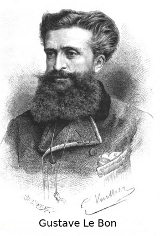 That is, useful information is not obtained from the
characteristics of the crowd so notably described by Gustave Le Bon:
That is, useful information is not obtained from the
characteristics of the crowd so notably described by Gustave Le Bon:
“In crowds it is stupidity and not mother-wit that is accumulated. … The individualities in the crowd who might possess a personality sufficiently strong to resist the suggestion are too few in number to struggle against the current. … The disappearance of the conscious personality, the predominance of the unconscious personality the turning by means of suggestion and contagion of feeling and ideas in an identical direction, the tendency to immediately transform the suggested ideas into acts; these we see, are the principal characteristic of the individual forming part of a crowd.[67]
Le Bon's characterization here illuminates the sociological basis of the ad populum fallacy.
- However, under empirically tested conditions, including conditions
such as those described above by Surowieki, studies have shown when
individual guesses or bets are aggregated and then averaged the group,
while usually not better than one or so single person's guess, the
statistical result proves to be the reliable over time.[68]
- James Surowiecki, who coined the term, “the wisdom of
crowds,” points out necessary conditions for effective prediction:
(1) many diverse people participate, (2) the people are decentralized,
(3) the people act independently, and (4) the people have access to
diverse information.[66]
- Crowdsourcing: Reliable information can also be achieved by
means of some optimized formats of crowdsourcing which are designed to be
superior to simply querying groups of experts or public groups in
general.[69] A public call,
usually on the Internet, is made by an initiator for voluntary information,
problem solving, capital, or work freely provided by the public for a
specific project.
- Specific crowdsourcing methods can utilize platforms which lead to
the emergence of excellent results depending upon how well thought out
the sourcing formats and modes of communication among the organization
and its participants.
- Crowdsourcing is a developing field of inquiry and appears to have
much future research potential. Even so, simply aggregating beliefs
without concern for evidence-based mechanisms of data collection and
analysis is usually ineffectual.
- Specific crowdsourcing methods can utilize platforms which lead to
the emergence of excellent results depending upon how well thought out
the sourcing formats and modes of communication among the organization
and its participants.
- On the one hand, obviously when credible evidence exists against
a popular belief, the belief cannot be entirely trusted. For example,
the issue of the safety of kidney transplants in the early research
into chronic renal failure underlined to the issue of the degree of
patient sensitization (i.e., higher antibody levels in the blood
of the recipient):
- The number of persons who believe a claim can be supporting evidence for
the truth of the conclusion. But ordinarily, without further information about
the case in point, the number of persons believing in a statement or an argument
is not directly related to the truth or the validity of the claim.
- Thus, the truth of a statement is not dependent upon the number of
persons who believe it or the depth of the feelings of individuals
associated with it.
- Even in instances of common knowledge, rather than popular belief, a
statement is not true because everyone knows it's true. As Douglas Watson
et al. point out we can ask the critical questions:
“What evidence like a poll or an appeal to common knowledge, supports the claim that [statement] A is generally accepted as true? … Even if A is generally accepted as true, are there any good reasons for doubting that it is true?[70]
A statement is known to be true because it has been proven to be true by a standard method of method of proof such as science, logic, or mathematics. (In all of these fields, “truth” is fallible and subjective to revision, alternative axioms, redefinition, or retest.)
- E.g., the truth that the general shape of the earth is an
oblate spheriod does not depend upon how many people believe that it
is.
- Thus, the truth of a statement is not dependent upon the number of
persons who believe it or the depth of the feelings of individuals
associated with it.
- For example, conventional truths such as the proper definition of words
or the standard use of symbols are functionally established through the
majority as, are other typical examples such as clothing styles, jury verdicts,
Hollywood Oscars, public opinions, or political elections. Also, of course,
appeals to experts or qualified authorities in their fields of expertise are
relevant appeals and so are not necessarily fallacious appeals.
- Ad Populum Distinguished
from Other Informal Fallacies: Other fallacies which can appear to be
similar to argumenta ad populum include:
- Hasty Generalization: the
fallacy whereby an overgeneralized conclusion is based on
insufficient or complete lack of evidence. Consequently, when the
bandwagon version of ad populum occurs, it often
can be effected as a false generalization as in the following
argument:
“Since the ideal exists, there is presumptive evidence that it could be realized; everyone confesses he has not arrived at completeness. It does not require a Marcus Aurelius to declare that if a man does not reach his proper destination it is because of his principles, not because of insurmountable obstacles; any observer must see that.“ [emphasis added][71]
The presumption that the ideal (i.e., “an image of that which he could be and that he knows he should be”) can be thought does not imply possibility, much less existence. The appeal to the ideal, although uplifting, inspiring, and ennobling to the audience, is the unsupported generalization that everyone's lack of success in reaching one's ideal is caused by everyone's faulty principles.[72]
- Argumentum ad
Baculum (appeal to threat or force): when an appeal
intended to invoke fear is irrelevant to the truth of a point at
issue is pressed upon the public, an ad populum
fallacy can occur along with the ad baculum as
well. This well-known passage from the revivalist theologian
Jonathan Edwards provides such an overlap:
[W]hatever pains a natural man takes in religion, whatever prayers he makes, til he believes in Christ, God is under no manner of obligation to keep him a moment from eternal destruction. So that thus it is that natural men are held in the hand of God over the pit of hell; they have deserved the fiery pit, and are already sentenced to it; and God is dreadfully provoked.”[73]
The sermon urges everyone to convert, not for truth, but from fear.
- Argumentum ad Verecundiam:
Identification of the ad populum fallacy
(either snob appeal or a given reference group's bandwagon effect)
can occasionally overlap with identification of an
ad verecundiam
(appeal to authority) when the irrelevant authorities cited are
an exclusive or elite group.
Such a fallacy is described in this description of the political commitment to a liberal agenda by Hollywood film stars and moguls:“The improbable credence given to many Hollywood figures as political spokesmen is merely a reflection of a more unsettling truth: … credibility derives as much from ‘the impression of sincerity, authenticity, vulnerability, or attractiveness’ as from experience or knowledge. … When they speak genuinely, and from their own experiences, stars can move the public as effectively as any politician …”[74]
When presidential candidate George H.W. Bush attacked the American Civil Liberties Union in 1988, Hollywood liberal …“[Danny] Goldberg approached the task of defending the ACLU … from the same gut level that the Bush campaign aimed its attacks. ‘In thirty seconds you can't make a lot of substantive arguments,’ he said at the time. ‘But you can evoke some emotions.” Which the ads did focusing tightly on the venerable figure of [Bert] Lancaster [and the cast of hit NBC show L.A. Law]”:
The audio was simply:“I'm Burt Lancaster and I have a confession to make; I'm a card carrying member of the ACLU.”[75]
In this TV advertisement, Burt Lancaster was not specifically stating an argument, and the assessment of a fallacy in instances like this one depend upon the credibility of whether or not visual presentations can be properly classified as arguments.[76] If they can be as some informal logicians argue, then, this appeal can be viewed as either an ad verecundiam or an ad populum. Considered as an exclusive, glamorous group, the understanding of political science by many Hollywood political spokespersons lies outside of their realms of expertise.
J. Anthony Blair defines a visual argument:“an argument at least some of the essential elements (reasons or claims) of which are not expressed or communicated in the words of a natural language, but instead are expressed or communicated pictorially, by images and/or non-verbal signs or symbols.“[77]
He believes visual arguments are rhetorical, not logical. Leo Groarke, argues further that visual arguments can be “stated” with non-verbal visual images.[78]
In fact, some logicians view the bandwagon variant of ad populum as a type of ad verecundiam where the authority in question is the number of persons cited.[79]
And, of course, opposing authority or groups of people involves personal risk. Arnauld and Nicole advised caution whenever questioning the authority of the public in this passage from The Port-Royal Logic (1662):“[N]ot only modesty and prudence, but justice itself, obliges us to assume a modest air when we combat common opinions or established authority, otherwise we cannot escape the injustice of opposing the authority of an individual to an authority either public, or greater and more widely established, than our own.”[80]
Arnauld and Nicole recognized the ad populum as a fallacy but advised that the individual “ought never to maintain that his authority should prevail against that of all others.”[81]
- Argumentum ad
Misericordiam (argument from pity or misery): The
ad misericordiam fallacy occurs
when pity, misery, or a related emotion such as sympathy or compassion is
used as an excessive or irrelevant appeal in support of a conclusion.
Historically, the fallacy was considered a part of ad
passiones, and, for example, Roy Wood Sellars classifies ad
misericordiam as a sub-fallacy of ad
populum.[82]
- Argumentum ad Hominem
(argument against the person): the ad hominem
fallacy occurs when the character or circumstances of an individual
is attacked instead of attempting to refute what is claimed. Sometimes
the personal attack is passionate, in which case it is also describable
as the variety of emotive ad populum.
For example, B.H. Smart provides this argumentative example in his book on rhetoric:“ [I]f a public magistrate stands in the way of the speaker's private interest, and the latter is a person of no principle, but of great popularity, he may at once gain his own ends by exciting auditors ready to go along with him against one whom they already hate … The topics of the speaker may be, that the man is corrupt in his magisterial duties, an oppressor of the poor, an instrument of tyranny in the hands of the rich; without one proof of such allegations, which cool, instructed judgement would admit.“[83]
In this descriptive example, the fallacy would be due to the speaker's disregard of the public magistrate's argument instead of a personal denouncement irrelevant to the question at issue. The emotional appeal, considered by itself, can be influential but is not logically fallacious since the attack is not a mistake in reasoning per se. It can only be considered fallacious in the sense of its distraction.
In his book on logic, Smart also states that ad passiones arguments (what we have also termed “emotive ad populum arguments”) cannot be called arguments in the strict sense of the word.[84]
Smart cites his example stated above as an ad passiones, yet, of course, the personal attack ignores the magistrate's claims and is clearly best described as an ad hominem argument. What matters in arguments such as these is the irrelevancy of the emotion to the judgments at issue.
- Ignoratio Elenchi
(irrelevant conclusion): the fallacy of reaching a conclusion different
from the point at issue is often taken to include all fallacies of
relevance. Following Whately, many logicians extend the definition of
ignoratio elenchi to include any irrelevant
argument. E.g., Thomas Fowler includes the ad populum
as one form of ignoratio elenchi:
“[T]he speaker, in support of the truth of his assertions, … throw[s] discredit on an adversary, appeals, not to the unbiased judgment of his auditors, but to their passions, interests, prejudices, sentiments, and associations.[85]
And Fowler especially notes the overlap between ad hominem and ad populum fallacies.
- Ad Verecundiam
(argument from inappropriate authority): the fallacy of appealing to the
testimony of an expert outside of his field of expertise can occasionally
mistaken for the testimony of a popular figure unrelated to the field of
his popularity.
 Consider whether the following example argument is best cited as an
"ad verecundiam or an ad populum fallacy:
Consider whether the following example argument is best cited as an
"ad verecundiam or an ad populum fallacy:
“I think Schumpeter [a journalist for the Economist magazine] was a bit premature in predicting the demise of the hand-held device. One only needs to watch Captain Kirk flip open his communicator in ‘Star Trek’ to realise such devices will obviously remain indispensable, even in the 23rd century.”[86]
The point of the argument is to indicate that the behavior using a hand-held device by the iconic Captain Kirk, a well-known enduring fictional character, cool (at least to Trekkie fans), is likely to be emulated in the future since this character is so trendsetting in the public's imagination. Thus, the argument is of the ad populum variety.
- Hasty Generalization: the
fallacy whereby an overgeneralized conclusion is based on
insufficient or complete lack of evidence. Consequently, when the
bandwagon version of ad populum occurs, it often
can be effected as a false generalization as in the following
argument:
- Vox Populi Vox Dei: (the voice of the
people [is] the voice of God)[87]
— this derisive phrase attests to the disdain of the madness of crowds as
reflected in such phenomena as hysteria of the speculative booms of the South Sea
Joint-Stock Company, the Compagnie du
Mississippi, or Dutch
tulip mania.
The central basis of the ad populum appeal is the assumption that large numbers of persons are more likely to be right than a given individual is likely to be right. Also, in light of peer pressure, many persons feel it's better to be normal than to go against the crowd. Moreover, our social desire to be approved by others often results in our joining the “bandwagon” of the probable winning side in any political contest or public dispute.
The Port-Royal Logic (1662) described this version of the ad populum fallacy as follows:“ We often regard only the number of the witnesses, without at all considering whether the number increases the probability of their having discovered the truth, which is, however, unreasonable … it is more likely that a single person will discover the truth than that many will. Thus the following is not a valid inference: this opinion is held by the majority of philosophers; it is, therefore, the truest.”[88]
Although this inference is not valid (because the argument is not deductive), it does not follow that the conclusion follows without some probability.
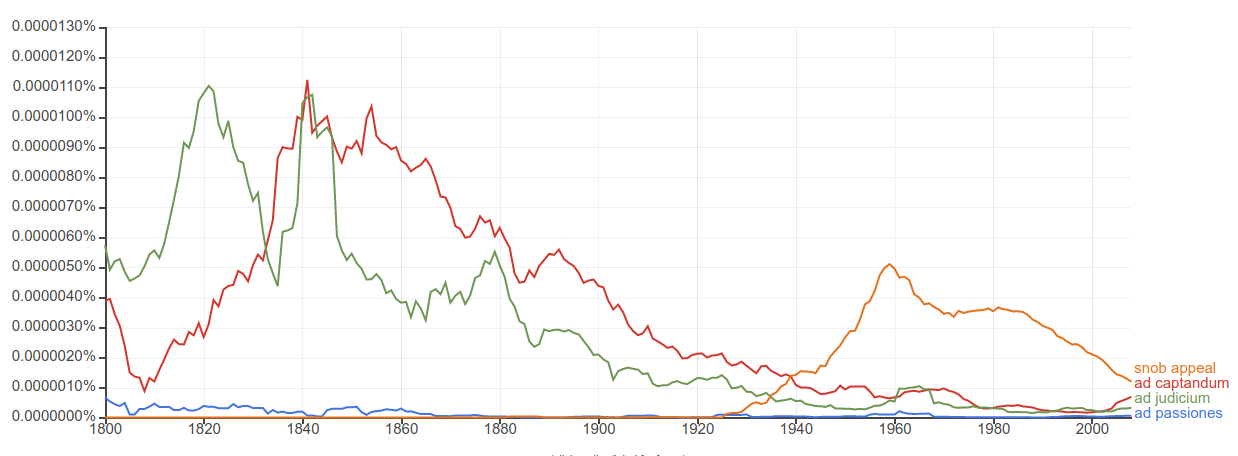
FIG. 2. Historical Frequency of Use of ad populum,” “snob appeal,” ad captandum,” “consensus gentium,” “ad judicium,” and “ad passiones,” in Google Books 1700-2010.
Links to Ad Populum Online Quizzes with Suggested Solutions
Test your understanding of ad populum arguments with one
of the following quizzes:
Ad Populum Examples
Exercise
Fallacies of Relevance I
Fallacies of Relevance II
Fallacies of Relevance III
Henry T. Charlton, Etchings from the Religious World (Charleston, SC: Observer Office Press, 1828), 91-92.
Notes
1. Arthur Schopenhauer sourly generalizes:
“There is no opinion, however absurd, which men will not readily embrace as soon as they can be brought to the conviction that it is generally adopted.”
[Authur Schopenhauer, Art of Controversy and Other Posthumous Papers (London: Swan Sonnenschein & Company, 1896), 37.]
And Seneca warns against depending upon the opinions of others and seeking approval in valuing the path of the crowd's non-returning “one-directional footprints.” [Lucius Annaeus Seneca, “De Otio Sapientis,” in Omnia Opera Quae Vulgo Exstant sub Nomine: Senecae Philosophica Declamatoria et Tragica (N.E. Lemaire, 1827), I:400.]↩
2. Stephen W. Hawking, A Brief History of Time: From the Big Bang to Black Holes (Toronto: Bantam, 1988), 178. The pamphlet cited as a book is Hans Israel, et al. Hundert Autoren Gegen Einstein (Leipzig: R. Voigtländer, 1931).↩
3. Thorstein Veblen, The Theory of the Leisure Class: An Economic Study of Institutions (New York: B.W. Huebsch, 1819), 205.↩
4. Veblen, The Theory of the Leisure Class, 131-132.↩
5. Changing behavior or beliefs by such persuasive techniques such as rhetorical methods and informal fallacy appeals are studied in a number of different fields: social psychology, linguistics, media studies, cognitive science, political science, and computer technology.↩
6. “Industry Promoting Coffee as ‘Think Drink’” The Fredericksburg Virginia Free Lance-Star 82 no. 390 (December 10, 1966), 10.↩
7. Henry Lee, “An Inquiry into the Causes of the Fall of Prices,” in An Exposition of Evidence in Support of the Memorial to Congress (Boston: Boston Press, 1832), 8.↩
8. “Hearings Before the Subcommittee of the Committee on Appropriations,” United States Senate Second Session on H.R. 17755, Department of Transportation and Related Agencies Appropriations for Fiscal Year 1971 (Washington, D.C.: U.S. Government Printing Office, 1970), 34. Chairman of the Civil Aeronautics Board Secor D. Browne favored the adoption, and House Representative Sidney R. Yates opposed approval of the plane.↩
9. Henry Hengeveld, “Understanding Atmospheric Change: A Survey of the Background Science and Implications of Climate Change and Ozone Depletion” State of the Environment Report Issue 91 Part 2 (Darby, PA: Diane, 1991), 58.↩
10. Edward Luttwak, “ Honoured Society,” in “Letters,” London Review of Books 35 no. 21 (Novenber 7, 2013), 4.↩
11. G. Mouret, “A Review of ‘Le Traité de Logique de Edmond Goblot,’ from Revue de Métaphysique et de Morale (Mai-Juin, 1919),” Mind: A Quarterly Review of Psychology and Philosophy series 2, 29 no. 113 (January, 1920), 120.↩
12. Karl Semper, Animal Life as Affected by the Natural Conditions of Existence (New York: Appleton, 1881), 103.↩
13. Lucas Malet (pseud.), A Counsel of Perfection (New York: D. Ap[pleton, 1888), 68.↩
14. Abraham Lincoln, Complete Works of Abraham Lincoln eds. John G. Nicolay and John Hay ((1894 New York: Francis D. Tandy, 1905), IX:68.↩
15. Lee Emily Pearson, Elizabethans at Home, (London: Oxford University Press, 1957), 289.↩
16. Sam Sinclair Baker, The Permissible Lie (Cleveland: World Publishing Company, 1968), 39.↩
17. Marketing Practices in the Gasoline Industry: Hearings Before the Subcommittee on Antitrust and Monopoly of the Committee on the Judiciary, United States Senate, Part I (Washington, D.C.: U.S. Government Printing Office, 1971), 115.↩
18. “The Editor's Diary: Races Cannot Mingle,” The North American Review 83 no. 604 (December 7, 1906) 1201, 1203.↩
19. John W. Walch Complete Handbook on Government Ownership of Railroads (Portland, ME: Platform News, 1939), 140.↩
20. Charles L. Stevenson, Ethics and Language (New Haven: Yale, 1944), 71-79.↩
21. Winston L. McCuen, “Post-election America Is Seeking Secession,” Index-Journal 94 no. 220 (December 8, 2012), 9A.↩
22. Billy Graham, Angels (Nashville, TN: Thomas Nelson, Inc.: 1995), Ch. 1.↩
23. Tobias Smollett, The Adventures of Sir Launcelot Greaves in Robert Anderson, M.D. ed., The Miscellaneous Works of Tobias Smollett, M.D. with Memoirs of His Life and Writings, vol. V (London: 1796), 87.↩
24. John Bell, “Review of An Examination of Phrenology by Thomas Sewall M.D.,” The Eclectic Journal of Medicine, 1 no. 12 (Philadelphia: Haswell, Barrington, and Haswell, 1837), 341.↩
25. Mathew Carey, The Dissolution of the Union: A Sober Address to All Those who Have Any Interest in the Welfare … of the United States (Philaelphia: Bioren, 1832), 3.↩
26. Charles Dickens, The Pickwick Papers in Works by Charles Dickens Vol. 1 (New York: Hurd and Houghton, 1867), 196. ↩
27. C. Geertz, “The Impact of the Concept of Culture on the Concept of Man,” Bulletin of the Atomic Scientists 22 no. 4 (April, 1966), 4. doi: 10.1080/00963402.1966.11454918 Geertz outlines from an anthropological point of view reasons why a criterion based on consensus gentium universals leads to inconsistencies.↩
28. Bruce Alexander Balmain, The Moral Order of the World in Ancient and Modern Thought The Gifford Lectures Second Series (New York: Charles Scribner's Sons, 1899), 380. ↩
29. C.G. Jung, Psychological Types or The Psychology of Individualtion trans. H.B. Baynes (New York: Harcourt, Brace, 1923), 58.↩
30. Aldous Huxley, Ends and Means: An Inquiry into the Nature of Ideals (1937 London: Transaction, 2012), 321.↩
31. G.W.F. Hegel, Lectures on the Philosophy of Religion Together with a Work on the Proofs for the Existence of God trans. E.V. Speirs and J.B. Sanderson vol. 3 (London: Kegan Paul, Trench, Trübner, 1895), 200.↩
32. John Stuart Mill, Nature, the Utility of Religion, and Theism (London: Longmans, Green, Reader, and Dyer, 1874), 156-159 passim.↩
33. Frederich Nietzsche, Human, All Too Human trans. Alexander Harvey (Chicago: Charles H. Kerr, 1915), 142.↩
34. C.S. Peirce, “The Fixation of Belief,” The Popular Science Monthly vol. 7 (November, 1877), 6.↩
35. T.W. Douban, “Introduction,” M. Tvlli Ciceronis, Tvscvlanarvm Dispvtationvm Libri Qvinqve ed. Thomas Wilson Douban (Cambridge: Cambridge University Press, 1905), lvi-lvii.
The quoted argument is Tusculanarum Disputationum I.13.30; the whole section is summarized here by Douban with another of Cicero's argumentum consensus gentium:
“[J]ust as general consent is held to prove the existence of the gods, so it should prove the immorality of the soul.”
[Tusculanarum Disputationum, XVI.36.1, footnote § 30.]↩
36. Bruce Alexander Balmain, The Moral Order of the World in Ancient and Modern Thought The Gifford Lectures Second Series (New York: Charles Scribner's Sons, 1899), 380.↩
37. Thomas DeWitt Cuyler, “Railroads and Canals,” Debates of the Constitutional Convention to Amend the Constitution of Pennsylvania, 139th Day (July 12, 1873), (Harrisburg: Benjamin Singerly, 1873), VI: 658.↩
38. John Locke defined this argument as “the using of Proofs drawn from any of the Foundations of Knowledge or Probability. This I call Argumentum ad Judicium.” Locke does not consider ad judicium to be fallacious. [John Locke, An Essay Concerning Human Understanding 11th. ed. (London: A. Bettesworth and C. Hitch, 1735), 306 (Bk. IV, Ch. XVII §22).↩
39. Isaac Watts, Logick, or, the Right Use of Reason in the Enquiry after Truth (London Printed for Emanuel Matthews, et al., 1733), 311.↩
40. Richard Whately, Elements of Logic 3rd. ed. (London: B. Fellows, 1829), 200.↩
41. See, for example, James Hervey Hyslop, Logic and Argument (New York: Charles Scribner's Sons, 1907), 175.↩
42. G.E. Moore, “Proof of an External World,” in Epistemology: An Anthology eds. Ernest Sosa, Jaekwon Kim, Jeremy Fantl, Matthew McGrath(New York: John Wiley & Sons, 2008), 26.↩
43. Washington Gladden, The Relations of Art and Morality (New York: W.B. Ketcham, 1897), 74.↩
44. John Locke, An Essay Concerning Humane Understanding (London: Awnsham and John Churchill, 1706), 579.↩
45. Isaac Watts, Logick: , 311. Also, mentioned in Thomas Belsham, Elements of the Philosophy of the Mind, and of Moral Philosophy (London Taylor and Wilks, 1801), 31 and B. H. Smart, Manual of Rhetoric (London: Longman, Brown, Green, and Longmans, 1848), 5. Smart rightly points out an appeal to the passions is not wrong “when the motives of the speaker are disinterested, and he has recourse to it only when, to the best of his judgement, he has won his audience to the side of truth by proofs …”↩
46. Isaac Watts, Logick, 311. In the corrected 5th edition (1733) of his Logick Watts concludes this sentence with “or if it be made publickly, it is call'd ad Populum, or an Appeal to the People.” [p. 311].↩
47. Charles L. Stevenson, Ethics and Language (New Haven: Yale,1944), 71-79.↩
48. James R. Boyd, Elements of English Composition (A.S. Barnes & Company, 1869), 343.↩
48a. Lachlan McLean, “Essay on Composition,” The Glasgow Mechanics' Magazine and Annals of Philosophy IV (October 15, 1825), 142.↩
49. John E. Adamson, The Teacher's Logic 3rd. ed. (London: Charles & Dible, n.d.), 186.↩
50. Samuel Taylor Coleridge, Specimens of Table Talk (London: John Murray, 1835), I:233.
Coleridge's example of increasing emotive significance is a likely source of Bertrand Russell's much quoted “declension”:
“I am firm.
You are obstinate.
He is a pig-headed fool.”
Russell was quoted in the “Result of Competition No. 952,” The New Statesman and Nation 35 (May 15, 1948), 402, an excerpt from the BBC's [“I am firm …”] “Brain Trust” (April 26, 1948) — BBC Written Archives↩
50a. Lachlan McLean, “Essay on Composition,” 142.↩
51. Frans H. van Eemeren, Bart Garssen, and Bert Meuffels, Fallacies and Judgments of Reasonableness: Empirical Research Concerning the Pragma-Dialectical Discussion Rules (Dordrecht: Springer 2009), 164, 182-183. doi: 10.1007/978-90-481-2614-9 ↩
52. Frans van Eemeren, Strategic Maneuvering in Argumentative Discourse: Extending the Pragma-Dialectical Theory of Argumentation (Amsterdam: John Benjamins, 2010), 198. doi: 10.1075%2Faic.2↩
53. van Eemeren, Strategic Maneuvering, 194.↩
54. Aristotle, On Rhetoric: A Theory of Civic Discourse trans. George A. Kennedy, 2nd. ed. (New York: Oxford University Press, 2007), I.2.5-6; and on the web compare Aristotle, Aristotle's Treatise on Rhetoric trans. Theodore Buckley (London: George Bell and Sons, 1910), I.2.5-6.↩
55. Antoine Arnauld and Pierre Nicole], The Port-Royal Art of Thinking (London: Proprietors, 1818), 213-215.↩
56. Richard Whately, Elements of Logic 9th ed. (London: John W. Parker and Son, 1853), 142-143.↩
57. Linda Carozza, “Emotional Arguments: What Would Neuroscientists and Psychologists Say?,” OSSA Conference Archive 74 (2016), 1.↩
58. Michelle Obama, Becoming (New York: Crown, 2018), 160.↩
59. Thomas Wakley, “Medical Annotations,” The Lancet 1 no. 3 (March 20, 1858), 296.↩
60. “Transcript of President Obama's Election Night Speech,” New York Times (November 7, 2012).↩
61. C. L. Hamlin, Fallacies (London: Methuen, 1970), 44. Hamlin also points out that Francis Bacon's famous Idols mark “more completely than any other piece of work a changed attitude towards fallacy … [viz.] an appeal to psychological factors.” Hamlin, Fallacies, 146.↩
62. “Adjuvants” he explains are “a thing that aids or help[s].” Raphaël Micheli, “Emotions as Objects of Argumentative Constructions,” Argumentation 24 no. 1 (October, 2010), 2. doi: 10.1007/s10503-008-9120-0↩
63. Douglas Walton, The Place of Emotion in Argument (University Park, PA: Pennsylvania State University, 1992), 66.↩
64. William E. Lassiter and Carl W. Gottschalk, Research Needs in Nephrology and Urology (Bethesda, MD: NIH, 1978), 62-63. Following the evidence rather than what many people believed, in this case, did prove to be in accord with later research. See “Highly-Sensitized Transplants,” Cedars Sinai (accessed 2020.03.22)↩
65. Sir Bryrom Bramwell, The Diseases of the Spinal Chord (Edinburgh: Clay, 1895), 355. (Some of the evidence for spinal direct current stimulation (tsDCS) is reviewed in this study: Gianluca Ardolino, et al., “Spinal Direct Current Stiumulation (tsDCS) in Hereditary Spastic Paraplegias (HSP): A Sham-Controlled Crossover Study,” The Journal of Spinal Cord Medicine (December, 2018), 1-8. doi: 10.1080/10790268.2018.1543926↩
66. James Surowiecki. The Wisdom of Crowds (2004 New York: Anchor Books, 2005), xviii.↩
67. Gustave Le Bon, The Crowd: A Study of the Poular Mind (London: T.F. Unwin, 1913), 32, 35-36. Image Credit for “Gustave Le Bon”: Dessin de G. Vuillier, source: M. Édouard Charton, Le Tour du Monde (Paris: Librairie Hachette), 1881, 88.↩
68. For example, Stefan Luckner, Christian Slamka, et al. exhibit how accurate predictions have made in well -designed field experimental studies of elections, sports outcomes, corporate decisions, stock market prices and other prediction markets in Prediction Markets: Fundamentals, Designs, and Applications (Wiesbaden: Gabler Verlag, 2012). doi: 10.1007/978-3-8349-7085-5↩
69. G.L. Guth and D.C. Brabham, “Finding the Diamond in the Rough: Exploring Communication and Platform in Crowdsourcing Performance,” Communication Monographs 84 no. 4 (August, 2017), 3-4. ↩
70. Douglas Walton, Chris Reed, and Fabrizio Macagno, Argumentation Schemes (Cambridge: Cambridge University Press, 2008), 311.↩
71. A.A. Lindsay, Daily Life Psychology revised (Detroit: A.A. Lindsay, 1917), 106.↩
72. The generalization, itself, is a version of fallacy a posse ad esse non valet consequentia: the possibility of a thing does not prove its existence.↩
73. Johathan Edwards, Sinners in the Hands of an Angry God (Boston: Lumisden and Robertson, 1745), 13.↩
74. Ronald Brownstein, “Hollywood Hardball,” Mother Jones 16 no. 1 (February, 1981), 87.↩
75. “Hollywood Hardball,” 85.↩
76. See, for example, J.A. Blair, “Probative Norms for Multimodal Visual Arguments,” Argumentation 29 no. 2 (May, 2015),217-233. doi: 10.1007/s10503-014-9333-3.↩
77. Blair, “Probative Norms,” 218.↩
78. Leo Groarke, “Logic, Art and Argument” 18 no. 2 (1996), 105-129. See also the response to Groarke by Ralph H. Johnson, “Why Visual Arguments” Aren't Arguments,“ OSSA Conference Archive OSSA 5, 49 (2003), 1-13, where Johnson expresses his doubts about the possibility of visual arguments.↩
79. See, for example, Frans van Eemeren, Bart Garssen and Bert Meuffels Fallacies and Judgements of Reasonableness. Empirical Research Concerning the Pragma-Dialectical Discussion Rules (Dordrecht: Springer, 2009), 183. They state, “The argumentum ad populum studied here (in the populistic variant) can also be characterized as a sub-variant of the argumentum ad verecundiam.”↩
80. Port-Royal Logic, 297.↩
81. Port-Royal Logic, 296-297. Interestingly, some logicians, historically, did not distinguish ad populum arguments from ad verecundiam arguments. Thomas Fowler, for example, treats the two arguments as identical. The Elements of Deductive Logic (London: Macmillan, 1867), 140.↩
82. R. W. Sellars, The Essentials of Logic (Boston: Houghton Mifflin, c1917), 154.↩
83. Benjamin Humphrey Smart, A Manual of Rhetoric (London: Longman, Brown, Green, and Longmans, 1848), 5.↩
84. Benjamin Humphrey Smart, Practical Logic (London: G. and W.B. Whittaker, 1823), 64.↩
85. Thomas Fowler, The Elements of Deductive Logic (Oxford: Clarendon Press, 1867), 140.↩
86. Greg Nole, “Letters: Highly Illogical,” The Economist 449 no. 9370 (November 4th—10th, 2023), 14.↩
87. Alcuin wrote:
“Do not listen to those who say, ‘The voice of the people [is] the voice of God,’ for the conveyed tumult of the mob is very close to insanity.”
(“Nec audiendi sunt qui solent dicere ‘Vox populi, vox dei’ cum tumultuositas vulgi semper insaniae proxima sit.”)
Alcuini (or B. Flacci Albini), Epistolae in Opera Omnia (804 France: J.P. Migne, 1883), CLXVI §9 (I: 438).↩
88. The Port-Royal Logic, 291.↩
Readings: Ad Populum
Aristotle, On Rhetoric: A Theory of Civic Discourse trans. George A. Kennedy, 2nd. ed. (New York: Oxford University Press, 2007), I.2.3-6 and II. or on the web Aristotle, Aristotle's Treatise on Rhetoric trans. Theodore Buckley (London: George Bell and Sons, 1910), I.2.3-6 and II.
Ken Bahm, “The Ad Populum Fallacy in Paradigm Construction: A Reconsideration of Audience-Centered Debate,” Annual Meeting of the Speech Communication Association, (November, 1988), 1-41.
Emanuele Bardone and Lorenzo Magnani, “The Appeal of Gossiping Fallacies and Its Ecological Roots,” Pragmatics & Cognition 18 no. 2 (January, 2010), 365-396. doi: 10.1075/pc.18.2.06bar
Aaron Ben-Ze’ev, “Emotions and Argumentation,” Informal Logic 17 no. 2 (Spring, 1995), 189-200. doi: 10.22329/il.v17i2.2407
Alan Brinton, “Appeal to the Angry Emotions,” Informal Logic 10 no. 2 (Spring, 1988), 77-87. doi: 10.22329/il.v10i2.2641
Alan Brinton, “Ethotic Argument,” The History of Philosophy Quarterly 3 (1986), 245-258.
Alan Brinton, “Pathos and the ‘Appeal to Emotion’: An Aristotelian Analysis,” The History of Philosophy Quarterly 5 (1998), 207-209.
Alan Brinton, “A Rhetorical View of the Ad Hominem” The Australasian Journal of Philosophy 63 (1985), 50-63.
Butler, “Upon Resentment,” in Fifteen Sermons Preached at Rolls Chapet (London: 1726), Sermon 8
Linda S. Carozza, “Emotional Arguments: What Would Neuroscientists and Psychologists Say?,” OSSA Conference Archive 74 (2016), 1-9.
Cicero, De Inventione trans. H.M. Hubbell, The Loeb Classical Library (Cambridge: Harvard Univiversity, 1949), I, 1iii (Indignatio)
Don Dedrick, “Is an Appeal to Popularity a Fallacy of Popularity” Informal Logic 39 no. 2 (2019), 147-167. doi: 10.22329/il.v39i2.5101
John Deigh, “Walton's The Place of Emotion in Argument,” Informal Logic 17 no. 1 (Winter, 1995), 113-121. doi: 10.22329/il.v17i1.2399
D. M. Estlund, “ Opinion Leader, Independence, and Condorcet's Jury Theorem,” Theory and Decision 31, 36.
Rod L. Evans, “Appeal to Popular Opinion,” International Philosophical Quarterly 40 no. 3 (September, 2000), 387-389. (review of Walton) doi: 10.5840/ipq200040326
Michael A Gilbert, “Emotion, Argumentation and Informal Logic,” Informal Logic 24 no. 3 (January, 2004), 245-264. doi: 10.22329/il.v24i3.2147
Michael A Gilbert, “What Is An Emotional Argument? or Why Do Argument Theorists Quarrel with Their Mates?,” Analysis and Evaluation: Proceedings of the Third ISSA Conference on Argumentation Vol. II, eds. F.H. van Eemeren, R. Grootendorst, J.A. Blair, and C.A. Willard (Amsterdam:Sic Sat, 1994), 1-10.
David M. Godden, “On Common Knowledge and Ad Populum: Acceptances as Grounds for Acceptability,” Philosophy and Rhetoric 41 no. 2 (2008), 101-129. doi: 10.1353/par.0.0000
Jean Goodwin, “Accounting for the Appeal to the Authority of Experts,” Argumentation 25 no. 3 (July, 2011), 285-296. doi: 10.1007/s10503-011-9219-6
Moira Howes and Catherine Hundleby, “The Epistemology of Anger in Argumentation,” Symposion 5 no. 2 (2018), 229-254. doi: 10.5840/symposion20185218
Charles F. Kielkopf, “Relevant Appeals to Force, Pity and Popular Pieties,” Informal Logic 2 no. 2 (January, 1979), 1-5. doi: 10.22329/il.v2i2.2816"
Erik C.W. Krabbe and Jan Albert van Laar, “That's No Argument! The Dialectic of Non-Argumentation,” Synthese 192 (2015), 1173-1179. doi: 10.1007/s11229-014-0609-9
A. J. Kreider, “Informal Fallacies as Abductive Inferences,” Logic and Logical Philosophy 25 no. 1 (February, 2016), 73-82. doi: 10.12775/LLP.2016.001
Fabrizio Macagno and Douglas Walton, “Emotive Meaning in Political Argumentation,” 39 no. 3 (September, 2019), 229--261. doi: 10.22329/il.v39i3.5493
Benjamin W. McCraw,“Appeal to the People,” Bad Arguments: 100 of the Most Important Fallacies in Western Philosophy eds. Robert Arp, Steven Barbone, and Michael Bruce (Hoboken, NJ: Wiley Blackwell, 2019), 112-114.
Beth Innocenti Manolescu, “A Normative Pragmatic Perspective on Appealing to Emotions in Argumentation,” Argumentation 20 (September, 2006), 327-343. doi: 10.1007/s10503-006-9016-9
Bilyana Martinovski and Wenji Mao, “Emotion as an Argumentation Engine: Modeling the Role of Emotion in Negotiation” Group Decision and Negotiation 18 no. 3 (May 2009), 235-259. doi: 10.1007/s10726-008-9153-7
Raphaël Micheli, “Emotions as Objects of Argumentative Constructions” Argumentation 24 no. 1 (October, 2010), 1-17. doi: 10.1007/s10503-008-9120-0
W.S. Minot, “A Rhetorical View of Fallacies: Ad Hominem and Ad Populum.“ Rhetoric Society Quarterly 11 no. 4 (Autumn, 1981), 222-235. JSTOR doi: 10.1080/02773948109390615
Evgenia Paparouni, “A Case for Emotion Awareness,” in Rhetoric and Cognition eds. Thierry Herman and Steve Oswald (Bern: Peter Lang, 2014), 129-153. doi: 10.3726/978-3-0352-0271-7
C. Plantin, “Arguing Emotions,” in Proceedings of the Fourth Conference of the International Society for the Study of Argumentation eds. F.H. van Eemeren, R. Grootendorst, J.A. Blair, and C.A. Willard (Amsterdam, SicSat, June 16-19, 1998), 1-9.
Plutarch, “On the Control of Anger,” Plutarch's Moralia trans. W.C. Helmbold (London: Wm. Heinemann, 1939), Vol. VI.
Claire Polo, Kristine Lund, and Gerald P. Niccolai, “Group Emotions: The Social and Cognitive Functions of Emotions in Argumentation,” International Journal of Computer-Supported Collaborative Learning 11 (June 2016), 123-156. doi: 10.1007/s11412-016-9232-8
H.H. Price, “The Appeal to Common Sense,” Journal of Philosophical Studies 5 no. 18 (April, 1930), 24-35. doi: 10.1017/S0031819100013255
Amelie Rorty, ed. Explaining Emotions (Berkeley: University of California, 1980).
Sara Rubinelli, “Logos and Pathos in Aristotle's Rhetoric: A Journey into the Role of Emotions in Rational Persuasion in Rhetoric,” Revue Internationale de Philosophie 4 no. 286 (2018), 361-374. doi: 10.3917/rip.286.0361 Abstract
And Seneca, Seneca: Moral Essays trans. J.W. Basore, The Loeb Classical Library (London: Wm. Heinemann, 1928), Vol 1.
Jeremiah Seed, “Of Anger, Meekness, &c.,” The Posthumous Works of Jeremiah Seed Vol. I (Dublin: 1750), 273-314.
John Shand, “Review: The Place of Emotion in Argument,” 36 no. 2 Philosophical Books (April, 1995), 114-116. doi: 10.1111/j.1468-0149.1995.tb02917.x
Robert Solomon, The Passions (Garden City, NY: Anchor Press, 1976).
Thomas S. Vernon and Lowell A. Nissen, Reflective Thinking: The Fundamentals of Logic (Belmont, CA: Wadsworth, 1968), 147-149.
Serena Villata, “Chapter 6: Emotions in Human Argumentation,” Explainable, Trustable and Emphatic Artificial Intelligence from Formal Argumentation Theory to Argumentation for Humans (Université Côte d’ Azur: 2018). 185-215.
Serena Villata, Elena Cabrio, Imène Jraidi, Sahbi Benlamine, Chaouachi Maher, Claude Frasson, and Babien Gandon, “Emotions and Personality Traits in Argumentation: An Empirical Evaluation,” Argument & Computation 8 no. 1 (2017), 61-81. PDF doi: 10.3233/AAC-170015
Douglas N. Walton, “Ad Populum,” in The Place of Emotion in Argument (University Park, PA: Pennsylvania State University, 1992), 65-104. (preview)
Douglas N. Walton, Appeal to Popular Opinion (Philadelphia, PA: Pennsylvania State University Press, 1999). (Preview)
Douglas N. Walton, “Appeals to Emotion,” in Informal Logic: A Handbook for Critical Argument (Cambridge: Cambridge University Press, 1989), 82-89. (Google preview)
Douglas N. Walton, “Argumentum Ad Populum,” The Place of Emotion in Argument (University Park, PA: Pennsylvania State University, 1992), 65-104.
Douglas N. Walton, “Evaluating Appeal to Popular Opinion,” Opinion: Critical Thinking Across the Disciplines 20 no. 1 (Fall, 2000), 33-45. doi: 10.5840/inquiryctnews200020116
Douglas N. Walton, The Place of Emotion in Argument (University Park, PA: Pennsylvania State University, 1992). (Google preview)
Douglas N. Walton, “Why Is the Ad Populum a Fallacy?,” Philosophy and Rhetoric, 13 no. 4 (Fall 1980),264-278. doi: 10.1515/9783110816082-018
Douglas N. Walton and Fabrizio Macagno, “Common Knowledge in Argumentation” Studies in Communication Sciences 5 no. 2 (2005), 1-22.”
Douglas N. Walton and Fabrizio Macagno, “Common Knowledge in Legal Reasoning about Evidence,” International Commentary on Evidence 3 no. 1 (January, 2005), 1-40. doi: 10.2202/1554-4567.1035
Alan R. White, “Moore's Appeal to Common Sense,” Philosophy 33 no. 126 (July, 1958), 221-239. JSTOR doi: 10.1017/S0031819100038407
Harald Wohlrapp, “Who is Afraid of Emotion in Argument?,” International Society for the Study of Argumentation Proceedings 6th ISSA Conference (2006). Also, “Who is Afraid of Emotion in Argument?”
Michael Wreen, “A Feeling Disputation,” Dialogue: Canadian Philosophical Review 36 no.4 (September, 1997), 787-812. doi: 10.1017/S0012217300017674
Michael Wreen, “Jump with Common Spirits: Is an Ad Populum Argument Fallacious,” Metaphilosophy, 24 nos. 1 & 2,(January, 1993) 61-75. doi: 10.1111/j.1467-9973.1993.tb00445.x
George Wrisley, “Appeal to Emotion,” in Bad Arguments: 100 of the Most Important Fallacies in Western Philosophy ed. Robert Arp, Steven Barbone, and Michael Bruce (Hoboken, NJ: Wiley Blackwell), 98-101.




Send corrections or suggestions to
larchie[at]philosophy.lander.edu
Read the disclaimer
concerning this page.
1997-2024 Licensed under GFDL and
Creative
Commons 3.0


The “Copyleft” copyright assures the user the freedom
to use, copy, redistribute, make modifications with the same terms.
Works for sale must link to a free copy.
The “Creative Commons” copyright assures the user the freedom
to copy, distribute, display, and modify on the same terms. Works for sale
must link to a free copy.
Arguments | Language | Fallacies | Propositions | Translation | Symbolic

