

 philosophy.lander.edu philosophy.lander.edu
|

|
Homepage > Logic > Categorical Syllogisms > Syllogistic Fallacies > Existential Fallacy

|
|

| Quizzes |
| Tests |
| Links |
| Search |
| Readings |
| Syllabus |
Introduction to Logic
Syllogistic Fallacies: Existential Fallacy
Abstract: The Existential Fallacy occurring in syllogistic
arguments is defined and illustrated with examples.
- The final fallacy of the syllogistic fallacies
can be illustrated by the following argument:
“Since no rigid levers are flexible things, Some rigid levers are not elastic bars because all elastic bars are flexible things.”
- When set up in standard form and order, the
syllogism looks like this:
All [elastic bars] are [flexible things].
No [rigid levers] are [flexible things].
Some [rigid levers] are not [elastic bars].
- The Venn Diagram for this argument raises some interesting issues.
How would you evaluate the following argument?
If the argument is valid, you should be able to “read off” the conclusion of the above syllogism as “Some [rigid levers] are not [elastic bars].”
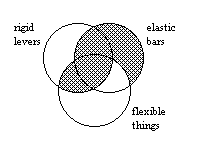
- According to our interpretation of the symbols used in Venn
diagrams, we would have to have an “X” in the S
MParea (i.e., the area of the "rigid levers" class with no marking), but there is no “X”; there. The lack of marking indicates no information is known about that area. - If we had independent information concerning the existence of rigid
levers, we would know that at least one rigid lever existed, and this
one would have to be in the S
MParea of the diagram — the area of the S class with no shading. - However, if we are evaluating the argument as given and we do not assume
anything else, we cannot validly get to the conclusion from these premisses,
because we cannot see the presence of an “X” outside of the
“P” class (i.e., the class of “elastic bars”).
- This means on the Boolean interpretation of syllogisms, the subject
terms of universal statements are not known to actually exist unless some
kind of additional information is provided to the contrary. The Boolean
postulation is taken so we can reason about such things as theoretical,
imaginary, or fictional entities.
For example, it is true in Euclidean geometry that “All straight lines are the shortest distance between two points” even though such lines have no width.
Just as something that has no width does not exist in the everyday world, so also rigid levers (levers that do not distort under any amount of force) do not exist in the everyday world. Perfectly rigid levers are an ideal or theoretical conception of a lever considered as a limiting concept in physics.
- The Venn Diagram for this argument raises some interesting issues.
How would you evaluate the following argument?
- On the Boolean interpretation of categorical syllogisms, we cannot
assume the existence of individuals mentioned in universal statements. In
syllogistic language, if we want to assert that individuals exist, we
must say so by adding a particular statement.
- On this convention, the word “some” when used in a
particular statement is taken to imply at least one individual in the
class exists.
- In sum, then, on this interpretation, universal statements do
not imply either that the classes mentioned or that the members of
the classes exist, whereas particular statements do imply that at
least one member of the classes mentioned exist.
- We take this interpretation in our logic here so that arguments
can be presented concerning subjects such as abstract, ideal, or
theoretical entities — entities such as frictionless planes,
ideal gases, and black bodies which absorb all radiation.
- On this convention, the word “some” when used in a
particular statement is taken to imply at least one individual in the
class exists.
- When set up in standard form and order, the
syllogism looks like this:
- Rule (The Boolean Interpretation): No valid standard form categorical syllogism with a particular conclusion can have both premisses universal.
- Reason: If the rule were not followed, then we would mistakenly
reason from premisses with no existential import in an attempt to prove a
conclusion that does have existential import.
- The Existential Import of a statement is established by
whether or not its subject exists.
So, for example, the statement “All persons are mortal beings” is said in ordinary conversation to have existential import because it is common knowledge that persons exist, whereas the statement “All round squares are rhombi” does not have existential import since round squares are known not exist. - We want to be able to reason using terms “referring”
to nonexistent things (such as events before the Big Bang, the world
in the next century), subjects not known to exist (other universes,
ESP, past lives) or surmised subjects (possible worlds,
“reasonable men” as a legal fiction, novelist Sinclair
Lewis' literary character named “Babbit”) or abstract
subjects known not to exist (e.g., nothingness, not-being,
emptiness).
- A related sense of an existential fallacy in philosophy is
illustrated by Søren Kierkegaard's implication in the context of
any
attempt to prove the existence of God. The existence of the reference
of a term does not suddenly emerge from a concluding statement in a
logical argument — it would be as if we were attempting to conjure
up the existence of God from the presence of written statements on a
piece of paper.
- Venn Diagrams are used to illustrate the problem of existential
import in the example syllogism EAO-4 on this site's page: Venn Diagrams: Categorical
Syllogisms.
- The Existential Import of a statement is established by
whether or not its subject exists.
- In sum, the Existential Fallacy occurs whenever a standard form syllogism has two universal premisses and a particular conclusion.
- See if you can determine merely by inspection whether or not the following
syllogisms commit the Existential Fallacy.
That is, which of the following syllogisms have two universal premisses with a particular conclusion?
AAI-3 EEO-4 EAO-1 EAI-3 AE0-1 AEA-2 E00-2 AOI-3 OEO-4 OOO-1
- Note: If you are using a syllogistic logic presupposing existence,
you cannot simply discard this rule against the existential fallacy without
adding additional other rules, since the remaining rules on the Boolean interpretation
do not rule out all fallacious syllogisms. In other words, the rule against the
commission of the existential fallacy prevents other invalid syllogisms as well.
- Reason: If the rule were not followed, then we would mistakenly
reason from premisses with no existential import in an attempt to prove a
conclusion that does have existential import.
Readings: Existential Fallacy
“Does This Syllogism by Russell Show That Aristotelian Logic Doesn't Work,” Philosophy Stack Exchange: A discussion about Bertrand Russell's example criticism of Aristotle's syllogisms with this argument:
“If I were to say: ‘All golden mountains are mountains, all golden mountains are golden, therefore some mountains are golden,” my conclusion would be false, though in some sense my premisses would be true.”Laurence R. Horn, “All John's Children are as Bald as the King of France: Existential Import and the Geometry of Opposition,” Chicago Linguistic Society 33 (1997), 154-179. A thorough discussion of the traditional and modern views of existential import and related topics for the square of opposition and the four kinds of categorical propositions.
Bertrand Russell, “Aristotle's Logic,” in A History of Western Philosophy (1946 London: Taylor and Francis, 2005), 190.
Gyula Klima, “Existential Import and the Square of Opposition,” in John Buridan (Oxford: Oxford University Press, 2009), 143-157. doi: 10.1093/acprof:oso/9780195176223.003.0006
Terence Parsons, “The Traditional Square of Opposition: Later Developments,” The Stanford Encyclopedia of Philosophy (Summer, 2017).
Stephen Read, “Aristotle and Łukasiewicz on Existential Import.” Read argues that Aristotle's syllogistic admits empty terms in the square of opposition.
Maria Reicher, “Nonexistent Objects,” The Stanford Encyclopedia of Philosophy (Winter, 2016). Reicher examines the questions which arise from the admission that there are nonexistent objects.
Bertrand Russell; Hugh MacColl, “The Existential Import of Propositions,” Mind New Series 14 no. 55 (July, 1905), 392-402. doi: 10.1093/mind/xiv.3.398 A discussion of the meaning of existence with respect to the existential import of propositions in reference to standard form categorical propositions. MacColl maintains the null-class is a class of non-existences having many unreal members, whereas Russell maintains there is no class of non-existences but only a non-existent class with no members.
Abraham Wolf, The Existential Import of Categorical Predication (Cambridge University Press, 1905).
Michael Wreen, “Existential Import,” Crítica: Revista Hispanoamericana de Filosofía 16 no. 47 (August, 1984), 59-64.
Joseph S. Wu, The Problem of Existential Import (From George Boole to P.F. Strawson) Notre Dame Journal of Formal Logic 10 no. 4 (October 1969), 415-424. DOI: 10.1305/ndjfl/1093893792




Send corrections or suggestions to
larchie[at]philosophy.lander.edu
Read the disclaimer
concerning this page.
1997-2020 Licensed under GFDL and
Creative
Commons 3.0


The “Copyleft” copyright assures the user the freedom
to use, copy, redistribute, make modifications with the same terms.
Works for sale must link to a free copy.
The “Creative Commons” copyright assures the user the freedom
to copy, distribute, display, and modify on the same terms. Works for sale
must link to a free copy.
Arguments | Language | Fallacies | Propositions | Translation | Symbolic

