|
|
|

The Nature of
Philosophy and
Logic
Abstract: The disciplines of philosophy and logic are
defined and briefly described with mention of some representative problems.
- What is Philosophy?
- The derivation of the word “philosophy” is from the Greek
roots:
philo — love of, affinity for, liking
of.
As in the words …
philander — to engage in love affairs
frivolously
philanthropy — to love helping others
philately — to “love”
collecting postage stamps
—phile — one having a love for,
e.g. an anglophile as one who loves English culture.
philology — having a liking for words
sophia — wisdom
As in the words …
sophist — one who loves knowledge
sophomore — one who thinks he's
wise
sophisticated — one who is knowledgeable
- A suggested definition for “philosophy”:
Philosophy is the systematic inquiry into
the principles and presuppositions of any field of inquiry.
- Psychologically, philosophy is an attitude, an approach, or a calling
to answer, or to ask, or even to comment upon certain peculiar problems
(i.e., problems such as those usually in the main branches of
philosophy discussed below).
- Eventually we must despair of an abstract definition and turn to what
philosophers do — i.e., explore the practice of philosophy.
- The Main Branches of Philosophy are divided as to the
nature of the questions asked in each area. The integrity of these divisions
cannot be rigidly maintained since many problems encompass more than one
area of inquiry.
Axiology
close ×
Axiology:
The analysis of values to determine their meaning, characteristics,
origins, types, criteria, and epistemological status.
Peter A.
Angeles, A Dictionary of Philosophy (London: Harper, 1981),
22.
the study of value; the investigation of its nature, criteria
and metaphysical status.
- Characterization of some features of the definition:
Nature of value: is value a fulfillment of desire, pleasure,
a preference, or simply some kind of human interest?
Criteria of value: is there no accounting for taste
(de gustibus non
(est) disputandum)
close ×
de gustibus non (est) disputandum)
“There is no disputing about tastes.” This Latin phrase
implies that a person's values cannot be logically justified.
or can rules and
standards of values be set?
Status of value: how are values related to scientific facts?
What ultimate worth do human values have, if any? Would the universe have
any value if human beings did not exist?
- Axiology is sub-divided into …
Ethics
close ×
Ethics
The study of the concepts involved in practical reasoning: good,
right, duty, obligation, virtue, freedom, rationality, choice.
Simon Blackburn, The Oxford Dictionary of Philosophy (London:
OUP, 1994), 126.
The study of value in human behavior; the study of moral problems
which seeks to discover how one ought to act, not how one does
in fact act or how one thinks one should act
Usually, in philosophy, morals or mores (customs of a society) are viewed
as the descriptive practices of a society: what people actually believe
about morality.
Ethics, then, is considered prescriptive or normative: what people really
ought to do, apart from what they usually do.
What is the nature of the life of excellence?
What is the ultimate worth of the goals you seek? (Once you obtain your
goals, so what?)
What specific courses of conduct, in keeping with the goals you seek, will
help lead to a life of excellence? What are the roles of pleasure, duty,
self-realization, usefulness, goodness, justice, or acting in accordance
with your (biological) nature?
Aesthetics
close ×
Aesthetics
The study of the feelings, concepts, and judgments arising from
out of appreciation of the arts or of the wider class of objects
considered moving, or beautiful, or sublime.
Simon Blackburn,
The Oxford Dictionary of Philosophy (London: OUTP, 1994),
8.
the study of value in the arts — the study of the beauty,
sublimity, and principles of taste, harmony, order, and pattern.
Are beautiful shapes and sounds describable mathematically as Pythagoras
thought?
Does art relate to ethics? Is there a truth in aesthetic representation?
Is emotion an essential part of artistic appreciation?
Epistemology:
close ×
Epistemology:
The Theory of knowledge. Its central questions include the origin of
knowledge; the place of experience in generating knowledge, and the place
of reason in doing so; the relationship between knowledge and certainty,
and between knowledge and the impossibility of error, the possibility of
universal scepticism; and the changing forms of knowledge that arise from
new conceptualizations of the world.
Simon Blackburn, The Oxford
Dictionary of Philosophy (London: OUP, 1994), 123.
the study of knowledge, in particular, the study of the nature, scope,
and limits of human knowledge.
- Epistemology is the investigation of the origin, structure, methods,
and validity of knowledge.
- As an example of orders of knowledge, consider the statement:
“The earth is round.”
This can be successively translated depending upon context as …
The earth is spherical.
The earth is an oblate spheroid (i.e.,
it's flattened at the poles).
But what of the height of mountains, the depth of oceans, and so forth?
Even if we surveyed exactly the earth's shape, the process of surveying
would itself measurably change the shape of the earth — e.g.,
footprints and indentations formed by our measuring instruments.
In practice, can the exact shape ever be actually known? (No, but even
though we can probably never know the exact shape of the earth at any
given moment, we do know the earth has an exact shape.)
- Consider two well-known epistemological problems: the first is not
solvable, the second is solvable.
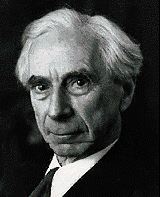 First: Bertrand Russell's Five Minute World Hypothesis:
Suppose the earth were created from scratch five minutes ago, complete
with memory images, history books, geological records, etc. That is,
at the moment of creation, the universe would have all the evidence that
it was billions of years old already “packed in.”
First: Bertrand Russell's Five Minute World Hypothesis:
Suppose the earth were created from scratch five minutes ago, complete
with memory images, history books, geological records, etc. That is,
at the moment of creation, the universe would have all the evidence that
it was billions of years old already “packed in.”
How could it ever be known that the creation of the universe did not
begin five minutes ago? Russell writes:
“There is no logical impossibility in the hypothesis
that the world sprang into being five minutes ago, exactly as it then
was, with a population that ‘remembered’ a wholly unreal
past. There is no logically necessary connection between events at
different times; therefore nothing that is happening now or will happen
in the future can disprove the hypothesis that the world began five
minutes ago.
Hence the occurrences which are called knowledge of the past
are logically independent of the past; they are wholly analysable into
present contents, which might theoretically, be just what they are even
if no past had existed. I am not suggesting that the non-existent of
the past should be entertained as a serious hypothesis. Like all
sceptical hypotheses, it is logically tenable, but uninteresting.”
[Bertrand Russell, The
Analysis of Mind (rpt. 1922 London: George Allen & Unwin,
1921), 159-160.]
Russell states that he is not suggesting that this is a serious hypothesis.
As a skeptical hypothesis, he says it is possible, but quite uninteresting.
Another way of explaining Russell's hypothesis is to consider that there
is no way to disprove scientifically that the universe is being created
ex nihilio (i.e., from nothing) moment-by-moment by
an all-powerful God.
Second: Suppose everything in the universe were to expand
uniformly so that eventually everything in existence was one hundred
times larger in size. How could we ever know it?
At first glance, it might seem that this problem of scale would be
unsolvable. As objects proportionally increase in size their volume and
mass increase by the cube. So, roughly speaking, if the laws
of chemistry and physics remain the same, objects on earth one hundred
times greater in size would be crushed by their own weight.

So, on earth, there's a limit to the size animals of animals as well as
a limit to the height of skyscrapers. (For example, the blue whale, the
largest animal on earth, could not survive without the buoyancy provided
by the sea.) If such an expansion of size and weight were possible,
then the scientific laws of the universe would have to change.
- Ontology
close ×
Ontology
(1) The study of the essential characteristics of Being in itself
apart from the study of particular existing things … (2) the order
and structure of reality in the broadest sense possible … (3) the
nature of ultimate Being … (4) asks the question “What does
‘to be, ’ ‘to exist mean?’ … Ontology has
been used as a synonym for metaphysics …
Peter A. Angeles,
A Dictionary of PhilosophyLondon: Harper & Row, 1981),
198.
or
Metaphysics:
close ×
Metaphysics
Any enquiry that raises questions about reality that lie beyond or
behind those capable of being tackled by the methods of science.
Simon Blackburn, The Oxford Dictionary of Philosophy (London:
OUP, 1994), 240.
the study of what is “really” real. Metaphysics deals
with the so-called first principles of the natural order or the ultimate
generalizations available to the human intellect.
- E.g. Since ideas actually have no size shape, color, and
so forth, my idea of the Empire State Building is quite as small as
my idea of a book.
Do ideas exist in the same manner that physical objects exist?
- Consider the truths of mathematics. How and where do they exist?
In what manner does a geometric figure exist? — After all, points
have no size and lines have no width.
- What is spirit or soul made of? Or matter? Or space? Or a vacuum?
- To Which of these branches of philosophy do you think logic belongs?
- Logic:
close ×
Logic
The general science of inference. Deductive logic, in which a conclusion
follows from a set of premises is distinguished from inductive logic, which
studies the way in which premises may support a conclusion without entailing
it.
Simon Blackburn, The Oxford Dictionary of Philosophy/cite>
(London: OUP, 1994), 221.
the study of the methods and principles used in distinguishing correct
from incorrect reasoning.
- Our knowledge is interrelated by logic. It forms the fabric of the sciences
by ensuring the consistency of the statements that compose them.
- Hence, logic is usually considered a subdivision of epistemology, although,
of course, logic is used in all areas of philosophy.
Recommended Reading
Lee Archie and John G. Archie, “The
Nature of Philosophical Inquiry,” in Reading for Philosophical
Inquiry (Greenwood, SC: Open Source, 2006). 31 pp. Philosophical
questions are characterized, many ways of thinking are discussed, and the main
divisions of philosophy are outlined with some some typical philosophical
problems illustrated. (This website).
Wikipedia contributors, “Types of
Logic,” Wikipedia. Logic is defined and the main types
types of logic are characterized. (accessed September 1, 2020).
Wikipedia contributors, “Branches
of Philosophy,” Wikipedia. A general overview of a
collection of a number of types of philosophy is outlined The branches
of philosophy are characterized with examples. (accessed September 1, 2020).
|
|










