

Site Homepage » Logic » Informal Fallacies » Fallacy of Accident



The Fallacy of Accident: Fallacia Accidentis
Abstract: The fallacy of accident occurs whenever a commonly accepted generalization is used to infer a specific case which is not a proper instance of that generalization.
Thus, this mistake occurs when assuming what is generally true must also be true in atypical or “accidental” circumstances.
For example, lions, in general, are regarded as dangerous animals, but from this fact we cannot necessarily conclude that a well-fed, trained lion is dangerous in a particular situation.[1]
When the fallacy of accident is viewed as the more general fallacy of neglecting qualifications, it consists of reasoning from a statement with an unqualified term to another statement with the same term presented unqualified. In the example just used, the term “lions” in the premise is unqualified, and the term “lions” in the conclusion is qualified as to just those being well-fed and trained.
Contents
- The Fallacy of Accident Defined and Its Historical Background.
- The Fallacy of Accident Argumentation Scheme.
- Some Common Varieties of the Fallacy of Accident
- Arguments Sometimes Confused with the Fallacy of Accident
- Unresolved Difficulty in the Fallacy of Accident
- Historical Frequency
of Use of the Fallacy of Accident and Accidentis
Fallacia 1800-2019 in Google Books Ngram Viewer
The Fallacy of Accident Defined
- Fallacy of Accident: the logical mistake of inferring an atypical specific example or examples from a general premise which does not apply to that instance or those instances.
This fallacy occurs whenever anyone concludes that the scope of a generalization refers to uncharacteristic or incongruous examples of that generalization.
Caveat for the Fallacy of Accident: Historically, the fallacy of accident has been defined in several discrepant ways under different designations; consequently, some recent informal logicians conclude the fallacy should not be covered in the standard treatment of informal fallacies. Q.v., Postscript below.Since the time of Aristotle, the fallacy of accident has been occasionally identified with the fallacies of fallacia accidentis, a dicto simpliciter ad dictum secundum quid (arguing from a statement made generally to a qualified statement), converse accident, and a dicto secundum quid ad dictum simpliciter, (arguing from a qualified statement to a statement made generally), among others. The noted informal logician Douglas Walton recommends combining all the fallacies in this class under any one of the following names: “the neglect of qualifications,” secundum quid (i.e., somehow qualified), or “overlooking special circumstances.”[2]
- All things are generally classified in accordance with the general
features of resemblance among their instances. Individual things of this
kind also, of course, can differ in other non-characteristic respects as
well. The fallacy of accident occurs when a dissimilar respect (or
accidental feature) of some kind is mistakenly claimed to be a consequence
of being of that kind.
E.g., This type of mistake occurs if someone were to argue that since everyone in the U.S. has the right to vote, children, criminals, and noncitizens have the right to vote.
Thus, the claim that accidental properties generally true of something are always true of each and every individual of that type is a fallacious claim. This error is sometimes explicitly prevented by adding a qualifying phrase to these kinds of non-universal generalizations, such as in statements like these:“As a rule, such and such is true.”
“Normally, such and such is true.”
“Typically, such and such is true.”
“On the whole, such and such is true.”
“In general, such and such is true.”
Abstract principles and rules of thumb have to allow for qualifying conditions. Sometimes the accidental feature of a kind or type of thing is said to be “the exception that proves the rule.”
- Hermann Lotze cites this fallacy as characteristic of a demagogue:
“The doctrinaire is an idealist, who refuses to see that though ideas may be right in the abstract, yet the nature of the circumstances under which and of the objects to which they are to be applied must limit not only their practicability but even their binding force.”[3]
For example, the fallacy would occur if a disciplinarian were to claim that there are no exceptions to the general ethical rule that one ought never lie; therefore it is wrong to write poetry or fiction, tell a joke, or respond agreeably to awkward questions.
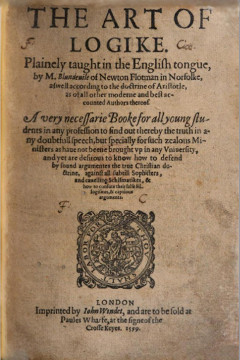 Historically, the fallacy of accident was first described in English in
1599 by the Renaissance polymath Thomas Blundeville in his Arte of
Logike:
Historically, the fallacy of accident was first described in English in
1599 by the Renaissance polymath Thomas Blundeville in his Arte of
Logike:
”Fallacia Accidentis … whch may be Englished thus: The Fallax of the Accident …”[4]
Blundeville describes the fallacy, heretofore termed fallacia accidentis, as comprising of both accident and converse accident.
- A century ago, logician H.W.B. Joseph described the type of non-universal
generalization used in many examples of the fallacy of accident in this
manner:
“[T]here is no fallacy more insidious than that of treating a statement which in many connexions is not misleading as if it were true always and without qualification.”[5]
More recently, the pragmatic informal logic theorist Douglas Walton writes:“The default type of generalization can also be called the defeasible
Examples of these types of generalizations appearing in the fallacy of accident include include abstract principles[7], rules of thumb, legal and moral laws, maxims, adages, clichés, aphorisms, proverbs, and limited generalizations.(presumptive) generalization, a type of generalization that admits of exceptions, and is compatible with some new arguments that turn up counter-instances. This type of generalization is not strict, but is open ended and tentative in nature.”[6]close ×Defeasible:
Capable of being overturned … A proposition is defeasible if further evidence may render it doubtful. Simon Blackburn, The Oxford Dictionary of Philosophy (Oxford: Oxford University Press, 1994), 96.
- These types of generalizations (i.e., those which are true
under certain circumstances) are sometimes described in philosophy and
logic as “soft generalizations.” Examples are provided
in Section III Explained Examples below.
In sum, soft generalizations (defeasible generalizations) need to allow for qualifying conditions.
- S.H. Emmons, among many other 19th century logicians, recognizes the
subtleties of the fallacy of accident:
“Fallacies of this nature are very difficult to detect, in consequence of the readiness which exists to lose sight of the limitations which alone render a general law capable of being applied to some particular case.… [T]here are many various ways of sophistication by means of ambiguity in expression which … are often employed.[8]
Thus, “accidental” or non-essential instances of a generalization can differ in virtually limitless ways. The noted argumentation theorist Douglas Walton goes so far as to conclude:“Whatever accident is, it is far from clear that it is the kind of common error of reasoning or fallacy that belongs in the standard treatment of fallacies in logic textbooks …”[9]
Indeed, many current logic textbooks omit the treatment of the fallacy of accident altogether.
- Hermann Lotze cites this fallacy as characteristic of a demagogue:
- Generally speaking, historically important definitions of the fallacy
of accident have shifted from the fallacy defined in the use of terms, for
example …
“Socrates is white.
… to the fallacy of accident defined in terms of the use of statements, for example:
White is a color.
Therefore, Socrates is a color.”[10]By law, all children must attend school.
The definition in terms of statements is often equated with the fallacy of a dicto simpliciter ad dictum secundum quid (i.e.. the fallacy of arguing from what is true absolutely to what is true in a certain [qualified or accidental] respect).
∴ Your child, although ill, must attend school.
From the point of view of definition, the fallacy of accident is often said to have the same extension (i.e. refers to the same things) as this kind of secundum quid but have a different intension (i.e. different described properties). Accident is defined by its use of terms, whereas usually secundum quid is defined by its relation of statements.
- The initial phrasings of the fallacy of accident from which the
contemporary versions are derived were due to Aristotle:
“Fallacies connected with Accident occur when it is claimed that some attribute belongs similarly to the thing and to its accident; for since the same thing has many accidents, it does not necessarily follow that all the same attributes belong to all the predicates of a thing and to that of which they are predicated.” [Aristotle, Soph. El. 166b 28-33.][11]
Even though Aristotle considered accident to be a material (i.e. non-verbal) fallacy, the fallacy of accident during the medieval period was regarded, for the most part, as a verbal fallacy. E.g. John Wallis summarized:“The fallacy of accident is when something accidental is confused with what is primarily intended to be essential or principally intended.”[12]
One way Wallis's definition was interpreted is that a term used or supposed materially (or referentially) should not be confused with a term used formally (non-materially or abstractly).
For example in the sentence “The cat is a species” the subject is used formally, whereas in the sentence “The cat is a calico” the subject is supposed in a material sense.
When the supposition of a term is changed in the midst of an argument, the fallacy of accident is said to occur because the change is in effect a change in the designation of the term.[13]
- The following definition of the fallacy is a restatement by Henry
Aldrich in his Compendium of Logic (1756) — a
definition repeated in some logic texts until the end of the 18th century:
“The Fallacy of the Accident; when some accidental Circumstance is confounded with what is essential.”[14]
Aldrich provides the following example — an example commonly used in logic textbooks until the early 20th century:What destroys Men ought to be prohibited.
Essential characteristics of objects or events are said to be always present in objects or events of that kind; accidental characteristics are said to be not always present. Aldrich explains his example:
Wine destroys Men.
Therefore Wine ought to be prohibited.[15]“The major Proposition must mean, What necessarily destroys Men: Otherwise it is not true: The minor, Wine accidentally destroys Men. Therefore here also there are four Terms.“[16]
Note that in this example of the fallacy, all statements are general statements, but the major premise is more general than the general instances named in the conclusion. Note also that Aldrich points out that the [informal] fallacy of accident in this example also commits the syllogistic formal fallacy of the four term fallacy.
-
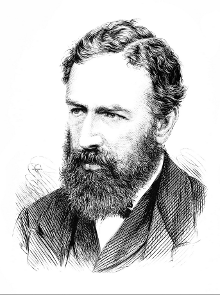 In his 19th century celebrated textbook, W. Stanley Jevons defines the
fallacy in modern terms:
In his 19th century celebrated textbook, W. Stanley Jevons defines the
fallacy in modern terms:
“The fallacy of accident consists in arguing erroneously from a general rule to a special case, where a certain accidental circumstance renders the rule inapplicable.”[17]
Jevons’s formulation of the fallacy was adopted by a great many textbooks of the period, and his definition appears frequently in logic textbooks and on webpages today.
- In the latter 20th century, many informal logicians concurred with
Douglas Walton's assessment that the fallacy of the accident has had such
a checkered history that if it is to be taught at all in logic classes,
it's best to be thought of as a ”fallacy of ignoring exceptions.“
”Trying to explain the historical origins of unfamiliar and puzzling terms like ‘accident’ … seems a hopeless and unrewarding task, not to mention the variety of Latin terms and phrases peppered through the traditional textbook treatments. While ignoring exceptions to a rule or qualifications to a generalization did seem important failures to warn students about, nevertheless the complications and puzzles inherent in the standard treatment suggested that it was prudent to bypass this area, restricting coverage to a brief mention of the basic fault, in simple terms.”[18]
In general, the fallacy of accident described in textbooks today is illustrated by examples arguing from general to specific, genus to species, essence to accident or abstract to concrete terms — all cases where the existence of qualifying circumstances are neglected.
The examples of the fallacy of accident on this website in notes, quizzes, and tests are restricted to the fallacy of ignoring exceptions to a rule or ignoring qualifications to non-universal generalizations.
- A historically exemplary instance of ignoring qualifications or
secundum quid which also exhibits the characteristics
of arguing erroneously from a general rule to a special case where a
certain uniquie (accidental) circumstance renders the rule inapplicable
is as follows:
Water is liquid.
Ice is water.
∴ Ice is liquid.In the first (major) premise, the term “water” is used in accordance with its essential definition in a general sense without condition; however, in the second (minor) premise, the term is used to refer to water in the conditional sense of being frozen. So the premises shift from a basic, unconditional statement to a statement incorporating a specific condition.
From another point of view, the argument proceeds from a general rule (“Water is liquid) to conclude with a special case where the subject is restricted to the unrepresentative case of water in a certain phase, namely that of ice.
- The initial phrasings of the fallacy of accident from which the
contemporary versions are derived were due to Aristotle:
-
The Fallacy of Accident Argumentation Scheme
Informal Guide to the Fallacy of Accident
A generalization or rule is normally true.
∴ An exceptional instance of that generalization is claimed true.
The “accidential” features of the specific case make it an exception to the underlying conditions of the generalization or rule. The conclusion of the argument is not an instance commensurate with all typical examples included in the meaning of the major premise.
- E.g., the following argument is often used as an example
of the accident fallacy:
Water is liquid.
“Water” is used in its unexceptional, unconditioned meaning in the premises; however, in the conclusion “water“ is used in an atypical sense. The condition of being ice is not essential to being water.
Ice is water.
Ice is liquid.
- Another way this scheme is ordinarily understood is that the
fallacy of accident occurs in arguments where a qualified or atypical
statement is concluded from an ostensibly absolute statement.
Most generalizations and rules have exceptions, and to treat these rules as universally true absolute generalizations is faulty reasoning.
- E.g., the following argument is often used as an example
of the accident fallacy:
Some Common Varieties of the Fallacy of Accident
Some of the common types of the fallacy of accident are illustrated in this section.
- From a Soft Generalization: Soft
generalizations are statements claiming something is usually,
mostly, typically, or normally the case. So the general statement
is ordinarily true but can have exceptions for any number of different
reasons. Types of soft generalizations include abstract principles,
rules of thumb, legal and moral laws, and aphorisms.
- Soft generalizations are the basis of most examples of the
accident fallacy provided in current logic textbooks. Here are
two examples of a soft generalization from traditional textbooks:
“All persons who do not pay import duties are smugglers. (Envoys have immunity.)
In the statement of the generalization, exceptions are normally understood.
All students off grounds are truant. (Some have permits.)”[19]
- Another illustration of this kind of fallacy is the following
tacit inference from the soft generalization “On country walks,
there is much to be seen.”

“During a country walk there is much to be seen: but a country walk may be taken on a pitch-dark night: therefore on a pitch-dark night there may be much to be seen.”[20]
In this example, the presumed time condition of country walks during the daytime is ignored in the conclusion to the argument.
- H.H. Munro offers this example:
“Fidelity is a virtue.
“Allegiance to an ignoble cause” is not, as such, representative of “fidelity” in general. The more specific use of the concrete “accidental” term “fidelity” in the minor premise is used in contrast to a more general use of the term in the major premise — the contrasting usages of the term give rise to the fallacy of accident.
Allegiance to an ignoble cause is fidelity.
∴ Allegiance to an ignoble cause if a virtue.”[21]
- Another fallacy which uses a general statement having an implicit
qualified meaning as if it were not so qualified is illustrated in
the following argument:
E.g., “[A]s if a traitor should argue from the sixth commandment, Thou shalt not kill, to prove that he himself ought not be hanged.”[22]
The premise “Thou shalt not kill” treated as a generalization which refers to the unlawful or unjustified killing of human beings, and its meaning is misconstrued in the conclusion to refer to a different specific example (presumably a locally lawful or military judicially justified instance) from those denoted in the premise.
This argument can be interpreted as follows:
Note two important things:No persons should kill other people.
∴ No persons should kill me, a traitor.
- The grammatical form of the premise “Thou shalt not
kill” is stated as a particular premise, but in the context
of being a religious moral law, the premise is intended to be a
statement applying to everyone:
“No persons should kill [in the sense of “unlawful killing] other persons [all other things being equal].”
So, sometimes, statements which appear to be particular statements are intended to be understood as general statements.
- Even if the conclusion were to be stated as a general statement,
e.g. …
“No persons should kill traitors.”
… the argument would be the fallacy of accident. Note this general conclusion is narrower in scope that its premise:“ No persons should kill other persons.”
The fallacy of accident concludes with an atypical instance said to have been implied by a generalization which is not meant to include that instance. In this argument, the conclusion, itself, is a generalization, but the generalization is about individuals of a different sort that the generalized premise.
So, it's important to notice that the atypical instance mentioned in the conclusion can be, and often is, a generalization about circumstances of less scope than the premise.
- Finally, it's important to notice that even if both premise and
conclusion were to be expressed as particulars, the argument would
be an accident fallacy:
One should never kill another person.
This example illustrates why the accident fallacy is best identified as a fallacy of neglecting qualifications rather than the inference of an exceptional case from a general rule.
An executioner should never kill a legally condemned person.
- Consequently, many cases of the fallacy of accident cannot be
analyzed in terms of generality or specificity. Indeed, traditionally,
many logicians do not distinguish among the fallacies of accident,
converse accident, and secundum quid.
- The grammatical form of the premise “Thou shalt not
kill” is stated as a particular premise, but in the context
of being a religious moral law, the premise is intended to be a
statement applying to everyone:
- Soft generalizations are the basis of most examples of the
accident fallacy provided in current logic textbooks. Here are
two examples of a soft generalization from traditional textbooks:
- From Moral and Legal Principles: Moral and legal rules are to
be understood in terms of “all other things being equal.”
Interpreting a moral or legal law as an absolutely universal statement or
hard generalization can lead to the fallacy of accident.
This variety of the fallacy of accident can occur when a judge misinterprets the application of a moral or legal rule. Jevons points out the ubiquity of the fallacy of accident in legal issues:“Almost all the difficulties which we meet in matters of law and moral duty arise from the impossibility of always ascertaining exactly to what cases a legal or moral rule does or does not extend; hence the interminable differences of opinion, even among the judges of the land.”[23]
Additionally, whenever the wrong legal or moral standard is followed an error of law is said to occur.
- E.g., Felicia Hemans' well-known poem Casabianca
recounts an actual incident from the 1798 Battle of the Nile concerning a
young boy who refused to leave a burning ship without his father's orders
(interpreted as a moral rule):
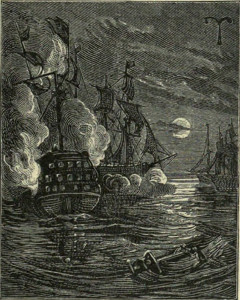
Casabianca's father never intended his son to remain on deck under such dire circumstances. In some unanticipated circumstances, prescriptive rules have exceptions.“The boy stood on the burning deck
Whence all but he had fled;
The flame that lit the battle's wreck,
Shone round him o'er the dead.
…
The flames roll'd on—he would not go
Without his Father's word;
That Father, faint in death below,
His voice no longer heard.”[24]
- In this next example, a contemporary editorialist asserts socialistic
left-wing politicians violate a religious commandment:
“The Ten Commandments prohibit theft and envy, the pillars of socialism — using political power to seize and redistribute private property — which the highly politicized left-wing crowd so loves.”[25]
Since the proper application of the Ten Commandments as religious law is being applied outside its sphere of application to democratically derived consensual governmental law, the fallacy of accident occurs.
- Whenever a prescription is invoked away from its frame of reference and
is pressed beyond its sphere of application, the fallacy of accident will
occur.
- E.g., Felicia Hemans' well-known poem Casabianca
recounts an actual incident from the 1798 Battle of the Nile concerning a
young boy who refused to leave a burning ship without his father's orders
(interpreted as a moral rule):
- From the First Use of a Term Rendered Abstract and the Second Use
Concrete: Abstract terms refer to immaterial things (usually general and
qualitative) such as qualities, concepts, states, events, and ideas which
as a rule cannot be sensed, whereas concrete terms usually refer to material
(usually specific and quantitative) or tangible objects which can be sensed.
- The difference between an abstract and a concrete term is not polar
relationship but is a matter of degree: many abstract and concrete terms
exist on a continuum and can be abstract or concrete depending on their
context in a passage.
- E.g. the abstract term “virtue” can, in context, be
used concretely if it is used as separable into different kinds: the virtues
of courage, justice, prudence, and so forth. So in a sentence such as
…:
“Courage is the price that life exacts for granting peace,”[26]
… “courage” is used more concretely than in the sentence:“Courage doesn't always roar.”[27]
However, identifying the accident fallacy solely in terms of the abstract-concrete distinction is only one variety of the fallacy.
- Consider the following syllogism devised by Thomas Crumley:
“Fidelity is a virtue.”
The more specific “accidental” concrete term “fidelity” in the minor premise is used in contrast to a more general use of the term in the major premise — the contrasting usages of the term gives rise to the fallacy of accident.
Allegiance to an ignoble cause is fidelity.
∴ Allegiance to an ignoble cause is a virtue.[28]
- The difference between an abstract and a concrete term is not polar
relationship but is a matter of degree: many abstract and concrete terms
exist on a continuum and can be abstract or concrete depending on their
context in a passage.
- In Syllogisms as Equivocation or the Four
Term Fallacy: To reason from a hard generalization to a particular
instance covered by that generalization is one kind of deduction and is
ordinarily necessarily valid unless ambiguity of a term is present
in the argument.
Historically, the fallacy of accident has been described as an ambiguous middle term in a syllogism.[29] Nevertheless, any of the three terms in a syllogism might have this ambiguity, although it is often the middle term (the term in both premises) when an ambiguity is present. The fallacy of accident often occurs when one of the terms is used in a general or definitional sense (i.e., its essential sense or essence) in one premise and a difference sense of the term is used in a special, limited, or restricted sense (i.e., an accidental sense).
Thus, the fallacy of accident as equivocation in a syllogism can occur whenever a term is in a general sense in one premise and in an atypical particular or less general sense in the other premise. When considered as a syllogistic argument, such fallacy can be regarded alternately as an informal fallacy or a formal one since, in a sense, the proper form of the syllogism is broken because essentially more than three terms are present.
- E.g., the following argument appears at first glance
to be a valid-formed argument but is not valid:
Education develops the subject's intellect.
The common term “education” in each premise is used in difference senses. Some types of education do not develop the intellect; the training of animals is consider education only in a Pickwickian sense.
The training of animals is education.
∴ The training of animals develops their intellect.[30]
Some informal logicians who see the major premise as a soft generalization and the minor premise as an exception to that generalization, label this argument the fallacy of accident (or one form of secundum quid). However, the mistake in the argument is best seen as the fallacy of equivocation (or, formally speaking, four term fallacy).
- In 1686, Henry Aldrich repeats the oft-used straightforward
example (used above) of a syllogistic four-term fallacy committing
fallacia accidentis:
“What destroys Men ought to be prohibited.
Wine destroys Men.
Therefore Wine ought to be prohibited.”[31]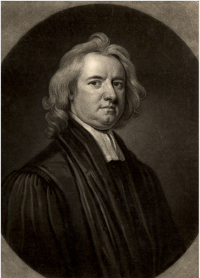 Aldrich like John Wallis[32]
before him described this fallacy as “some accidental circumstance
is confounded with what is essential.”
Aldrich like John Wallis[32]
before him described this fallacy as “some accidental circumstance
is confounded with what is essential.”
Most historical references (1600-1850) used this same definitional description for the more general fallacy of fallacia accidentis and often did not distinguish the fallacy of converse accident from that of accident. However, in this example when the major premise is seen a soft generalization and the conclusion is viewed as an “accidental” instance of that generalization, the fallacy was considered to be that of accident.
Aldrich argues that since the first premise denotes what “necessarily destroys men” and the second premise denotes what “accidentally destroy men,” the fallacy of accident occurs.
- F.C.S. Schiller provides a subtler example of the fallacy of
accident occurring in a syllogistic four-term fallacy:
“[I]t may be generally true that ‘all men love good stories,” and undeniable that ‘Smith is a man’; yet the inference that ‘therefore Smith loves this good story,’ may be falsified in this particular case by the fact that the story is told about him, and that, therefore, he hates it.”[33]
The ambiguity of the middle term is claimed to be based on the fallacy of accident in that Smith is a man who loves ‘good stories,’ but not a man who loves ‘good stories about him.’
Other logicians have noted the occurrence of the fallacy in a syllogism when the middle term is used in one premise as applying to a general term as to its essence or general meaning (i.e., simply) and in the other premise applying to a particular, qualified, or special case of the term as accidental.
Schiller goes on to say “[i]t is arbitrary whether the ambiguity of the middle [term] is described as a ‘fallacy of accident,’ or the form of the syllogism is itself regarded as involving this fallacy …”[34]
Interestingly, elsewhere, Schiller suggests that no syllogism can produce certainty, since all syllogisms might commit the fallacy of accident as the fallacy of the ambiguous middle term. In the context of the statements in which it occurs, the middle term might always imperceptibly vary to some degree in its signification.[35]
- E.g., the following argument appears at first glance
to be a valid-formed argument but is not valid:
- In the Immediate Inference, Conversion Per
Accidens: Historically, the fallacy of accident has, at times,
been based on the assumption that a term and its necessary or essential
predicates are exchangeable, whereas a term and its accidental predicates
are not.[36]
Thomas Crumley writes:“[I]n effect the fallacy of Accident is based on the assumption that an accident is commensurate with its subject, and that consequently an ordinary A proposition is simply convertable. As a false principle of reasoning the assumption may be given the following expression: What is predicable of a subject is predicable of its accidents.[37]
Crumley's use of the word “accident” indicates, for example, that whenever the subject of a statement is distributed (i.e., refers to each and every member of the subject class) and the predicate is undistributed (i.e., refers to only some of the members of the predicate class), the predicate is an accident.
Nevertheless, the subject and predicate terms must be more than essential in order for valid exchange of subject and predicate of a statement to be valid. That is, the subject and predicate must be commensurate: the same intension if both subject and predicate: i.e. terms in identical statements or definitions.
- On the one hand, if a man with a brown hat steals a purse and a
suspect is found who is wearing a brown hat, then the suspect with the
brown hat is not thereby guilty. The thief with the brown hat is not
necessarily the suspect with the brown
hat.[38]
-
 On the other hand, a statement such as …
All lodestones are magnetic iron ores.
can be validly converted to …All magnetic iron ores are lodestones.
because a lodestone is defined as magnetic iron ore. A lodestone is a chunk of magnetite which was magnetized, perhaps from a lightning strike. Nevertheless, in spite of its name, not all pieces of magnetite are magnetic. So, the statement …All magnetic iron ores are magnetites.
is true but its converse is not true:All magnetites are magnetic iron ores.
Consequently, an invalid conversion of an A type of categorical proposition (“All S is P”) is sometimes said to commit the fallacy of accident when the S and P terms are not necessarily commensurate or essential to each other, as they are not in this case of relating magnetite to magnetic iron ore.
However, a valid conversion in a case like this can be made if we reduce the quantity of the statement:Some magnetites are magnetic iron ores.
This inference is usually termed “conversion by limitation” or “conversion per accidens.”
Nevertheless, to conclude that the universal conversion of a universal non-necessary statement (e.g. not a definition, a tautology) is a fallacy of accident extends the scope of that fallacy beyond most traditional definitions of trying to prove an special case under exceptional circumstances from a generalization.
Although all planets are celestial bodies, we cannot infer all celestial bodies are planets because being a celestial body is (although necessary) is not sufficient for being a planet.
- The following example is from a philosophical dispute: F.C.S. Schiller
accused formal logicians of this kind of invalid conversion when they claimed
that pragmatists maintain:
“Whatever works is true, because … whatever is true must work.”[39]
If the class of “whatever is true” is larger than the class of “whatever works,” then the fallacy of accident might be said to occur because from the non-universal generalization “Whatever works is true,” it's also usually understood that some things that work might not be true.
Nevertheless, if “whatever works” is understood in the context of being defined as “whatever is true,” then no fallacy would occur.
- On the one hand, if a man with a brown hat steals a purse and a
suspect is found who is wearing a brown hat, then the suspect with the
brown hat is not thereby guilty. The thief with the brown hat is not
necessarily the suspect with the brown
hat.[38]
- Aphorisms and proverbs sometimes fashion the basis of a fallacy
of accident. An aphorism is a concise statement of a
general truth of good advice which usually originates from a classical
or traditional source, and a proverb is a succinct saying,
often metaphorical, which expresses a general truth or word of advice.
- Voltaire's aphorism …
“The best is the enemy of the good”[40]
assures that over-striving for achievement can block the possibility of obtaining something good enough. The fallacy of accident occurs whenever someone argues, for example, from this aphorism to the conclusion that a surgeon need not try try to do her best because she might botch her surgical procedure.
It's worth noticing almost any aphorism is a non-universal statement, and usually can be opposed by some other aphorism with which it conflicts. In the case of Voltaire's aphorism, for example, the novelist W. Somerset Maugham writes, “[I]f you refuse to accept anything but the best, you very often get it.”[41]
Some additional examples of conflicting aphorisms include:
Absence makes the heart grow fonder. Out of sight, out of mind. Look before you leap. He who hesitates is lost. Do unto others as you would have others do unto you. Nice guys finish last.
- An obvious and rather silly example of this kind of fallacy can be
fashioned from a well-known Scottish
proverb:[42]:
The proverb “Kindness begets kindness” implies termites are allowable in residences.”
The fallacy of accident occurs here because termites in houses are not the kinds of circumstances implied by the proverb; termites in houses are irrelevant to the kinds of things kindness is claimed to bring forth.
- Voltaire's aphorism …
- From a Soft Generalization: Soft
generalizations are statements claiming something is usually,
mostly, typically, or normally the case. So the general statement
is ordinarily true but can have exceptions for any number of different
reasons. Types of soft generalizations include abstract principles,
rules of thumb, legal and moral laws, and aphorisms.
Arguments Sometimes Confused with the Fallacy of Accident
- Arguing From a Hard Generalization To a Relevant Specific
Instance: If a particular conclusion is a proper instance or example
of the generalized premise, no fallacy is committed.
In the fallacy of accident, a general premise proceeds to a more particular conclusion where the particular conclusion is an abnormal instance, example, or case in point of the premise.
- The following example illustrates the mistake of
identifying the fallacy of accident as arguing from a general
rule to a special case.
The late 19th century Oxford Handbook of Logic defines the fallacy of accident in this manner and provides the following example: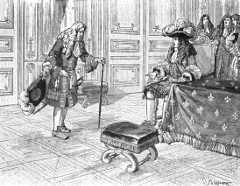
“The Divine law orders that kings should be honoured: Louis Quatorze is a king: therefore the Divine law orders that Louis Quatorze should be honoured. Fallacy of Accident — arguing from general rule to special case.”[43]
Louis Quatorze refers to the Sun King, Louis XIV of France.
- The following argument from the Roman Stoic philosopher
Seneca appears to proceed logically from a general premise to a
specific instance, but the argument is not a fallacy of
accident:
“[The] fact that all men agree upon something is a proof of its truth. For instance, we infer that the gods exist, for this reason, … that there is implanted in everyone an idea concerning deity …”[44]
A summary argument of this passage can be translated as follows:
The conclusion of this argument is not an exceptional instance of the generalization as in the accident fallacy; instead, the informal fallacy is the ad populum fallacy: i.e., simply because most people believe something is true, that truth does not logically prove the belief is thereby correct.Whatever all people agree on is true.
All people agree on the existence of gods.
∴ People's belief on the existence of gods is true.
(Note, however, Seneca's argument is unsound since the major premise “Whatever all people agree on is true” is false.)
- The following example illustrates the mistake of
identifying the fallacy of accident as arguing from a general
rule to a special case.
- The informal fallacy of division is sometimes mistaken for the
fallacy of accident: other times, in particular contexts, the fallacy
of division is virtually indistinguishable from the fallacy
of division. In the fallacy of division, a premise describing the
characteristics of something considered as a whole is mistakenly claimed to
imply the characteristics of its part or parts are the same.
- The well-known 19th century logician and mathematician
Augustus DeMorgan recounts a law case which he claims illustrates
the fallacy of accident:
“Some years ago, a man was tried for stealing a ham, and was acquitted upon the ground that what was proved against him was that he had stolen [only] a portion of ham.”[45]
In this case, the ambiguity of the word “ham” is based on the reference first to the whole (considered as “essential”) and next to the part of a ham (considered as “accidental.”).
- Sam Blows's 1899 exercises on the fallacies of presumption
provide the following argument which is intended to be an example
of the fallacy of accident:
The verdict of the jury is seldom wrong.
However, in this case, the fallacy does not turn on the accidental use of the notion of a verdict, but, instead, results from the presumption that whatever is true of the jury as a whole is also necessarily necessarily true of each member of the jury as a part. The fallacy of division occurs (whatever is true for a whole of something is also true for its parts). Here the collective use of the term “verdict” in this argument is conflated with its distributed use.
A is a member of the jury.
∴ His verdict is seldom wrong.”[46]
- N.K. Davis gives this example of accident:
“The Greeks produced masterpieces of art;
“Greeks” is used in a generic sense in major premise and in a more particular or more specific sense in the conclusion. Davis states:
The Spartans were Greeks;
∴ The Spartans produced masterpieces of art.”[47]It is fallaciously assumed that whatever is attributable to the genus as such, may be attributed to an accidental member.[48]
Note how this example closely resembles the fallacy of division. But the class “Greeks” is not taken to mean “all Greeks without exception in the first premise.” That premise is a soft generalization. So the claim in this argument is not an example of the kind of fallacious reasoning where a class having a certain characteristic implies its members must also have that characteristic.
- The distinction between “accidental” and
“essential” or “essence” has many
difficulties. Current treatments of the fallacy of accident are
in accord with Hamblin's assessment:
“ Unfortunately it is often difficult to say of a property whether it is ‘essential’ or not, and few people these days would be prepared to go so far as to maintain generally that that the essential properties of every kind of thing can be uniquely specified. Yet all the most common examples depend on this assumption.”[49]
Usually current textbooks of the fallacy of accident eschew the doctrinal interpretation of “accident” and express the fallacy in terms of generality and specificity (I.e. taking the secundum quid route). Consider the following example:Governments [in general] provide public goods for its citizens.
The conclusion that a brutal despotism provides public goods for its citizens does not logically follow from the premise that governments provide public goods since the premise is a a soft generalization, i.e., one which is true for the most part.
A brutal despotism is a government [in particular].
A brutal despotism provides public goods for its citizens.[50]
- The well-known 19th century logician and mathematician
Augustus DeMorgan recounts a law case which he claims illustrates
the fallacy of accident:
- Converse Accident is sometimes
confused with the Fallacy of Accident.
Converse accident is often characterized as a fallacy that is the opposite of the fallacy of accident, and is defined as the fallacy of considering too few cases or of considering certain exceptional atypical cases and inductively generalizing to a rule that fits them alone, whereas in accident the argument proceeds from a generalization to a nontypical particular instance.
- E.g., Cusack's Principles of Logic inexplicably
provides the following mistaken example of converse accident:
“ [An] example of the converse fallacy of accident is —
The general principle in the first premise refers to instances of anyone who hurts another maliciously, whereas, in second (minor) premise refers to an atypical instance: a teacher who hurts a pupil without malice. This example clearly fits the schema for the fallacy of accident, not converse accident.
He who hurts another deserves punishment.
The teacher who punishes a refractory pupil hurts another.
∴ Such teacher should be punished.”[51]
- Nevertheless, on occasion, the fallacies of accident and converse
accident can be virtually indistinguishable. C.L. Hamlin, for
example, notes the fallacy of accident and its usual converse are not
distinguisable in the absence of argument indicators:
“[I]n view of the ease with which an argument may be cast into different forms, the distinction is a little artificial.”[52]
For example, consider the following two statements as premise and conclusion in an argument: (1) Drugs can lead to harmful health issues and (2) Drug use is risky. Without premise or conclusion indicators we cannot guess which is the qualified one or which statement is the conclusion:Drugs can lead to harmful health issues.
Indeed, both statements can be viewed as qualified or atypical.
Drug use is risky.
ORDrug use is risky.
Drugs can lead to harmful health issues.
- A more recent legal example of the confusion of accident and
converse accident cropped up in a class action suit based on conditions
in Albuquerque, N.M. jails where the Court of Appeals Judge Gorsuch
rejected the defense's attempted application of a precedent case:
“[I]t doesn't follow from this fact [from Midland Asphalt Corp. v. United States] that every case with a final judgment in it is appealable. The defendants are too quick to generalize and in doing so run afoul of the logical fallacy of accident. … [J]ust because final judgments can be appealed doesn't mean everything in every case that has a final judgment may be appealed.”[53]
And by implication the fact that final judgments can be appealed doesn't mean the case at hand (i.e., the accidental instance) may be appealed.
- As noted earlier, unfortunately, many times it is difficult to
determine the order of generality and specificity of premises. Some
fallacies of direct (or sometimes dubbed specific) accident are
non-general in both premises.
Other times it is difficult to distinguish generality and specificity of premises because a term is being used in two different accidental senses. William Stanley Jevons's influential textbook (widely used from 1870-1920) provides the following example of arguing from one special case to another special case:“He who thrusts a knife into another person should be punished; a surgeon in operating does so; therefore he should be punished.”[54]
Crumley also provides an example of a fallacy of accident when arguing from special case to special case.“Giving money to the poor encourages idleness.
Crumley points out the middle term is used in an “accidental sense” in both premises. In one sense, money is being given to the shiftless poor; in the other, money is being given to the deserving poor.
Giving money to the poor is charity.
∴ Charity encourages idleness”[55]
Most logicians, following Jevons and, later, Crumley, separate the following fallacies:
(1) simple accident (reasoning from generalization to exception)
(2) specific accident (reasoning from unique case to a different unique case), and
(3) converse accident (reasoning from exception to generalization)[56]
Even so, Jevons admits:“[M]uch difficulty is often encountered in saying to which of the three [types of the accident fallacy] any particular example is best referred.”[57]
These three types of accident were still listed in logic textbooks in the middle to late twentieth century.
- More recently, Douglas Walton sums up:
“Whatever you call the fallacy or fallacies — secundum quid, accident, … and so forth — it does seem to make same sense to observe that the inference contained in it can go either way — from the general statement to the specific case, or vice versa.”[58]
There may well be a trend by informal logicians today to incorporate all these fallacies under the rubric of the fallacy of neglecting qualifications.
- E.g., Cusack's Principles of Logic inexplicably
provides the following mistaken example of converse accident:
Unresolved Difficulty in the Fallacy of Accident
The crux of the identification of the accident fallacy is the difficulty of recognizing the conditions under which an instance of an unconditioned soft generalization is exceptional.
- F.C.S. Schiller raises an important issue with respect to the
presence of ambiguity when the fallacy of accident is viewed from
the point of view of its current definition:
“[T]he Fallacy of Accident … is defined as an attempt to argue falsely from a rule which is true in general to a case in which, owing to particular circumstances, the rule does not hold. … [T]here always are ‘particular circumstances,’ that there is a real difficulty in applying a rule and arguing from a ‘law’ to a ‘case,’ because it is possible to misapply rules and necessary to find the right rule for the case.”[59]
Schiller raises an excellent point which is widely recognized by a number of other logicians.[60]
- In the example of capital punishment discussed before
concerning the killing of a legally condemned person, i.e.
…
“[A]s if a traitor should argue from the sixth commandment, Thou shalt not kill, to prove that he himself ought not be hanged.”
… abolitionists who oppose capital punishment on moral grounds conclude that the premise “One should never kill another person,” is an absolute universal generalization, not a soft generalization.
So, under this moral point of view, the non-execution of a condemned traitor not only should be, but is, a proper instance of the generalization that killing a person is morally wrong. Thus, the argument that traitors should not be executed is sound, not fallacious.
- Distinguishing between usual and unique circumstances is just as
difficult as distinguishing between essential and accident circumstances.
Hamlin points out:
“Unfortunately, it is often difficult to say of a property whether it is ‘essential’ or not, and few people these days would be prepared to go so far as to maintain generally that the essential properties of every kind of thing can be uniquely specified. … [I]t is not at all clear how someone who claims that given property is not an essential one will be able to argue against someone else who claims that it is.[61]
For this reason, among others, the fallacy of accident is most certainly best understood at this time as the fallacy of neglecting qualifications or secundum quid.
- In the example of capital punishment discussed before
concerning the killing of a legally condemned person, i.e.
…
- Given that the fallacy of accident occurs whenever the conclusion is an
unusual, unique, or exceptional case of a soft generalization, how are we to
distinguish unusual, unique, or exceptional qualifications from usual, ordinary,
or unexceptional qualifications? Consider these three examples of the accident
fallacy from a 19th century textbook:
“[T]he fallacy … which argues from something generally true and undeniable to the same when some special condition is introduced, is also a very frequent and often a very pernicious one. The teetotaller who refuses to give wine to the sick, even when the doctor orders it, on the ground that it is dangerous …”
“[T]he parent who will not correct his pilfering child on the plea that it is cruel to beat children …”
“[T] theologian who condemns Abraham's intention to sacrifice Isaac, on the ground that murder is always unjustifiable …”[62]
- F.C.S. Schiller raises an important issue with respect to the
presence of ambiguity when the fallacy of accident is viewed from
the point of view of its current definition:
- For the fallacy of accident or the fallacy of the neglect of qualifications
to be a useful tool in the identification of fallacious arguments, a reliable
criterion of qualification or unique instance need be specified.
- Arguing From a Hard Generalization To a Relevant Specific
Instance: If a particular conclusion is a proper instance or example
of the generalized premise, no fallacy is committed.
Historical Frequency of Use of the Fallacy of Accident and Accidentis Fallacia 1800-2019 in Google books Ngram Viewer
- From a historical point of view, the fallacy of accident prior
to 1800 was included in either one form of the medieval Scholastic's
fallacy of fallacia accidentis (as the confusion between
essential and accidental properties) or in one form of the
fallacy secundum quid (i.e. the neglect of
necessary qualifications).
- As can be seen the following Google Ngram graph, the name
“fallacy of accident” has superseded one of its
designations “fallacia accidentis” in everyday discourse.
- From a historical point of view, the fallacy of accident prior
to 1800 was included in either one form of the medieval Scholastic's
fallacy of fallacia accidentis (as the confusion between
essential and accidental properties) or in one form of the
fallacy secundum quid (i.e. the neglect of
necessary qualifications).
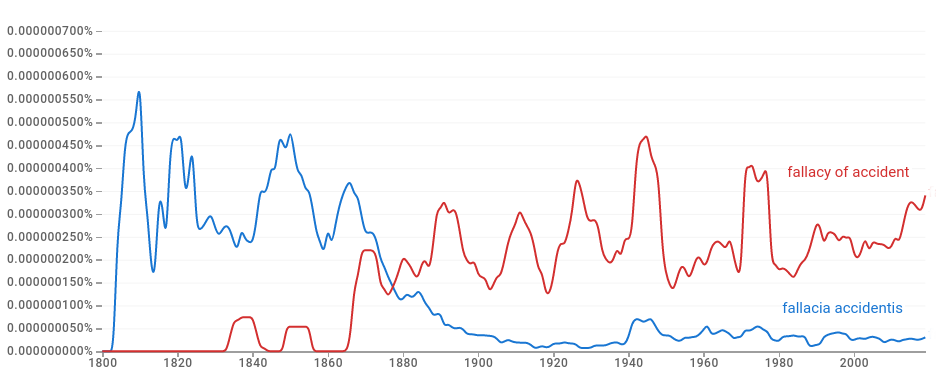
Historical Frequency of Use of the Fallacy of Accident and Fallacia Accidentis in Google Books 1800-2019
 “Accident is not so much a fallacy in the sense of a common
error of reasoning. It could perhaps better be described as a paradox
or series of puzzles, a general category for a family of quite subtle
types of errors or problems of reasoning. Whatever accident is, it
is far from clear that it is the kind of common error of reasoning
or fallacy that belongs in the standard treatment of fallacies in
logic textbooks (especially textbooks meant for general reading by
nonspecialists and introductory students).”
“Accident is not so much a fallacy in the sense of a common
error of reasoning. It could perhaps better be described as a paradox
or series of puzzles, a general category for a family of quite subtle
types of errors or problems of reasoning. Whatever accident is, it
is far from clear that it is the kind of common error of reasoning
or fallacy that belongs in the standard treatment of fallacies in
logic textbooks (especially textbooks meant for general reading by
nonspecialists and introductory students).” Douglas Walton, Argumentation Schemes for Presumptive Reasoning (1998 Oxford: Routledge, 2013), 148.
doi: 10.4324/9780203811160
”Trying to explain the historical origins of unfamiliar and puzzling terms like ‘accident’ … seems a hopeless and unrewarding task, not to mention the variety of Latin terms and phrases peppered through the traditional textbook treatments. While ignoring exceptions to a rule or qualifications to a generalization did seem important failures to warn students about, nevertheless the complications and puzzles inherent in the standard treatment suggested that it was prudent to bypass this area, restricting coverage to a brief mention of the basic fault, in simple terms.”
Douglas N. Walton, “Ignoring Qualifications (Secundum Quid) as a Subfallacy of Hasty Generalization,” Logique & Analyse no. 129-130 (1990), 114.
Links to Additional Examples and Online Practice Quizzes with Suggested Solutions for the Fallacy of Accident
Test your understanding of the fallacy of accident occurring in the
following quizzes:
Fallacy of Accident Examples Exercise
Fallacies of Relevance I
Fallacies of Relevance II
Fallacies of Relevance III
Fallacy of Accident Notes
1. Example from J.D. Morell, Handbook of Logic new ed. (London: Longmans, 1866), 59.↩
2. Douglas N. Walton, Argumentation Schemes for Presumptive Reasoning (1996 New York: Routledge, 2009), 27, 133. doi: 10.4324/9780203811160
Furthermore, Walton writes:
”All in all, the bewildering variety of different labels for what seems to be the same kind of fallacy (or the same family of fallacies) is a serious problem for informal logic … [Walton, Argumentation Schemes, 36-37.]
And elsewhere he writes:
“The sheer diversity of terminologies prevents one from even beginning to speak about these fallacies in a coherent and orderly way, never mind trying to build up some basic knowledge on what the fallacies are.” [Walton, Argumentation Schemes, 135.]
To talk about the fallacy of accident specifically, J. Lacy O'Byrne Croke's definition is taken as adequate for our purposes on this website.
“The Fallacy of Accident, Fallacia accidentis or, a dicto simpliciter ad dictum secundum quid, — the fallacy of proceeding from what is said simply, and without qualification, to what is said in a certain respect, or with a certain qualification.” [J. Lacy O'Byrne Croke, Logic (London: Robert Sutton, 1906), 205.]
However, as Walton has noted, many different views appear in the literature. In the 19th century the fallacy of accident was often defined as the converse of the current definition. E.g., in the popular Treasure of Knowledge and Library of Reference the definition listed was as follows:
“The fallacia accidentis, drawing general conclusions from accidental circumstances.” [Samuel Maunder, Treasury of Knowledge and Library of Reference revised ed. (New York: J.W. Bell, 1855), III: 243.]
Other logicians who defined the fallacy of accident in terms of its converse
include:
John Andrews, Elements
of Logick 2nd ed. (Philadelphia: 1807), 159.
William Marratt and Pishey Thompson, The
Enquirer: Or, Literary, Mathematical, and Philosophical
(London: 1812), II:175.
Levi Hedge, Elements
of Logic (Boston: Hilliard, Gray, 1833), 149.
Laurence Johnstone, A
Short Introduction to the Study of Logic (London: Longmans,
Green, 1887), 112.
Moreover, as late as 1921, William Poland combined accident and converse
accident in this definition:
“Fallacy of the Accident. This consists in assuming as essential what is purely accidental.” [William Poland, The Laws of Thought or Formal Logic (Chicago: Loyala University Press, 1921), 79.]
His definition expresses no commitment to a generalization. Poland's definition is similar to Aristotle's original ontological characterization of the fallacy. Although Aristotle's characterization of the fallacy of accident is not entirely consistent throughout his works, in one passage, he writes:
“Fallacies connected with Accident occur when it is claimed that some attribute belongs similarly to the thing and to its accident; for since the same thing has many accidents, it does not necessarily follow that all the same attributes belong to all the predicates of a thing and to that of which they are predicated.” [Aristotle, Soph. El. 166b329-33, trans. Furley]
Aristotle views the accident fallacy as a confusion between an accidental quality and an essential quality in an argument, as is interpreted in this example:
This war will be waged against a nation less numerous than the successful war against a previous nation. So this war will be successful. [Argument paraphrased from Charles Mercier, A New Logic (Chicago: Open Court, 1912), 384.]
“‘[E]ssential’ here means "material to the argument.’” [Mercer, A New Logic, 384.] So the fallacy of accident can be, and often is, arguing to a similarity which is not material to the argument. In this case, the relative number of the enemy does not necessarily affect winning or losing in a particular situation.
The fallacy of a dicto simpliciter ad dictum secundum quid is assumed to be essentially the same as accident by the influential informal 20th century logicians Douglas Walton and Hamblin. [Douglas N. Walton, Argumentation Schemes for Presumptive Reasoning (New York: Routledge, 1996), 138, and C.L. Hamblin, Fallacies (London: Methuen, 1970), 28-29].
Thomas Fowler, for example, writes that fallacia accidentis is the same thing as a dicto simpliciter ad dictum secundum quid and is “[arguing] from what is true as a general rule (i.e. unless there be some modifying circumstances) as if it were true under all circumstances.” [Thomas Fowler, The Elements of Deductive Logic 7th ed. (London: Macmillan, 1880), 148.]
Additionally, Cohen and Nagel in their historically important textbook identify the fallacy of accident with the traditional a dicto simpliciter ad dictum secundum quid. [Morris R. Cohen and Ernest Nagel, An Introduction to Logic and Scientific Method (New York: Harcourt Brace, 1934), 377.] Many other logic textbooks distinguish fallacia accidentis from a dicto simpliciter ad dictum secundum quid, and many textbooks describe fallacia accidentis as a combination of accident and converse accident.
So, from a historical point of view, it makes sense, as a number of recent informal logicians have suggested, to subsume the fallacy of accident, the fallacy of converse accident, and the two varieties of secundum quid under the description of fallacies of something like “ignoring qualifications” because of the interminable problems of distinguishing these fallacies from each other.↩
3. Hermann Lotze, Logic in Three Books of Thought, of Investigation and of Knowledge trans. Bernard Bosanquet (Oxford: Clarendon Press, 1888, 5.↩
4. Thomas Blundeville, The Art of Logike. Plainely Taught in the English Tongue (London: Iohn Windet, 1599), 166.↩
5. H.W.B. Joseph, An Introduction to Logic 2nd. ed. rpt. (1916 Oxford: Clarendon Press, 1967), 590.↩
6. Douglas Walton, Argumentation Schemes for Presumptive Reasoning (1996 New York: Routledge 2009), 141.↩
7. John Stuart Mill, for example, describes this fallacy as “the misapplication of abstract truths.” John Stuart Mill, A System of Logic 2 Vols. 8th ed. (London: Longmans, Green Reader, and Dyer, 1872), II:387.↩
8. S.H. Emmens, A Treatise on Logic, Pure and Applied (London: Virtue Brothers, 1865), 93-94.↩
9. Douglas Walton, “Ignoring Qualifications (Secundum Quid ) as a Subfallacy of Hasty Generalization,” Logique & Analyse 129-130 (1990), 131. Also in Walton, Argumentation Schemes 148.↩
10. Example from Allan T. Bäck, Aristotle's Theory of Predication (Leiden: Brill, 2000), 229. Aristotle's account of the fallacy of accident is not consistent on this point. In Soph. El. 179b38-180a3, he clearly states the fallacy is not based on ambiguity, and Aristotle's examples involve all singular statements. Moreover, even recent informal logicians are not consistently based on statements; Hamblin, for example, mentions but does not name “modern treatments” where accident is based on predication. [Hamblin, Fallacies, 27.]↩
11. Aristotle, On Sophistical Refutations trans. E.S. Forster (Cambridge, Mass.: Harvard University Press, 1955), 25.↩
12. John Wallis,“De Fallaciis,” Grammatica Linguae Anglicanae Cui præfigitur De Loquela (Excudebat Leon Lichfield. Veneunt apud Tho. Robinson, 1653), 178.↩
13. John of St. Thomas, Outlines of Formal Logic: Translated from the Latin Medieval Texts in Translation No. 8, trans. Francis C. Wade (Milwaukee: Marguette University, 1955), 77.↩
14. Henry Aldrich, Compendium of Logic 2nd ed. (London: 1756), 30-31. This characterization of the fallacy of accident was often used during the 1800s. E.g., see Charles P. Krauth and William Fleming, A Vocabulary of the Philosophical Sciences 3rd. ed. (New York: Sheldon, 1878), 191, and Henry Calderwood, Vocabulary of Philosophy (New York: Charles Scribner's Sons, 1895), 151.↩
15. Aldrich, Compendium 31.↩
16. Aldrich, Compendium 31.↩
17. W. Stanley Jevons, Elementary Lessons in Logic: Deductive and Inductive (London: Macmillan, 1870), 176. Jevons' definition was adopted by many other 19th century logic textbooks without proper accreditation. E.g., see E. L. Hawkins, The Oxford Handbook of Logic, Deductive and Inductive 5th ed. (Oxford: A.R. Shrimpton, 1893), 71.↩
18. Douglas N. Walton, “Ignoring Qualifications (Secundum Quid) as a Subfallacy of Hasty Generalization,” Logique & Analyse no. 129-130 (1990), 114.↩
19. William H. Burton, Roland B. Kimball, and Richard L. Wing, Education for Effective Thinking: An Introductory Text (New York: Appleton-Century-Crofts, 1960), 219.↩
20. Edward L. Hawkins, The Oxford Handbook of Logic, Deductive and Inductive 5th ed. (Oxford: A. Thomas Schrimpton and Son, 1893), 71.↩
21. Adapted from H.H. Munro, A Manual of Logic: Deductive and Inductive (Glasgow: Maurice Ogle and Son, 1850), 226.↩
22. John Andrews, A Compend of Logick (Philadelphia: Budd and Bartram, 1801), 123.↩
23. Jevons, Elementary Lessons in Logic, 178. An accident fallacy resulting from moral rules is so common in religious discourse that the early 20th century logic writer and Thomistic philosopher John Toohey and Thomas Crumley designate the fallacy of accident as the fallacy of the “Moral Universal” [John J. Toohey, An Elementary Handbook of Logic (New York: Schwartz, Kirwin & Fauss, c1918), 180.; Thomas Crumley, Logic: Deductive and Inductive (New York: Macmillan, 1926), 267.]↩
24. Felicia Hemans, Casabianca in Poems (New York: Geo. A. Leavitt, 1851), 256-257.↩
25. Star Parker, “ Liberal Fascists Ambush Chelsea Clinton,” Index-Journal 101 no. 5 (March 23, 2019), 9A.↩
26. Amelia Earhart, Last Flight: The World's Foremost Woman Aviator Recounts … Arranged by George Palmer Putnam (New York: Crown, 2009), 197.↩
27. Mary Anne Radmacher, Courage Doesn't Always Roar (Coral Gables, FL, 2022).↩
28. Adapted from Thomas Crumley, Logic: Deductive and Inductive (New York: Macmillan, 1926), 263.↩
29. Albert the Great in his Elenchorum (Venice: 1632) Liber I, Tractatus III, Caput III, identified the fallacy of the middle term with the fallacy of accident:
“[F]allacia accidentis dicatur fallacia medii.”
[The fallacy of accident is called the fallacy of the middle.]
This identification of the syllogistic fallacy of the middle term with the fallacy of accident was repeated in the middle of the 19th century in Lyman H. Atwater's Manual of Elementary Logic (Philadelphia: J.B. Lippincott, 1867), 169, and in the early 20th century by Alfred Sidgwick, Elementary Logic (Cambridge: Cambridge University Press, 1914), 150.↩
30. Crumley, Logic: Deductive and Inductive (New York: Macmillan, 1926), 265.↩
31. Henry Aldrich, A Compendium of Logic 2nd ed. (London: [s.n.] 1756), 30. See also Aldrich's 1st ed. Artis Logicæ Compendium (1692 Oxonii: J. Parker, 1810), 137, and William Fleming, Vocabulary of Philosophy 4th ed. revised by Henry Calderwood (New York: Scribner and Welford, 1887), 161.↩
32. C.f. John Wallis, Institutio Logicæ (1686 Oxonii: L. Lichfield, 1729), 244.↩
33. F.C.S. Schiller, Formal Logic: A Scientific and Social Problem (London: Macmillan, 1912), 200.↩
34. Schiller, Formal Logic, 200.↩
35. F.C.S. Schiller, Logic for Use: An Introduction to the Voluntarist Theory of Knowledge (New York: Harcourt, Brace, 1929), 277. Schiller is assuming subtle distinctions can always be made with respect to different applications of the exact same term. ↩
36. E.g. Joseph B. Walsh, Logic (New York: Fordham University Press, 1940), 104, and H.W.B. Joseph, An Introduction to Logic 2nd ed. (Oxford: Clarendon, 1916), 595. ↩
37. Thomas Crumley, “Simple, Converse, and Specific Accident,” Logic: Deductive and Inductive (New York: Macmillan, 1926), 262-263.↩
38. Example fallacy based on Walsh, Logic, 104.↩
39. Schiller, Formal Logic, 200.↩
40. “[L]e mieux est l'ennemi du bien,” Voltaire, “La Bégueule Conte Moral,” (1772) Poésies, Oeuvres complétes de Voltaire (Bruxelles: Wodon, 1827-1829), Vol. 79.↩
41. W. Somerset Maugham, “The Treasure,” Collected Stories of W. Somerset Maugham (London: Alfred A. Knopf, 2004), 515-516.↩
42. Andrew Henderson, Scottish Proverbs (Edinburgh: Oliver & Boyd, 1887), 38.↩
43. E. L. Hawkins, The Oxford Handbook of Logic, Deductive and Inductive 5th ed. (Oxford: A.R. Shrimpton, 1893), 71.↩
44. Seneca Ep. 17.6 (trans. Penn), 341.↩
45. Augustus De Morgan, Formal Logic: or, The Calculus of Inference, Necessary and Probable (London: Taylor and Walton, 1847), 252.↩
46. Sam Blows, Cusack's Principles of Logic (London: City of London Book Department, 1899).↩
47. Noah K. Davis, Elements of Deductive Logic (New York: Harper & Brothers, 1894), 191.↩
48.Noah K. Davis, Elements of Deductive Logic 191.↩
49. Hamblin, Fallacies, 27.↩
50. Adapted from Lyman H. Atwater, Manual of Elementary Logic (Philadelhia: J.B. Lippincott, 1867), 169, and J.H. Gilmore, Outlines of Logic (Rochester, N.Y.: Evening Express, 1876), 93.↩
51. Sam Blows, Cusack's Principles of Logic (London: City of London Book Department, 1899), 169.↩
52. Hamlin, Fallacies, 27.↩
53. McClendon v. City of Albuquerque, 630 F.3d 1288, 1292–93 (10th Cir. 2011).↩
54. Jevons, Elementary Logic, 177.↩
56. Jevons, Elementary Logic, 177, and Crumley, Logic, 264↩
57. Jevons, Elementary Logic, 177.↩
58. Walton, Argumentation Schemes, 40.↩
59. Schiller, Formal Logic, 200. Alfred Sidgwick also speaks to this issue, though in a different manner. Elementary Logic (Cambridge: Cambridge University Press, 1914), 150.↩
60. E.g., Henry Bradford Smith, How the Mind Falls into Error (New York: Harper & Brothers, 1923), 65-67, and Alfred Sidgwick, The Application of Logic (London: Macmillan, 1910), 143-149.↩
61. Hamblin, Fallacies, 27. ↩
62. Richard F. Clark, Logic (London: Longmans, Green, 1889), 448.↩




Relay corrections or suggestions to
larchie@philosophy.lander.edu
Read the disclaimer concerning
this page.
1997-2024 Licensed under GFDL
and Creative
Commons 3.0


The “Copyleft” copyright assures the user the freedom to use,
copy, redistribute, make modifications with the same terms.
Works for sale must link to a free copy.
The “Creative Commons” copyright assures the user
to copy, distribute, display, and modify on the same terms.
Works for sale must link to a free copy.
Last Modified: 04/09/24 April 2024